Global logistics today feels like a high-stakes relay race. Packages flow from warehouses to hubs, then onto trucks, ships, trains, planes, and finally to customers. Despite major investments in automation, route optimization, and connected devices, one small but critical element still trips up operations: the shipping label.
For decades, supply chains leaned on simple barcodes to keep this system moving. But in a world where shipments hop across multiple geographies and transport modes, those traditional labels create friction rather than clarity. That’s why QR codes are gaining traction. Industry research, including findings from DHL’s Logistics Trend Radar and McKinsey’s work on digital supply chains, shows that when tracking and documentation become fully digital, businesses see fewer handoff errors, faster scans, and much stronger end-to-end visibility. In other words, QR codes solve real operational bottlenecks without adding more work for already stretched logistics teams.
This guide explores how QR codes on shipping labels streamline warehouses, tighten multimodal coordination, strengthen last-mile accuracy, and why more logistics leaders are shifting to them at scale.
- Why QR Codes Are a Better Fit Than Barcodes
- Streamlining Warehouse & Fulfillment Operations
- Improving Multimodal Logistics with QR Codes
- Real-World Use Cases Across Logistics Sectors
- Best Practices for Implementing QR Codes on Shipping Labels
- Operational and Strategic Benefits of QR Codes for Logistics Leaders
- Emerging Trends: What’s Next for QR-Enabled Labels
- Final Thoughts for Supply Chain Leaders
- Frequently Asked Questions
Why QR Codes Are a Better Fit Than Barcodes
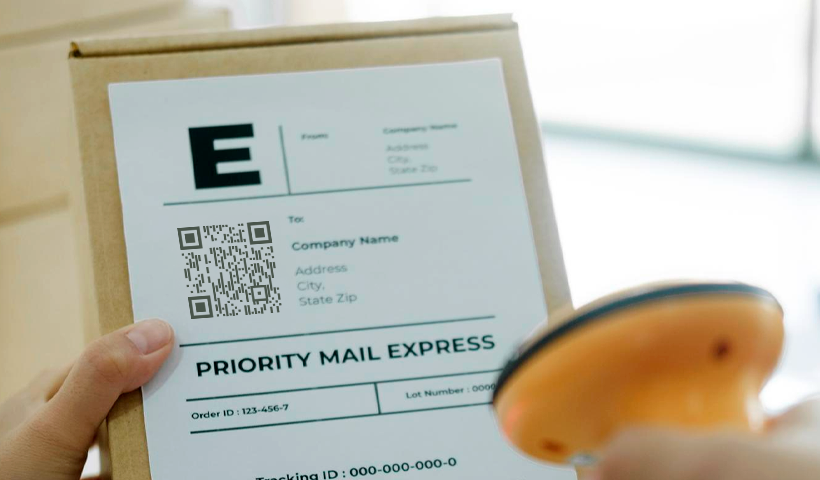
A traditional barcode carries only limited data, and when shipping labels get damaged or misaligned, scanning slows or fails. QR codes change that. They can store much more information (often up to 100 times what a barcode holds), and their error correction makes them surprisingly resilient even if slightly damaged or poorly printed.
That additional capacity isn’t just theoretical. On a single shipping label, a QR code can connect to:
- Real-time tracking status
- Handling instructions
- Dangerous-goods documentation
- Product specifications
- Customs paperwork
- Cold-chain temperature logs
- Hub handoff timestamps
Instead of juggling multiple barcodes, stickers, or separate documents, logistics teams get one dynamic label that’s actionable throughout the journey.
Streamlining Warehouse & Fulfillment Operations
For logistics managers, the receiving >> picking >> packaging >> dispatch cycle is often a major source of friction. Mislabeling, manual data entry errors, and damaged codes cost time and labor. Here, QR codes help in three critical ways:
1. Reliable, angled scanning
Even if a label isn’t perfectly placed or the surface is curved, QR codes scan cleanly. This reduces scanning failures and speeds up both inbound and outbound processes.
2. Reduced human error
With QR scanning, manual entry largely disappears. Staff don’t need to manually input SKU or destination data. Scans automate that work, reducing address mismatches and sorting mistakes.
3. One label, multiple functions
A single QR code can serve as the gateway to everything, including shipping data, packaging instructions, and regulatory documents. That consolidation reduces label clutter and lowers the risk of missing or misreading critical information.
According to a Zebra Technologies Warehouse Vision Study, automating repetitive scanning and workflow tasks can lead to significant productivity gains, crucial for high-volume operations.
Improving Multimodal Logistics with QR Codes
Multimodal shipments (by road, rail, air, and sea) are especially prone to delays and miscommunication at transition points. QR codes offer a unified tracking ID that stays consistent at every leg of the journey.
Here’s how QR codes on shipping labels help when freight changes hands:
- Each scan (by terminal, carrier, or handler) updates the same tracking log, capturing location, timestamp, and responsible party.
- QR codes can serve as digital carriers for critical paperwork, such as bills of lading, export documents, compliance forms, and more. This reduces reliance on paper and speeds up audits or customs reviews.
- For temperature-sensitive or regulated goods (such as in cold chain logistics), QR codes can link directly to real-time sensor data, maintaining a digital trail that supports compliance and traceability.
The result is a chain of custody that’s clearer, faster, and less error-prone.
Real-World Use Cases Across Logistics Sectors
E-commerce Warehouses
High-velocity operations rely on speed and accuracy. QR-enabled labels help staff quickly identify items, match inventory, and dispatch orders with fewer mistakes. This is especially helpful during peak periods.
Courier Aggregators & Last-Mile Delivery
Agile delivery networks often involve multiple carriers. A shared QR code per package means each partner scans the same identifier, which updates the shipment status in a unified system. This improves coordination and gives customers up-to-date tracking information.
Third-Party Logistics (3PL)
3PLs juggle inventory for multiple clients, often with vastly different packaging and handling needs. QR codes give them a way to standardize tracking, manage lot batches, and ensure transparent status updates for their clients without manual rework.
Cold Chain Logistics
Temperature-sensitive goods demand constant monitoring. With QR codes linked to temperature sensor data, teams can instantly access a shipment’s temperature history, verify compliance certificates, and respond to deviations quickly. This enhances traceability and reduces spoilage risk.
You may also like: QR Codes for Supply Chain Management
Best Practices for Implementing QR Codes on Shipping Labels
Implementing QR on shipping labels successfully requires more than just printing them. Good design and workflow decisions also matter here.
- Use dynamic QR codes: This lets you update the linked information (e.g., new routing or documents) without reprinting all labels.
- Print at high resolution: Ensure quiet zones and contrast so the codes remain readable even when exposed to heat, cold, or moisture.
- Test across surfaces: QR codes should be scanned on corrugated boxes, plastic pouches, pallets, and curved packaging to validate readability under real conditions.
- Train staff on scanning: From warehouse operators to carrier personnel, everyone scanning QR codes needs to know the proper technique to minimize misreads.
- Plan for environmental conditions: For cold chain or outdoor transport, choose materials and printers that support durability and legibility in harsh environments.
Operational and Strategic Benefits of QR Codes for Logistics Leaders
For operations managers, the value of QR-enabled shipping labels goes beyond tech. It translates into real business outcomes as follows:
- Improved Accuracy & Throughput: Faster, more accurate scans reduce cycle times, inbound errors, and sorting bottlenecks.
- Reduced Costs: Dynamic QR codes reduce reprinting costs; fewer misroutes mean fewer return shipments.
- Traceability & Compliance: Full traceability across carriers and touchpoints strengthens quality control, supports audits, and helps meet regulatory requirements (e.g., GS1, export controls).
- Scalability: From high-volume e-commerce to 12,000-pallet-strong 3PL operations, QR systems scale without major infrastructure overhaul.
- Customer Experience: End customers gain visibility on their shipment, increasing trust and reducing support tickets.
Emerging Trends: What’s Next for QR-Enabled Labels
The future of logistics labeling is smart, connected, and increasingly autonomous. Here’s how it looks:
- IoT-enabled QR labels: Paired with sensors, QR codes can broadcast real-time temperature, humidity, or shock events.
- Blockchain + Chain of Custody: QR scans written to an immutable ledger can authenticate custody transitions.
- Hybrid QR & NFC tags: Combine both for redundancy. Use QR for general access, NFC for privileged or secure scans.
- Augmented Reality (AR) for Workers: Warehouse workers using AR glasses could scan QR codes and instantly overlay picking instructions, manuals, or routing info.
- GS1 Digital Link Standards: Expect QR codes to become part of a broader data standard, replacing or augmenting traditional GTIN barcodes.
Final Thoughts for Supply Chain Leaders
Shipping labels may be small, but their impact on logistics operations is massive. By adopting QR codes, logistics teams transform a static piece of tape into a live data hub, enhancing accuracy, visibility, and compliance throughout the supply chain.
If you’re leading operations, managing a 3PL, or running a warehouse, QR codes offer a compelling, cost-effective way to modernize. Look for platforms that support bulk QR generation, dynamic updating, and analytics to ensure your label system grows with your business.
In the complex world of logistics, QR codes turn one more weak link into a source of strength. And that’s worth scanning for.
Frequently Asked Questions
Why should I use QR codes on shipping labels?
Using QR codes on shipping labels helps streamline logistics, improve tracking accuracy, and ensure faster processing times. They reduce errors, ensuring better visibility throughout the shipping process.
How do QR codes improve shipping label efficiency?
QR codes can improve shipping label efficiency by providing instant access to detailed shipment information, enabling real-time tracking, minimizing human error, and supporting seamless integration across various transportation methods.
Can QR codes help improve customer satisfaction?
Yes, QR codes can enhance customer satisfaction by providing easy access to real-time shipment information. These codes enable customers to track their packages seamlessly, provide more transparency, and ultimately, improve their overall experience.
You may also like
Approval-Based Digital Business Cards: A Smarter Workflow for HR Teams
Discover how approval-based digital business cards help HR teams ensure branding consistency, prevent misuse, and manage employee cards at scale.
Best Digital Business Card Makers for 2026 – Secure, Enterprise, and Scalable
Discover the best digital business card platforms for 2026. Compare the top 8 solutions with features like branding, CRM integration, analytics, and enterprise-grade security to find the right fit for your team or business.
How a Consumer Electronics Brand Fixed Its Post-Purchase Gap Using Form QR Codes
Learn how a consumer electronics brand improved warranty registration and post-purchase engagement using Form QR Codes. Discover the strategy, implementation, and results.
QRCodeChimp’s Analytics Dashboard: A Step-by-step Guide
A guide to QRCodeChimp’s analytics dashboard. Leverage the unique advanced features and metrics to optimize your marketing campaigns.
Most Popular
Contact Sales