Global trade runs on a standard most people never think about. Every product identifier, every barcode, every supply chain handoff across 25 billion transactions daily traces back to one organization and one set of rules: GS1.
GS1 Digital Link is the latest evolution of that standard. By encoding your existing GTIN as a structured web address, it allows the same code on your packaging to serve a checkout terminal, a warehouse scanner, a regulatory system, and a consumer’s smartphone simultaneously.
The timing matters. With digital labeling regulations expanding globally, the EU Digital Product Passport coming into force, and GS1 Sunrise 2027 pushing retailers to upgrade POS infrastructure worldwide, product identification is undergoing its biggest transformation in 50 years.
This guide explains what GS1 Digital Link is, how it works, and what it means for your business.
Key Takeaways:
- One code that works for POS, supply chain, and consumers.
- Your GTIN is already the starting point.
- Sunrise 2027 is industry-driven but practically mandatory.
- Update content anytime without reprinting packaging.
- Early adoption means early compliance readiness.
What is a GS1 Digital Link?
GS1 Digital Link is an international standard that encodes a product’s GS1 identifiers, starting with the GTIN, as a structured web address. That web address can be embedded in a 2D barcode, scanned by any device, and used to deliver the right information to the right audience at the right time.

Every product sold in a store carries a barcode. That barcode encodes a number, a GTIN, or Global Trade Item Number, that tells a checkout scanner what the product is. It has worked reliably for over 50 years.
But a GTIN is just a number. It cannot tell a consumer what is in the product. It cannot tell a retailer when a batch expires. It cannot link a supply chain partner to real-time logistics data. And it cannot be updated once it is printed.
GS1 Digital Link solves this. It is a standard developed by GS1, the global organization behind barcodes, GTINs, and supply chain standards, that transforms a product’s existing identifier into a structured web address. That web address can be encoded into a 2D barcode, scanned by any device, and used to deliver the right information to the right audience at the right time.
In practical terms: a POS scanner reads the GTIN from the Digital Link and processes the transaction, exactly as it would with a traditional barcode. A consumer scanning the same code with a smartphone is taken to product information, ingredients, certifications, or whatever the brand has chosen to share. A supply chain system reads batch and expiry data from the same code.
One code, multiple outcomes, all from a single scan.
Follow these steps to create a GS1 QR Code.
GS1 Digital Link Architecture and How It Works
A GS1 QR code is not just a regular QR code pointing to a website. The URL encoded within it follows a precise structure defined by the GS1 Digital Link standard. Understanding this structure helps you know what your code contains and why each part matters.
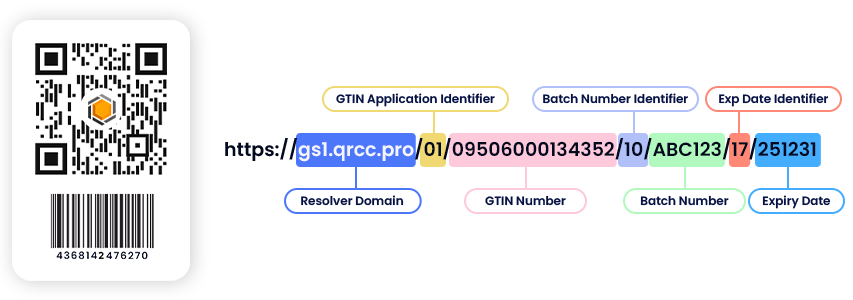
A typical GS1 Digital Link URL looks like this:
https://gs1.qrcc.pro/01/09506000134352/10/ABC123/17/251231
Here is what each part means:
Resolver Domain — https://dgs1.qrcc.pro
The resolver domain receives the scan and routes it to the right destination.
Application Identifier /01/ — GTIN /01/09506000134352
The /01/ identifies the GTIN, a 14-digit number that is your product’s unique identifier. GTINs with fewer than 14 digits must be padded with leading zeros.
Application Identifier /10/ — Batch or Lot Number /10/ABC123
The /10/ AI identifies the specific batch or lot a product belongs to, enabling traceability, targeted recalls, and supply chain visibility at the batch level.
Application Identifier /17/ — Expiry Date /17/251231
The /17/ AI encodes the product’s expiry date in YYMMDD format.
Other commonly used Application Identifiers:
/21/ — Serial number
/22/ — Consumer product variant
/13/ — Packaging date
/16/ — Sell by date
/310x/ — Net weight in kilograms
/3900/ — Amount payable
/422/ — Country of origin
Important note: QRCodeChimp automatically generates a GS1 Digital Link URL for each product using the data you provide. Users on the Ultima plan and above can white-label the GS1 Digital Link to use their own domain.
GS1 Digital Link vs. Traditional Barcodes
The shift from traditional barcodes to GS1 Digital Link is not just a format upgrade. It is a fundamental change in what a product identifier can do.
A traditional 1D barcode encodes a GTIN. Nothing else. It requires a dedicated scanner, cannot be read by smartphones, carries no additional product data, and cannot be updated after printing. It does one job reliably, but only one.
A GS1 Digital Link QR code encodes the GTIN alongside batch, expiry, serial data, and even links to websites and landing pages. It is readable offline by POS systems and online by smartphones. The content it delivers can be updated at any time without changing or reprinting the code. It supports consumer engagement, supply chain traceability, and retail identification simultaneously.
During the Sunrise 2027 transition period, GS1 recommends carrying both formats on packaging. The traditional 1D barcode ensures legacy POS compatibility, while the GS1 QR code handles everything else.
GS1 QR Code vs. GS1 DataMatrix: Which Format for Which Use Case
GS1 Digital Link can be encoded in different 2D barcode formats. The two most common are GS1 QR codes and GS1 DataMatrix. They are not interchangeable.
GS1 QR codes are the format of choice for retail and consumer goods. They are scannable by any smartphone camera without a dedicated app, making them ideal for consumer-facing product experiences. They are the primary format targeted by GS1 Sunrise 2027.
GS1 DataMatrix is the globally endorsed format for healthcare and medical devices. It is used to meet regulatory traceability requirements in over 75 countries, including the US FDA’s DSCSA requirements and EU MDR/IVDR regulations. If you operate in pharmaceutical or medical device markets, GS1 DataMatrix is the correct format, and GS1 Healthcare guidance applies.
For retail and consumer goods, including food and beverage, FMCG, apparel, beauty, and manufacturing, GS1 QR codes are the right choice.
How to Get Started with GS1 Digital Link
Getting started with GS1 Digital Link requires three things: a registered GTIN, a tool to generate compliant Digital Link QR codes, and a destination for consumers to land on when they scan.
1. Confirm your GTIN
Your GTIN must be registered with GS1. If you do not have one, you can obtain it through your national GS1 member organization. Existing GTINs do not need to change. Digital Link is built around them.
2. Generate a compliant GS1 QR code
The Digital Link URL must follow the exact GS1 format, with correctly structured Application Identifiers and a 14-digit zero-padded GTIN. Errors in the URL structure will cause codes to fail at POS or be misread by scanning systems. Using a purpose-built tool like QRCodeChimp’s GS1 QR Code Generator ensures the structure is generated correctly and automatically, without requiring technical expertise.
3. Set up your digital destination
Decide what consumers will see when they scan. A well-structured product page covering ingredients, sourcing, usage instructions, and certifications will deliver significantly more value than a generic homepage link. The content should be mobile-optimized and kept current.
Once your codes are generated, add them to your packaging alongside your existing 1D barcode, and you are Sunrise 2027 ready.
Benefits of the GS1 Digital Link
A single code on your packaging can now do the work of an entire product information system. Here is what that means for everyone it touches.
For Brands: Total Control Over Your Product Information
GS1 Digital Link gives brands something traditional barcodes never could: control over the information their products carry, long after they leave the production line.
⏩One source of truth: A single Digital Link connects consumers, retailers, regulators, and supply chain partners to the same product data. No conflicting information across touchpoints, no outdated specs in circulation.
⏩Update content without reprinting: Like a dynamic QR code, the Digital Link destination can be changed at any time. A product reformulation, a new certification, or a regulatory update can be reflected instantly without touching the packaging.
⏩Localized and contextual delivery: The same code can serve different content based on region, language, or audience. Local compliance information, region-specific promotions, and translated product details can all be delivered from a single code.
⏩Faster, more targeted recalls: When a product issue arises, batch and serial data encoded in the Digital Link allows brands to identify and communicate about the exact affected units, not the entire product line.
For Retailers: End-to-End Visibility Across the Supply Chain
GS1 Digital Link gives retailers end-to-end visibility across the supply chain, from manufacturer to shelf, without additional infrastructure.
⏩Real-time inventory visibility: Track product movement from production through warehousing and distribution to the shelf. Automate reorders, reduce out-of-stock events, and manage expiry-based markdowns with accurate, up-to-date data.
⏩Faster and more accurate checkouts: 2D barcodes scan reliably and quickly at POS. Standardized GS1 identifiers reduce checkout errors and operational inefficiencies across high-volume retail environments.
⏩Reduced counterfeiting and shrinkage: Unique digital identifiers allow products to be verified at multiple points in the supply chain. Counterfeits can be flagged, authentic products confirmed, and items tracked even into the resale market.
⏩Seamless system integration: GS1 Digital Link is built on existing GS1 standards, making it compatible with current POS, inventory, and supply chain management systems without requiring significant infrastructure changes.
For Consumers: Transparency at the Moment It Matters Most
Consumers today make more informed purchase decisions than ever before. 77% say product information directly influences what they buy, and trust is built long before they reach the checkout.
⏩Enhanced shopping experience: Product details, usage instructions, and self-help information are accessible with a single scan. Consumers get what they need instantly, making their decision-making faster and more confident.
⏩Deeper engagement: GS1 Digital Link bridges physical products with digital experiences. Brands can deliver video tutorials, how-to guides, recipes, and exclusive content that packaging alone could never accommodate.
⏩Trust and loyalty through transparency: Consumers can verify sourcing, certifications, and sustainability credentials on the spot. Brands that share their values and practices openly build the kind of trust that brings customers back.
⏩Direct brand connection: A scan can redirect consumers to a brand’s website, social media, or loyalty program, turning a one-time purchase into an ongoing relationship.
For Compliance: Built for the Regulatory Landscape Ahead
Multiple regulatory frameworks are moving toward digital product information requirements. Brands that build on GS1 Digital Link now are laying the groundwork for compliance before the deadlines arrive.
⏩EU Digital Product Passport: Being phased in through 2030, the DPP requires brands selling into European markets to make structured product data digitally accessible. GS1 Digital Link is one of the primary mechanisms for meeting this requirement.
⏩Global traceability regulations: Regulatory bodies across multiple markets are introducing serialization and traceability mandates. GS1 Digital Link’s support for batch numbers, expiry dates, and serial numbers provides the data structure these frameworks require.
⏩Proactive compliance infrastructure: Adopting GS1 Digital Link is not just about meeting today’s requirements. It builds a flexible, standards-based foundation that can accommodate new regulations as they emerge, without overhauling your product identification system from scratch.
Conclusion
GS1 Digital Link is not a product feature or a marketing tool. It is the infrastructure for how products communicate in a world where physical and digital are increasingly inseparable. It gives every product a structured digital identity that works for checkout systems, supply chains, regulators, and consumers, all from the same code on the same packaging.
With Sunrise 2027 approaching and digital labeling requirements expanding across global markets, the question is no longer whether to adopt GS1 Digital Link. It is how quickly you can build the foundation.
Frequently Asked Questions
Do I need a new GTIN to use GS1 Digital Link?
No. GS1 Digital Link is built around your existing GTIN. You do not need to register a new identifier. The standard transforms what you already have into a structured web address.
Is GS1 Digital Link the same as a QR code?
No. A QR code is a barcode format, simply a way of encoding data visually. GS1 Digital Link is a standard that defines what data goes inside the QR code and how it is structured. A QR code generated without following the GS1 Digital Link standard is not a GS1 QR code.
Can consumers scan a GS1 QR code without a special app?
Yes. GS1 QR codes are scannable by any standard smartphone camera. No dedicated app is required for the consumer-facing experience.
What is a resolver, and do I need to set one up?
A resolver is the web service that routes a scan to the appropriate destination. GS1 provides a free global resolver at id.gs1.org. You can also use your own branded domain as the resolver. Platforms like QRCodeChimp handle resolver configuration as part of the code generation process.
Is GS1 Sunrise 2027 mandatory?
It is industry-driven, not a government mandate. However, major retailers are actively preparing and are expected to require supplier compliance as the deadline approaches. For most brands with retail distribution, treating it as a practical requirement is the prudent approach.
Can I use GS1 Digital Link in healthcare or pharma?
GS1 Digital Link QR codes are designed for retail and consumer goods. In pharmaceutical and medical device contexts, GS1 DataMatrix is the globally endorsed 2D format for regulatory compliance. Refer to GS1 Healthcare guidance if you operate in those markets.
You may also like
How to Prepare Your GS1 QR Codes for Targeted Product Recalls
Learn how GS1 QR Codes can support batch-level and item-level product recalls, and use a 7-step mock recall to test whether your systems are ready.
Top 10 Free QR Code Generators to Help You Market in 2026
The most important aspect of using QR codes for your business is selecting the right QR code generator. Here are ten free QR code generators to help you get started.
How to Create and Manage White Label Merchandise?
Learn the step-by-step process to create and manage customized white label merchandise like digital business cards, pet tags, and medical alerts using QRCodeChimp.
QR Code Surveys: How to Get People to Scan and Respond
A QR code survey makes feedback easier to access, but the code alone doesn't generate responses. This guide explains how to create a QR code survey that earns the scan and keeps respondents moving to submission.
Most Popular
Contact Sales