The excitement of unboxing a new gadget is unmatched. A smart TV lights up for the first time, a sound system fills the room, an appliance hums to life. But for many brands, that moment also marks the end of visibility as warranty cards get tossed, URLs go ignored, and ownership data disappears.
For one leading consumer electronics company, this invisible drop-off became a costly blind spot. Despite strong sales of TVs, appliances, and audio devices, post-purchase engagement was nearly nonexistent. Warranties went unregistered, support teams lacked verified records, and service validation depended on manual checks. The company realized it didn’t truly know its customers after the sale.
This case study shows how the brand turned warranty registration into a seamless engagement channel using Form QR Codes powered by QRCodeChimp.
- The post-purchase blind spot
- Why warranty registration is a strategic asset
- Strategic objective: Remove effort completely
- The solution: Instant warranty registration via Form QR Codes
- The power of dynamic QR codes
- Operational results across the organization
- The bigger insight: Post-purchase is the new competitive battleground
- Lessons for modern brands
- Conclusion
- Frequently asked questions
The post-purchase blind spot
Warranty registration is meant to be simple: buy the product, activate the warranty, receive support when needed. In practice, most customers never complete registration.
Traditional processes relied on paper warranty cards or lengthy website forms designed for internal compliance rather than customer convenience. The brand identified a few consistent friction points:
- Customers postponed registration and forgot.
- Warranty cards were discarded with packaging.
- Long URLs discouraged completion.
- Ownership records remained incomplete.
- Service approvals required manual invoice verification.
- Manual data entry introduced errors.
Customers were not resistant, the process demanded effort at the wrong moment.
Industry data reinforces this reality. A 2024 study by PwC found that 73% of consumers say customer experience directly influences purchasing decisions, yet many companies still treat post-purchase interactions as administrative tasks instead of experience moments.
Warranty registration had quietly become the company’s weakest operational link.
Why warranty registration is a strategic asset
Modern electronics companies no longer operate as one-time transaction businesses. Revenue increasingly comes from lifecycle engagement, like service contracts, accessories, upgrades, software updates, and replacement purchases
Without registration data, companies lack visibility into product ownership and lose direct communication with customers.
Research from McKinsey & Company shows organizations effectively using first-party customer data can increase marketing ROI by up to 30%.
For this brand, every unregistered product meant:
- no direct customer channel
- slower support validation
- missed cross-sell opportunities
- weaker long-term loyalty
Leadership reframed the challenge. Warranty registration was not a support workflow problem; it was relationship infrastructure.
Strategic objective: Remove effort completely
The company adopted a simple principle: Capture registration at the moment of excitement, immediately after unboxing. The solution needed to:
- eliminate paperwork
- digitize data capture
- work across retail and e-commerce channels
- reduce manual processing
- scale across product lines
Registration had to feel effortless.
The solution: Instant warranty registration via Form QR Codes
Instead of directing customers to complex portals, the brand introduced a single action – Scan → Register → Done using Form QR Codes, which turned a physical product interaction to a digital onboarding experience.
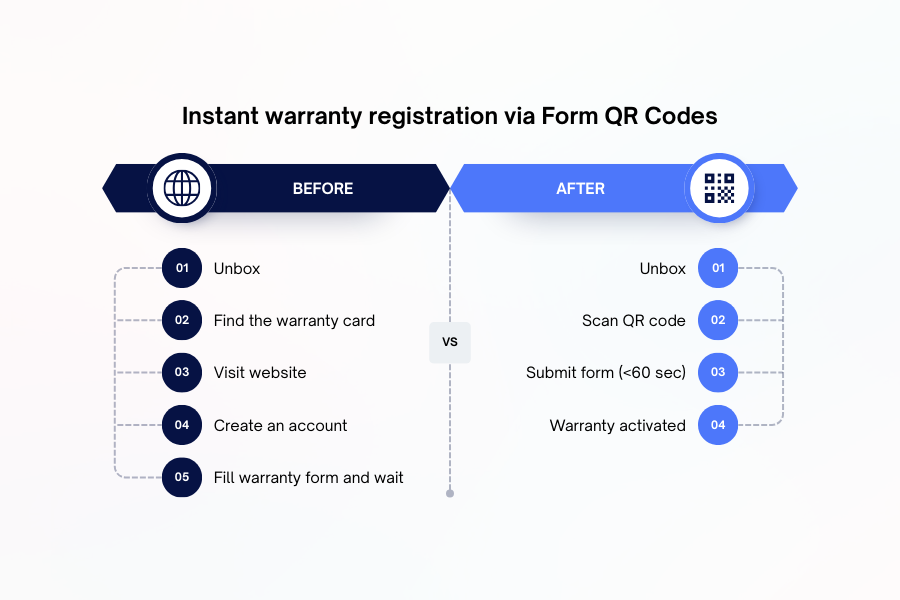
Step 1: A mobile-optimized warranty form
The company redesigned registration around simplicity. The digital form captured only essential information:
- customer name and phone number
- product model and serial number
- purchase date and retailer
- invoice upload
Reducing cognitive effort dramatically improved completion rates. Registration became a quick mobile action rather than a task customers postponed.
Step 2: Strategic QR code placement
Technology alone does not drive adoption; timing does. QR codes were placed exactly where customers naturally interacted with the product:
- product packaging
- installation guides
- warranty booklets
- invoice slips
- protective screen films for TVs
Registration happened during setup, eliminating the need for reminders later.
Step 3: The under-60-second experience
After scanning, customers completed registration directly on their phones:
- no app downloads
- no account creation
- no navigation complexity
The process took under a minute.
Research from Salesforce shows 88% of customers consider experience as important as the product itself. The warranty journey finally matched modern digital expectations.
Step 4: Instant data flow to support teams
Each submission automatically entered internal systems and CRM workflows, giving support teams real-time access to:
- verified ownership records
- purchase validation
- product lifecycle tracking
- customer contact details
Warranty validation shifted from reactive investigation to instant confirmation.
The power of dynamic QR codes
A major operational advantage came from dynamic QR technology.
The company could update registration forms, support links, or workflows globally without reprinting packaging already in warehouses or retail stores. Products already in circulation remained digitally updatable – a significant efficiency gain rarely considered in traditional packaging design.
Operational results across the organization
The impact extended well beyond registration metrics.
- Higher warranty participation: Simplified interaction dramatically increased registrations, strengthening the company’s first-party data ecosystem.
- Reduced administrative overhead: Manual data entry declined, freeing teams from repetitive processing tasks.
- Faster service resolution: Support agents validated eligibility instantly, reducing customer frustration during repair requests.
- Stronger product intelligence: The brand gained insights into geographic distribution, usage patterns, and upgrade readiness.
- Seamless channel scalability: The same workflow worked across retail chains, distributors, and e-commerce platforms without operational redesign.
The bigger insight: Post-purchase is the new competitive battleground
Many electronics brands optimize aggressively for acquisition while neglecting ownership experience.
Retention economics tell a different story. Analysis cited by Harvard Business Review shows acquiring a new customer can cost five to seven times more than retaining an existing one.
Warranty registration sits at the intersection of service readiness, customer data, and loyalty. By simplifying a single overlooked interaction, the company strengthened long-term customer relationships.
Lessons for modern brands
- Friction is the real competitor: Customers rarely refuse engagement. They abandon complexity.
- Timing beats incentives: The best engagement moment is immediately after unboxing.
- Data collection must deliver value: Customers share information when it improves support and convenience.
- Small operational changes create strategic advantage: A simple QR scan can transform service operations, marketing intelligence, and customer trust.
Conclusion
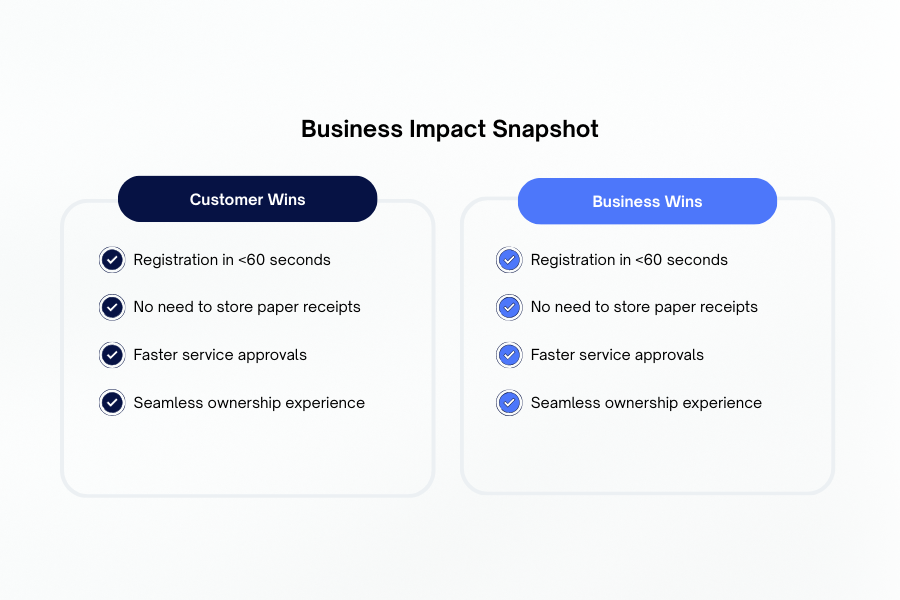
By implementing Warranty Registration Form QR Codes with QRCodeChimp, the consumer electronics brand transformed an ignored administrative step into a powerful engagement channel.
- Customers gained instant warranty activation.
- Support teams gained accurate ownership visibility.
- The business gained scalable post-purchase infrastructure.
What began as an effort to eliminate paperwork evolved into a broader transformation of how the company connects with customers after the sale.
In an industry where margins tighten and expectations rise, competitive advantage no longer ends at checkout. The brands that win are the ones that stay connected long after the box is opened.
Frequently asked questions
What is a Form QR Code?
A Form QR Code is a scannable code that opens a digital form for quick data capture.
How do Form QR Codes help warranty registration?
They remove paperwork and long URLs, making registration instant and simple.
Can QR Codes be updated after printing?
Yes, dynamic QR Codes let brands change forms or links without reprinting.
What data can companies collect?
Basic customer details, product info, purchase date, and invoice uploads.
Is this solution scalable?
Absolutely. It works across retail, distributors, and e‑commerce channels.
You may also like
QRCodeChimp’s Analytics Dashboard: A Step-by-step Guide
A guide to QRCodeChimp’s analytics dashboard. Leverage the unique advanced features and metrics to optimize your marketing campaigns.
Link Click Analytics in QRCodeChimp: How To Find Your Top Performing Links
Learn how to track link click analytics in QRCodeChimp, identify top-performing links, and optimize QR code campaigns using link-level insights and analytics.
How to Ensure Instant Student Access to Recorded Lectures?
Learn how to give students instant access to recorded lectures using dynamic QR codes. Reduce LMS friction, improve findability, and boost engagement.
When Excel Broke: How QRCodeChimp Simplified Digital Business Cards for a Fast-Growing IT/ITES Enterprise
Discover how a fast-growing IT/ITES enterprise replaced Excel uploads with QRCodeChimp’s form-based automation to create branded digital business cards faster, with HR control.
Most Popular
Contact Sales