In the automotive industry, reputation directly drives revenue. Before visiting a showroom, booking a test drive, or scheduling a service appointment, customers check Google reviews. In competitive city markets, the difference between 4.1 and 4.6 stars can shift footfall from one dealership to another.
For a rapidly expanding auto brand with multiple dealerships and service centers, this became a structural issue. Vehicles were selling. Service bays were full. Expansion was steady. The friction was elsewhere: reviews were being collected inconsistently across locations. At scale, inconsistency compounds quickly.
- The real problem was the process
- What scaling actually requires
- Why traditional review collection breaks at scale
- The shift to bulk infrastructure
- Turning physical moments into digital feedback
- Centralized visibility across the network
- The impact after implementation
- Net impact
- Why this model works in automotive
- The larger lesson: growth requires systems
- Frequently asked questions
The real problem was the process
Collecting Google reviews appears simple. Share a link and ask customers to leave feedback. Across dozens of dealerships, that simplicity broke down.
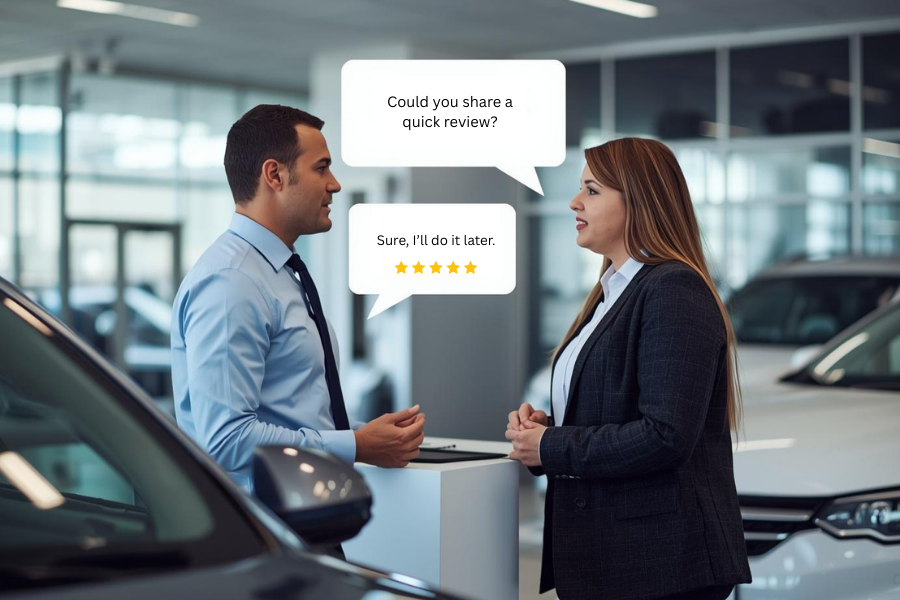
Some front-desk teams consistently requested reviews; others missed the opportunity during peak hours. Customers promised to leave feedback later, and rarely did. SMS and email campaigns averaged low engagement. New dealerships opened without a defined review workflow.
Marketing teams manually generated QR codes for each branch. Every new dealership required setup, customization, and distribution. Each manual process introduced variation in design, messaging, and deployment. Over time, brand consistency eroded.
The issue was not motivation. It was infrastructure.
What scaling actually requires
Leadership shifted the goal from “getting more reviews” to building a repeatable system that would:
- Make leaving a review effortless
- Standardize presentation across locations
- Enable bulk setup for new dealerships
- Maintain brand consistency
- Provide centralized performance visibility
Expansion was happening region by region. Review generation needed to expand without multiplying operational overhead.
Why traditional review collection breaks at scale
When review collection depends on individual staff behavior, manual link sharing, or location-by-location tracking, fragmentation is inevitable. The risks increase with growth:
- Uneven ratings across branches
- Inconsistent brand presentation
- Rising operational workload
Reputation management had to become systematic, not dependent on reminders or individual discipline.
The shift to bulk infrastructure
Instead of generating Google Review QR codes individually, the brand adopted bulk creation using QRCodeChimp.
Bulk generation in one upload
The marketing team compiled a single Excel sheet containing:
- Dealership name
- Google review link
- Location identifiers
With one upload, unique QR codes were generated for each branch. As new dealerships opened, they were added to the sheet and included in the next batch. What previously required repetitive setup became a standardized process. Expansion no longer created operational strain.
One master template, no brand drift
To eliminate visual inconsistency, the brand created a master QR template that included:
- Official logo
- Approved brand colors
- A standardized call-to-action (“Scan to Leave a Review”)
- Clean, professional formatting
Every QR code generated through bulk upload automatically followed the same template. Whether at a flagship metro showroom or a regional service center, customers saw the same branded experience.
Location-level precision
Each QR code was mapped to its specific dealership’s Google review listing. A customer scanning at a Seattle service center landed on Seattle’s page, not a central corporate profile.
This ensured:
- Accurate distribution of reviews
- Location-specific ratings
- No cross-location confusion
For dealership networks, reputation lives at the branch level. Precision mattered.
Turning physical moments into digital feedback
The impact came from deployment, not just generation. Instead of relying on post-visit emails, dealerships placed QR codes at key in-person touchpoints:
- Service reception desks
- Vehicle delivery areas
- Waiting lounges
- Billing counters
- Printed invoices and feedback cards
Customers were prompted immediately after positive interactions, when satisfaction was highest. Moving from delayed follow-ups to instant scan-based prompts significantly improved completion behavior.
Centralized visibility across the network
With centralized analytics, marketing and regional teams could track:
- Total scans across all locations
- Engagement by dealership
- High- and low-performing branches
- Trends over time
Review generation became measurable. Underperforming locations were identified quickly. High-performing teams were benchmarked and replicated. Performance management shifted from anecdotal to data-driven.
Also Read: Google Review QR Code: Strategies and Tips
The impact after implementation
Within the first 90 days of deploying bulk Google Review QR codes across all dealerships, measurable gains were recorded across reputation, efficiency, and visibility.
1. Review volume increased by 2.3×
- Average monthly reviews per location rose from 18 to 42
- Total network-wide monthly reviews grew by 130%
- Newly opened dealerships reached 50+ reviews within 60 days (previously 4 – 6 months)
Replacing email/SMS follow-ups with immediate scan prompts significantly improved review velocity.
2. Response rates improved from ~3 – 5% to 12 – 18%
Before QR deployment:
- SMS/email campaigns averaged 3 – 5% response rates.
After QR placement at physical touchpoints:
- Scan-to-review completion averaged 12 – 18%.
- Service centers reached up to 20% when QR codes were placed at billing counters.
Immediate prompts outperformed delayed follow-ups.
3. Average star rating improved from 4.2 to 4.6
Within six months:
- Network-wide average rating increased from 4.2 to 4.6.
- 60% of locations crossed the 4.5-star threshold.
- Higher review velocity diluted the impact of occasional low ratings.
The improvement strengthened trust signals across search results.
4. 85% reduction in manual setup time
Previously:
- 20 – 30 minutes per dealership to create and deploy individual QR codes.
With bulk creation:
- Under 3 minutes per dealership.
- Onboarding 25 dealerships required less than one hour.
- Estimated annual operational savings exceeded 150 hours.
Manual repetition was eliminated.
5. 100% brand consistency across locations
Before implementation:
- QR designs varied by branch.
- Messaging lacked uniformity.
- Some dealerships had no QR presence.
After standardization:
- All active dealerships used branded templates.
- Visual identity was consistent across the network.
- Brand drift was eliminated.
6. Location – level visibility increased accountability
With centralized tracking:
- Regional managers monitored scan activity by dealership.
- Underperforming branches were identified within weeks.
- Top-performing locations were benchmarked.
Engagement variance between the highest- and lowest-performing branches narrowed by 35% within six months.
7. Improved local search visibility
Within 4 – 6 months:
- 70% of dealerships improved placement in Google Local Pack results.
- Locations surpassing 4.5 stars and 100+ reviews saw measurable increases in direction requests and calls.
- High-review-volume dealerships reported 8 – 12% higher inbound service bookings.
Review growth translated into increased discoverability and inbound demand.
Net impact
Within a year, the brand achieved:
- 2 – 3× increase in review volume
- 3× improvement in response rates
- 0.4 – star average rating increase
- 150+ hours of annual operational savings
- Full network standardization
- Measurable lift in local visibility
Review generation shifted from a manual marketing activity to an embedded operational system.
Why this model works in automotive
Automotive purchases are high-consideration decisions. Buyers compare dealerships within the same brand, evaluate service reviews, and assess ratings before booking appointments. Location-level reputation directly influences conversion.
Dealership networks are structurally complex. Different managers, teams, and customer volumes create natural variation. Bulk QR code creation addresses two core challenges simultaneously:
- It removes manual setup friction
- It enforces brand-wide consistency
Instead of relying solely on staff behavior, it strengthens the infrastructure that supports behavior.
The larger lesson: growth requires systems
Review collection is often treated as a campaign. Campaigns create short-term spikes while systems create sustained growth.
By implementing bulk Google Review QR code creation with standardized templates and centralized analytics, the brand moved from fragmented execution to structured infrastructure.
Every customer interaction became a feedback opportunity.
Every new dealership could be activated immediately.
Every performance metric could be tracked centrally.
The outcome was not simply more Google reviews. It was a scalable reputation infrastructure. In trust-driven markets such as automotive retail, that infrastructure becomes a competitive advantage.
Frequently asked questions
Why use QR codes instead of SMS or email for Google reviews?
QR codes capture feedback instantly at the dealership, when the experience is fresh—unlike SMS/email, which rely on delayed action and have low completion rates.
Do we need to create a separate QR code for every dealership?
Yes, but with bulk generation, you can create all location-specific QR codes in one upload instead of doing it one by one.
How do QR codes ensure reviews go to the correct location?
Each QR code is linked to that dealership’s exact Google review page, so there’s no risk of reviews being misattributed.
How do we keep QR codes consistent across all branches?
By using a single branded template (logo, colors, CTA) for all QR codes, ensuring uniform design across every dealership.
Where should QR codes be placed to get maximum reviews?
At high-conversion touchpoints like billing counters, service desks, delivery areas, and invoices—right when customer satisfaction is highest.
Can we track the performance of QR codes across locations?
Yes. Centralized analytics show scans and engagement by dealership, helping identify which locations are performing and which need improvement.
You may also like
When Excel Broke: How QRCodeChimp Simplified Digital Business Cards for a Fast-Growing IT/ITES Enterprise
Discover how a fast-growing IT/ITES enterprise replaced Excel uploads with QRCodeChimp’s form-based automation to create branded digital business cards faster, with HR control.
Why You Must Use Apple Wallet Business Cards in 2026
Unlock networking potential with Apple Wallet Business Cards. Seamlessly digitize your identity in 2026. Continue reading and elevate your digital presence now!
How to Use Smart QR Codes with Time-based Automation
Read on to discover how time-based smart QR codes can deliver dynamic, timely content intelligently, streamlining restaurant menus, retail promotions, fitness schedules, and more.
Creative Ways to Use QR Codes for Your Dance and Yoga Studio
Explore innovative ways to use QR codes for your dance and yoga studio. Tap into this comprehensive guide for next-level marketing and improved client experiences.
Most Popular
Contact Sales