Need to share a PDF without sending attachments, printing long URLs, or asking people to search for the document manually? A PDF QR code makes that easier. You can turn your PDF into a scannable QR code so users can open the document with one quick scan.
This is useful when you want to share brochures, guides, manuals, menus, reports, forms, learning material, or other PDF documents from print or digital channels.
In this guide, you’ll learn how to convert a PDF to a QR code, how to choose between uploading a PDF and using a hosted PDF link, and what to check before sharing or printing your QR code.
What does it mean to convert a PDF to a QR code?
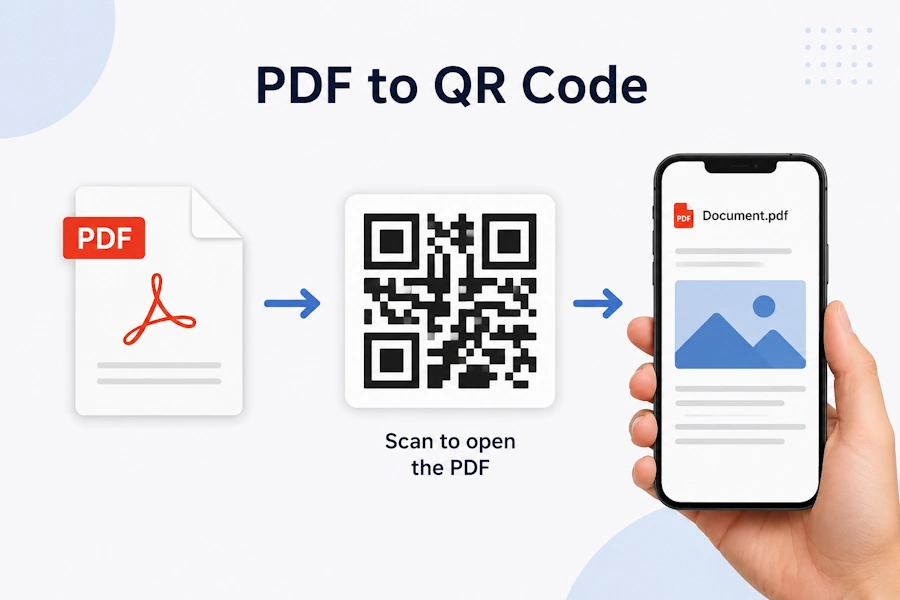
Converting a PDF to a QR code means creating a scannable code that opens your PDF document.
When someone scans the QR code with a smartphone camera, the PDF opens on their device. This removes the need to type a URL, search for a file, or download an attachment from email.
For example, you can place a PDF QR code on a brochure, poster, product label, office notice, event pass, classroom handout, or packaging insert. Users scan the code and access the PDF quickly.
Why convert a PDF to a QR code?
PDFs are useful because they can hold detailed information in a consistent format. But sharing PDFs offline can be inconvenient. Printed materials have limited space, and long document links are difficult to type manually.
A QR code solves this problem by connecting offline materials to your digital PDF.
You can use it to make documents easier to access, reduce manual sharing, and give users the information they need without crowding your print design.
How to convert PDF to QR code
Follow these steps to create a QR code for your PDF.
Step 1: Open the PDF QR Code Generator
Go to QRCodeChimp’s PDF QR Code Generator.
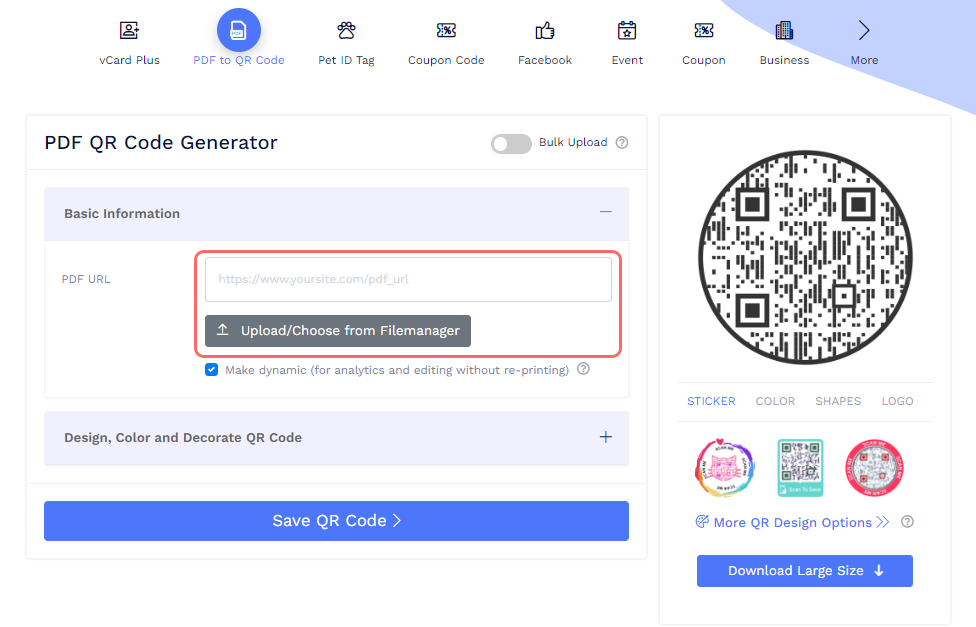
This is where you can upload your PDF, add a hosted PDF link, customize your QR code, and save the final QR code for print or digital use.
Step 2: Upload your PDF or use a hosted PDF link
Choose how you want to add your PDF.
If the PDF is saved on your computer, upload it to QRCodeChimp’s file manager. When you upload a PDF through the file manager, the QR code is created as a dynamic PDF QR code. File manager uploaded PDFs cannot be used to create static QR codes.
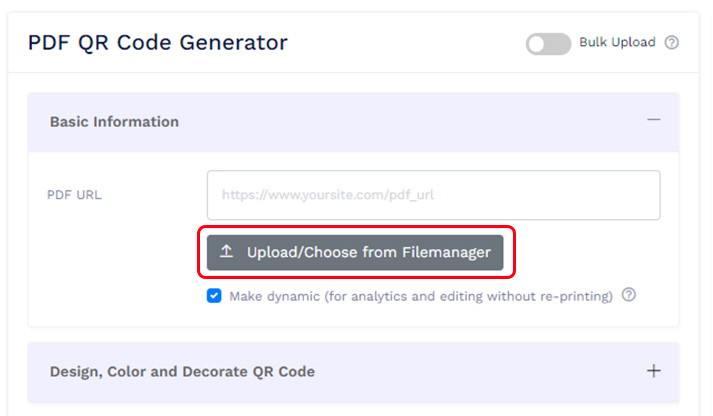
If the PDF is already hosted online, such as on your website, Google Drive, Dropbox, or another cloud platform, copy the PDF link and paste it into the PDF URL field.
💡 Important: Before moving ahead, make sure the PDF is the right version, easy to read on mobile, and accessible to the people who will scan the code. This helps avoid broken scans, outdated documents, or files that users cannot open.
Step 3: Choose static or dynamic
Next, choose whether you want to create a static or dynamic QR code.
If you upload the PDF to QRCodeChimp’s file manager, the QR code will be dynamic.
If you use a hosted PDF link, you can choose static or dynamic based on your requirement. A static QR code can work when the PDF link is permanent and you do not need tracking or future editing. A dynamic QR code is better when you want scan analytics, flexibility, or the option to update the destination later without reprinting the QR code.
💡 Pro tip: For business documents such as catalogs, menus, guides, reports, manuals, and policy documents, dynamic is usually the safer choice because these files often change over time.
Step 4: Choose whether to track precise location
If you create a dynamic QR code, you can choose whether to track precise scan location.
This option helps you capture GPS-based scan location data when users allow location access. It can be useful when you want more detailed location insights for campaigns, field materials, events, retail placements, or regional document distribution.
💡 Important: Keep in mind that precise location tracking depends on user permission and device settings.
Step 5: Customize your QR code
Customize the QR code so it looks clear, professional, and aligned with your brand.
You can add your logo, adjust the design, and use a sticker with fixed CTA text to make the scan action clearer. A sticker helps users understand what the QR code is for before they scan it.

Keep the design clean. Use enough contrast between the QR code and the background, and avoid making the code too decorative if it affects scan reliability.
Step 6: Save your QR code
Once your QR code is ready, save it.
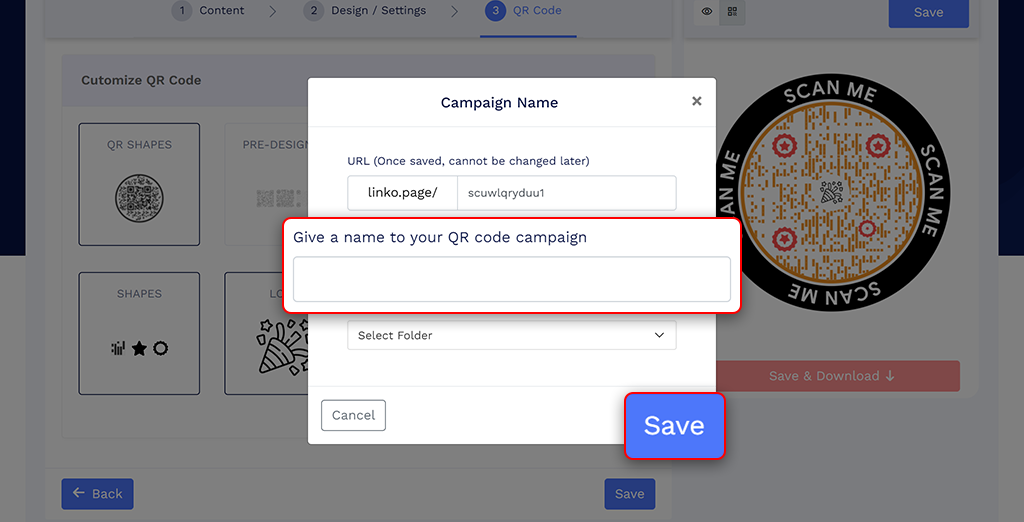
After saving, test the QR code before adding it to printed or digital materials. Scan it using different devices and check whether the PDF opens correctly. Also test the QR code after placing it in the final design because resizing, low contrast, folds, glare, or poor print quality can affect scanning.
What to check before creating a PDF QR code
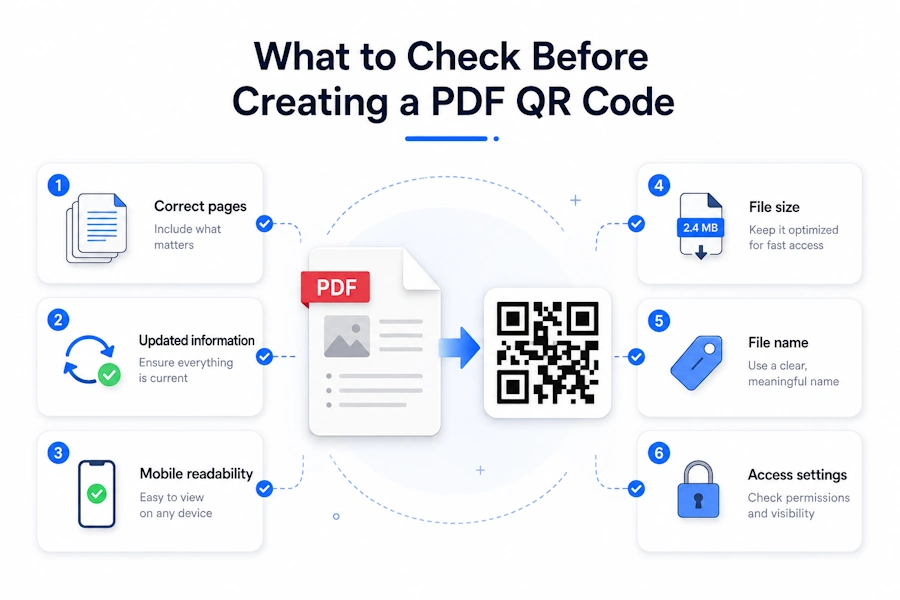
Before converting your PDF to a QR code, take a few minutes to review the document. This helps avoid broken experiences after users scan.
Check the following:
- Page order: Make sure all pages are included and arranged correctly.
- Updated information: Confirm that the PDF has the latest details, prices, dates, instructions, policies, or contact information.
- Mobile readability: Check that the text, images, tables, and layout are easy to view on a phone.
- File size: Keep the PDF size reasonable so it loads quickly after scanning. Compress the file if needed, but make sure the quality remains good.
- File name: Use a clear file name that helps you identify the document later. Avoid vague names such as “final.pdf,” “new-doc.pdf,” or “updated-version.pdf.”
- Access settings: If you are using a hosted PDF link, make sure the file is accessible. A restricted link can prevent users from opening the PDF after scanning.
Uploading a PDF vs using a hosted PDF link
There are two ways to convert a PDF to a QR code in QRCodeChimp. You can upload the PDF to the file manager, or you can use a hosted PDF link.
If you upload the PDF to QRCodeChimp’s file manager, the QR code is created as a dynamic QR code. Uploaded PDF files cannot be used to create static QR codes because the QR code points to a managed file destination.
If your PDF is already hosted online, such as on your website, Google Drive, Dropbox, or another cloud platform, you can paste the PDF link and create either a static or dynamic QR code. A static QR code can work when the link will not change. A dynamic QR code is better when you want flexibility, analytics, or the option to update the destination later without reprinting the QR code.
For most business documents, a dynamic QR code is usually the safer choice because PDFs often change after printing or distribution. But if you have a permanent hosted PDF link and do not need editing or tracking, a static QR code can also work.
Where can you use a PDF QR code?
You can use a PDF QR code anywhere users need quick access to a document.
Common placements include:
- Brochures and catalogs
- Product packaging
- Posters and flyers
- Menus and table tents
- Event badges and registration desks
- Classroom handouts
- Office notices
- Healthcare instructions
- Real estate property sheets
- Training materials
- Public information boards
Keep the use case simple. The QR code should clearly tell users what document they will get after scanning.
For example, use text such as “Scan to view the brochure,” “Scan to open the product guide,” or “Scan to download the event schedule.”
Common mistakes to avoid
Creating a PDF QR code is simple, but a few mistakes can reduce scans or frustrate users.
⚠ Using the wrong PDF version
Before creating the QR code, confirm that you are uploading or linking to the latest version of the PDF. This is especially important for catalogs, menus, policies, product guides, and event documents.
⚠ Using a restricted hosted PDF link
If you use a PDF link from Google Drive, Dropbox, your website, or another platform, make sure users can access the file. If the file is private or restricted, people may not be able to open it after scanning.
⚠ Making the QR code too small
A QR code that is too small may not scan properly. This is common on packaging, brochures, business cards, and labels where space is limited.
Test the QR code at the final printed size before publishing.
⚠ Using poor contrast
The QR code should stand out clearly from the background. Avoid low-contrast color combinations or busy backgrounds that make scanning difficult.
⚠ Placing the QR code in the wrong spot
Do not place the QR code on folds, edges, curved surfaces, or glossy areas that may affect scanning. Keep enough white space around the code.
⚠ Not explaining what the QR code opens
Users are more likely to scan when they know what to expect. Add a short instruction near the code, such as “Scan to view the PDF guide” or “Scan to open the manual.”
⚠ Not checking mobile readability
Many PDFs are designed for print or desktop viewing. If the text is too small or the layout is too dense, users may struggle to read the document on a phone.
⚠ Skipping final testing
Test the QR code before printing, after adding it to the design, and again after printing. A code that works on screen may not always scan well in the final printed format.
Best practices for sharing a PDF QR code
Use a clean QR code design that scans easily. Add your logo only if it does not affect readability. Keep enough space around the QR code so the scanner can detect it properly.
Place the QR code where users naturally look for more information. For example, put a product manual QR code near product instructions, a menu QR code on the table tent, and an event guide QR code near the registration desk.
Use direct and helpful scan text. The wording should tell users exactly what they will receive.
Good examples include:
- Scan to view the PDF brochure
- Scan to open the setup guide
- Scan to download the event schedule
- Scan to read the product manual
- Scan to access the training document
Avoid vague text such as “Scan me” when the document context is not clear.
How PDF QR codes make document sharing easier
PDF QR codes are useful because they reduce friction.
Instead of asking users to type a link, search a website, open an email attachment, or carry printed documents, you can give them instant access through a scan.
This is especially helpful when the PDF contains information that is too detailed for print. A product package can link to a full manual. A poster can link to an event guide. A brochure can link to a complete catalog. A classroom handout can link to additional learning material.
The printed material stays clean, while the PDF gives users the details they need.
Create your PDF QR code
A PDF QR code helps you share documents faster and make them easier to access from print and digital touchpoints.
Whether you want to share a brochure, guide, manual, report, menu, form, or learning resource, you can upload your PDF or use a hosted PDF link to turn it into a QR code that users can open with one scan.
Create your PDF QR code with QRCodeChimp’s PDF QR Code Generator.
Frequently asked questions
What should I prepare before converting a PDF to a QR code?
Keep the PDF ready before you start. Check the file name, page order, file size, mobile readability, and whether the document has the latest information. If you upload the PDF through QRCodeChimp’s file manager, the QR code will be dynamic. If you use a hosted PDF link, you can choose static or dynamic based on your use case.
Why is my PDF QR code not opening after scanning?
The most common reasons are restricted file permissions, an incorrect PDF link, a deleted file, a large PDF that loads slowly, or a QR code that is too small or unclear to scan.
Do I need to compress my PDF before creating a QR code?
Compress the PDF if the file is large. A smaller file usually opens faster on mobile devices, which improves the experience for users scanning from brochures, posters, packaging, or event materials.
What file name should I use for my PDF before uploading it?
Use a clear file name that helps you identify the document later, such as product-guide-2026.pdf or event-brochure-june.pdf. Avoid vague names like final.pdf or document-new.pdf.
Should I test the QR code before or after saving it?
Test it after saving the QR code and again after placing it in the final design. A QR code can work on screen but fail after resizing, printing, or placing it on a low-contrast background.
Why does my PDF look hard to read on mobile after scanning?
The PDF may have small text, dense layouts, large tables, or wide pages designed only for desktop or print. Before creating the QR code, check that the PDF is readable on a phone.
Can I use the same QR code file in different designs?
Yes, but test the QR code in every final design. Size, background color, placement, folds, glare, and print quality can affect scanning.
What should I write near the QR code?
Add a short line that tells users what they will get after scanning, such as “Scan to view the PDF guide” or “Scan to open the product manual.” This helps users scan with confidence.
You may also like
How to Secure a PDF QR Code: Passcode, Password, and Campaign Expiry
You can protect a PDF Gallery with a passcode, set an expiry date for a PDF QR code, or password-protect the PDF file itself. This guide walks you through all three methods, including how to set them up and when to use each one.
How to Create a Circular QR Code With Logo + Best Practices and Mistakes to Avoid
Learn how to create a circular QR code (round or circle) with your logo, plus best practices, scannability tips, and mistakes to avoid. Free to start on QRCodeChimp.
How to Group Cards in QRCodeChimp Entra ID Setup
Learn to organize digital business cards effectively using QRCodeChimp Entra ID grouping. Simplify card management by group, filter, or all-in-one.
Steps to Integrate Microsoft Entra ID (Azure AD) with QRCodeChimp
Learn how to connect Microsoft Entra ID with QRCodeChimp to automate digital business card creation, improve security, and simplify onboarding.
Most Popular
Contact Sales