IKEA stores globally attracted 899 million visitors in FY24, a nearly 4.5% increase from the previous year. Impressive indeed! But what’s even more notable is how the world’s largest furniture retailer manages that volume while keeping the shopping experience seamless.
IKEA’s edge comes from clever use of QR codes. Placed throughout the store, these codes turn a potentially overwhelming visit into a guided, self-serve journey. One scan gives shoppers product details, design inspiration, assembly help, and even AR previews to see how items fit in their homes.
For furniture retailers, the lesson is clear and easy to replicate. With the right QR touchpoints, you can simplify exploration, speed up decisions, and boost customer confidence.
This blog breaks down IKEA’s most effective use cases and how they can also level up both your operations and your shoppers’ experience.
What does IKEA use QR codes for?
‘Scan & Go’ shopping experiences
Many IKEA stores now let shoppers bypass queues entirely. A QR code at the entrance activates the IKEA app’s scanner, allowing customers to scan product QR codes as they move through the aisles and drop items into their cart or bag. Each scan populates a digital purchase list. When done, the app generates a single checkout QR code that customers present at the counter for quick payment. For retailers, this is a blueprint for cutting wait times, reducing cart-handling friction, and speeding up on busy days.
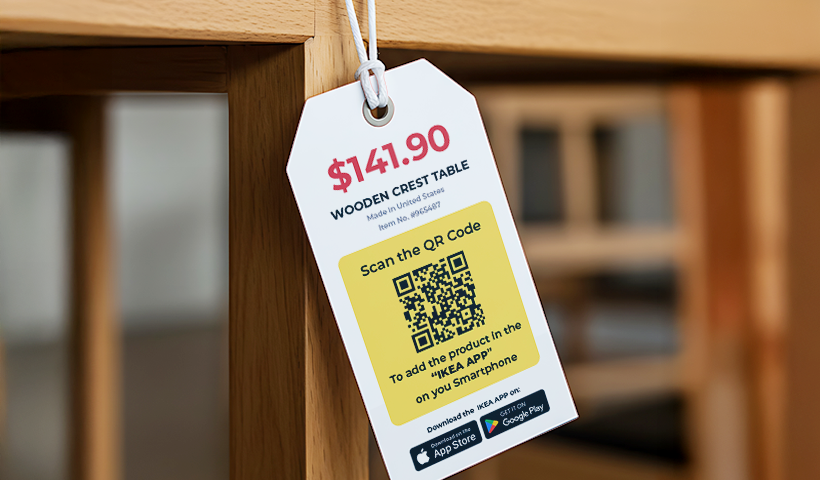
Adding items directly from product tags
IKEA also prints QR codes on product tags so shoppers can add items to a digital cart, order for delivery, or reserve for pickup. This is especially helpful for bulky furniture. Other furniture businesses can adopt the same approach to support customers who want to buy big pieces without physically lugging them across the store.
Instant product info and assembly guidance
QR codes on packaging and manuals link directly to digital product pages with assembly videos, care instructions, material details, measurements, color options, and recycling info. This helps shoppers compare options, make faster decisions, and get seamless post-purchase support. It also reduces the load on sales staff.
IKEA goes a step further by connecting some QR codes to alternative combinations, design tips, 3D demos, and AR previews. Other retailers can replicate this, too, to help customers visualize how pieces fit into their homes and, in turn, reduce returns.
Benefits of using QR codes for both IKEA and its customers
Benefits for IKEA
✅ Smoother operations
QR codes help IKEA streamline the in-store customer journey by digitizing the tedious, often cumbersome checkout process. This reduces congestion at checkout counters, eases pressure on staff during peak hours, and ensures a faster, more seamless customer experience, all while maintaining an efficient operational flow.
✅ Increased app adoption
At IKEA, customers need to download the IKEA mobile app to scan QR codes on product labels and manuals. This simple action drives wider app adoption as more shoppers engage digitally during their visit. Besides streamlining the in-store experience, the app fosters long-term engagement, allowing IKEA to stay connected with customers, personalize interactions, and extend the shopping journey well beyond the store.
✅ Detailed customer insights
The built-in analytics of QR codes provide valuable insights into customer behavior, product interest, browsing patterns, and engagement levels. These real-time insights enable IKEA to optimize store layouts, improve inventory planning, and deliver more personalized offers, thereby enhancing customer satisfaction.
✅ Lower print and signage costs
By using QR codes, IKEA saves on printing and signage costs, reducing paper waste in line with the company’s sustainability goals. QR codes seamlessly deliver detailed product information digitally, eliminating the need for extensive catalogs, paper manuals, or large promotional signs.
Benefits for Customers
✅ Faster journeys
Instead of waiting in long queues, customers can now simply present a QR code linked to their purchase list at the checkout counter. A quick scan expedites the billing process, enabling instant payments and significantly faster checkouts.
✅ Better decisions at the shelf
Shoppers can simply scan QR codes on price tags or packaging to access detailed product information, including specifications, care instructions, customer reviews, and design ideas. This gives them the clarity they need to make confident, on-the-spot choices, without having to track down a staff member for assistance.
✅ Enhanced accessibility with multilingual support
As a global home furnishing brand, IKEA welcomes customers from diverse regions of the world. To bridge the language gap, the company uses QR codes linked to multilingual content, ensuring product information and guidance are clear and accessible to everyone.
Other potential QR code use cases for IKEA
While IKEA already uses QR codes extensively, there are more practical ways the brand can use the technology to make the in-store experience even smoother for visitors. Take a look:
QR code menus for IKEA restaurants
QR codes placed on tables or at entry points in IKEA’s restaurants allow customers to view menus, check ingredients and other details, order directly from their phones, and, in some systems, even pay digitally. This streamlines restaurant operations during peak hours, reduces staff workload and wait times, and enhances the dining experience.
💡Learn more: Read this article to learn how to create touchless menu QR code for restaurants.
Smart parking with QR codes
Parking is always a big hassle at busy IKEA locations. QR codes at parking zones can simplify the parking process for visitors, linking them to digital parking tickets and navigation maps & guides. This can help them locate available parking spots and easily navigate back to their car after shopping.
Guided store navigation
IKEA’s vast, maze-like layouts can feel overwhelming, especially for first-time visitors. QR codes placed throughout the store link to interactive digital maps offering clear directions to specific aisles, departments, and even shortcuts to exits, simplifying navigation and making it less stressful and more seamless.
Loyalty programs and special offers
At IKEA, QR codes can also be used to engage shoppers with personalized discounts and loyalty rewards. Scanning these codes could unlock exclusive discounts, time-sensitive offers, and even IKEA Family benefits (including exciting member-only offers & deals).
QR codes for sustainability tips
IKEA can also use QR codes across its stores to share sustainability tips with customers. For instance, the codes can be linked to product-recycling and upcycling tips, as well as to information on the nearest recycling stations. This will not only educate shoppers on reducing their environmental footprint but also reinforce the brand’s commitment to sustainable living.
The bottom line
By weaving QR codes into the shopping journey, IKEA isn’t just adopting new tech; it’s redefining how customers experience a furniture store. The entire process becomes smoother. Shoppers move at their own pace, skip bottlenecks, access information instantly, and avoid long checkout lines.
For furniture retailers, the impact behind the scenes is just as big. QR codes reduce staff’s routine workload, freeing them to address real customer needs, like product guidance, style advice, and high-touch support. It’s a smart blend of digital convenience and human service, setting a clear benchmark for how modern furniture stores can elevate efficiency without losing the personal touch.
And the best part? You can implement the same system in your store with zero complexity. With QRCodeChimp, bringing IKEA-style QR experiences to life is not just possible, it’s surprisingly easy.
Frequently asked questions
Why does IKEA use QR codes in its stores?
IKEA uses QR codes to enrich shopping experiences by streamlining the checkout process, offering instant access to product information, and further enhancing user engagement with DIY assembly guides and AR visualization.
Can I find product details through IKEA QR codes?
Yes. IKEA uses QR codes on packaging, manuals, and price tags. These codes are linked to IKEA’s official product pages, where you can find product details like material types, dimensions, care instructions, and digital assembly manuals/guides.
How does QR code usage benefit IKEA?
QR codes at IKEA benefit the brand by streamlining store operations, reducing printing and signage costs, encouraging app adoption, and providing real-time insights into customer patterns.
You may also like
12 Practical Applications of QR Codes in Co-working Spaces
Learn practical ways to use QR codes in co-working spaces to create smarter, more connected workspaces—from streamlined check-ins to simplified meeting room bookings and payments.
How to Write High-Converting QR Code Call to Action Phrases (50+ Examples)
Learn the CTA formulas, design tips, and 60+ examples that boost QR Code scans and conversions plus how to test and measure them using QRCodeChimp tools.
Scan, Validate, and Check In Guests Faster with the New Validator App
Discover the new web-based validator app for quick event ticket validation. Scan, verify, and check in guests instantly to keep lines moving.
Approval-Based Digital Business Cards: A Smarter Workflow for HR Teams
Discover how approval-based digital business cards help HR teams ensure branding consistency, prevent misuse, and manage employee cards at scale.
Most Popular
Contact Sales