Creating QR codes one at a time becomes impractical when you need dozens, hundreds, or even thousands of unique codes. Instead, you can prepare the information in a spreadsheet and upload it once to create multiple QR codes in a batch.
If you’re wondering how to generate QR codes in bulk, the process typically involves downloading a sample file, adding one record per row, uploading the completed spreadsheet, validating the data, and generating the entire batch together.
This guide explains how to prepare your file correctly, choose between static and dynamic QR codes, avoid common upload errors, and manage your QR codes after creation.
- What is bulk QR code generation?
- Static vs. dynamic QR codes in bulk
- How to prepare your spreadsheet for bulk QR code creation
- How to generate QR codes in bulk step by step
- Design your QR codes as a batch
- Download and prepare your QR codes for printing
- Common bulk upload errors and how to fix them
- Manage your QR codes after creation
- How many QR codes can you create at once?
- Create hundreds of QR codes without creating them one by one
- Frequently asked questions
What is bulk QR code generation?
Bulk QR code generation lets you create many unique QR codes from a single spreadsheet instead of creating each one manually.
Each row in the spreadsheet represents a separate QR code, while the columns contain the information required for that code. Depending on the QR solution, this could include a URL, contact details, product information, ticket details, or other data.
For example, a spreadsheet with 300 rows can be used to create 300 unique QR codes in one bulk upload.
Static vs. dynamic QR codes in bulk
Before creating your batch, decide whether you need static or dynamic QR codes. This decision becomes especially important when you’re printing or distributing a large number of codes.
| Static QR codes | Dynamic QR codes | |
|---|---|---|
| Edit content after creation | No | Yes |
| Scan analytics | No | Yes |
| Best for | Fixed information that is unlikely to change | Content that may change or needs tracking |
| If information changes after printing | Create and print a new QR code | Update the destination without replacing the printed QR code |
Imagine printing 500 QR codes on product packaging and later discovering that the destination URL is incorrect. With static QR codes, you would need to generate and print new codes. With dynamic QR codes, you can update the destination while keeping the existing printed codes in use.
Static QR codes created in bulk cannot be edited after creation, so review your data carefully before generating the batch.
How to prepare your spreadsheet for bulk QR code creation
Bulk Upload is available for all QRCodeChimp solutions except Smart QR. Since the required fields vary by solution, always start with the sample file provided for the QR code type you want to create.
Preparing the spreadsheet correctly is one of the most important parts of the process. A clean file reduces validation errors and makes it easier to generate a large batch accurately.
Start with the sample file
Don’t create the spreadsheet structure from scratch.
Choose the QR code solution you want to use, enable Bulk Upload, and download the sample file provided by QRCodeChimp. This ensures that your columns match the fields expected by that solution.
Avoid renaming or removing required columns unless the instructions for that particular template allow it.
Use one row for each QR code
Each row should contain the data for one unique QR code.
For example, a simple URL-based bulk file might look like this:
| QR Name | Web URL |
|---|---|
| Product 001 | https://example.com/product-001 |
| Product 002 | https://example.com/product-002 |
| Product 003 | https://example.com/product-003 |
Uploading these three rows would create three separate QR codes.
A Digital Business Card, Event Ticket, Product QR Code, or another solution will have different columns based on the information required.
Use AUTO where the template includes a Page-code field
Some dynamic QR code solutions include a Page-code column.
Each QR code requires a unique page code. You can either enter a unique value manually or type AUTO to let QRCodeChimp assign one automatically.
Do not leave a required Page-code field blank.
The fields vary by solution, so follow the instructions included with the sample file rather than assuming every bulk template contains a Page-code column.
Add images correctly
Some bulk solutions allow images such as profile photos or other visual content.
Where the spreadsheet requires an image URL, upload the image to the QRCodeChimp File Manager first and add the resulting URL to the appropriate spreadsheet field.
Check that every image URL is accessible before uploading the file.
Use a supported file format
QRCodeChimp supports the following file formats for bulk upload:
- CSV
- XLS
- XLSX
If you’re preparing your data in Google Sheets, download the completed sheet as a CSV or XLSX file before uploading it to QRCodeChimp.
Clean your data before uploading
A few minutes of checking can prevent errors across an entire batch.
Before uploading:
- Check URLs for missing or incorrect characters.
- Use complete URLs, including
https://where required. - Check email addresses and phone numbers.
- Remove unintended blank rows.
- Make sure required fields aren’t empty.
- Check for duplicate values in fields that must be unique.
- Keep spreadsheet headers unchanged.
- If you’re using CSV with non-English text or special characters, save the file using UTF-8 encoding.
How to generate QR codes in bulk step by step
Once your spreadsheet is ready, creating the batch is straightforward.
Step 1: Choose your QR code solution
Sign in to QRCodeChimp and open the QR code solution you want to create.
Step 2: Enable Bulk Upload
Turn on the Bulk Upload option.
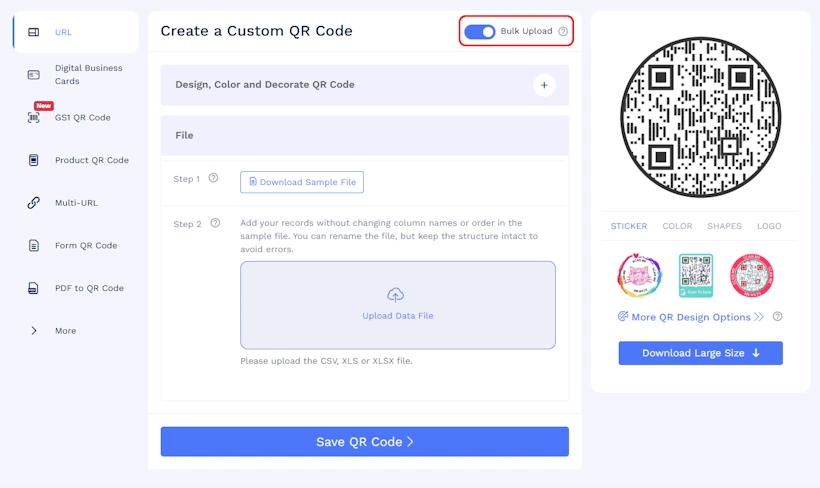
Bulk Upload is available across QRCodeChimp solutions except Smart QR.
Step 3: Download the sample file
Save or name your batch as prompted and download the sample spreadsheet.
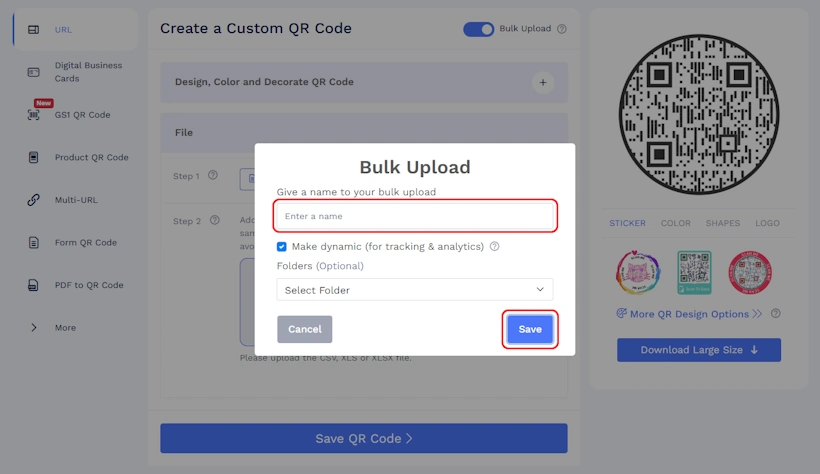
Use this file as the template for your data.
Step 4: Add your data
Enter the information for each QR code in a separate row.
Complete all required fields and use AUTO where applicable if you want QRCodeChimp to assign unique page codes.
Step 5: Upload the completed file
Save your spreadsheet as CSV, XLS, or XLSX and upload it to QRCodeChimp.
You may also be able to select a folder to help organize the batch.
Step 6: Check the field mapping
Review how the spreadsheet columns map to the QR code fields.
Make sure each column is connected to the correct field before continuing.
Step 7: Review validation errors
QRCodeChimp validates the uploaded data before creating the batch.
If any records contain errors, correct them and upload the file again.
Step 8: Complete the upload
Once the file passes validation, complete the bulk upload and review the newly created QR codes.
💡 For a screen-by-screen explanation of every option, see the full bulk upload walkthrough with screenshots.
Design your QR codes as a batch
You don’t need to design every QR code separately.
QRCodeChimp allows you to apply a consistent design across the batch, helping you maintain the same colors, shapes, frames, logo, and overall branding.
You can also customize individual QR codes separately when required.
When designing codes for printing, prioritize scan reliability over decoration. Maintain sufficient contrast between the QR code and its background, keep the quiet zone clear, and avoid design elements that interfere with readability.
Before producing hundreds of printed items, test a few QR codes on the material and at the size you plan to use.
Download and prepare your QR codes for printing
After creating the batch, you can download the QR codes together or download individual codes when needed.
Choose the appropriate QR code size and available file format based on how the codes will be used.
For large batches, also plan how you’ll match each downloaded QR code to the correct product, employee, ticket, or other record. A clear naming convention can help prevent codes from being assigned to the wrong item.
Before starting a large print run:
- Download a small sample.
- Print it at the actual intended size.
- Scan it using different phones.
- Confirm that each code opens the correct content.
- Test under the same lighting and surface conditions in which the QR code will be used.
This simple test can prevent costly reprinting later.
Common bulk upload errors and how to fix them
Bulk uploads can fail when the spreadsheet structure or data doesn’t match what the selected QR code solution expects.
Here are some common issues to check.
Required fields are empty
Problem: A required spreadsheet field has been left blank.
Fix: Review the sample template and complete all mandatory fields. If the solution requires a Page-code value, enter a unique value or use AUTO where supported.
Duplicate page codes
Problem: Two or more records use the same value in a field that must be unique.
Fix: Assign a unique value to each record or use AUTO where available.
Spreadsheet columns don’t match
Problem: Required columns have been renamed, removed, or changed.
Fix: Download a fresh sample file for the selected solution and transfer your data into that template without altering the required structure.
Invalid URLs
Problem: A URL is incomplete or incorrectly formatted.
Fix: Check the complete URL, including the protocol such as https://, and test it in a browser before uploading.
Images don’t appear
Problem: The image URL isn’t accessible or doesn’t point to the correct uploaded file.
Fix: Upload the image to the File Manager where required and use the correct accessible URL in the spreadsheet.
File doesn’t upload
Problem: The spreadsheet is saved in an unsupported format or its structure has been altered.
Fix: Save the file as CSV, XLS, or XLSX and compare its columns with a fresh sample template.
Manage your QR codes after creation
Bulk creation is only the first step. Good organization becomes increasingly important as the number of QR codes in your account grows.
✅ Organize codes into folders
Use folders and clear batch names so you can quickly find QR codes associated with a particular team, campaign, location, product group, or project.
✅ Edit dynamic QR codes
Dynamic QR codes allow you to update their content without changing the QR code itself.
For example, if 200 store QR codes point to a promotion that has ended, you can update the relevant dynamic QR codes instead of replacing the printed material.
If you need to update multiple records, see how to edit QR codes in bulk.
✅ Track scans
Dynamic QR codes also provide scan analytics, helping you understand how individual QR codes or campaigns are performing.
This becomes particularly useful when you’re managing QR codes across many locations, products, employees, or printed assets.
✅ Manage access when working with teams
For organizations with multiple users, QRCodeChimp’s account-management features can help teams work with QR codes while maintaining centralized control.
How many QR codes can you create at once?
For dynamic QR codes, the number you can create depends on the dynamic QR code allowance available under your plan.
Bulk Upload is available on Pro and higher plans.
For static QR codes, you can create up to twice your plan’s dynamic QR code limit in a single bulk batch.
For example, if a plan allows 300 dynamic QR codes, a static bulk batch can contain up to 600 static QR codes.
Very large uploads may be easier to process when divided into smaller batches.
Remember that static QR codes created in bulk cannot be edited after creation, while dynamic QR codes can be updated and tracked.
Create hundreds of QR codes without creating them one by one
A well-prepared spreadsheet can turn hours of repetitive QR code creation into a single bulk upload.
Start with the sample file for your QR solution, add one record per row, review your data carefully, and choose static or dynamic codes based on whether you’ll need editing and analytics later.
Once the batch is created, test a few codes before distributing or printing them at scale.
Frequently asked questions
Can I create QR codes in bulk for free?
Bulk Upload is available starting with the Pro plan. Free and lower-tier plans do not include the Bulk Upload feature.
Can I generate QR codes in bulk from Google Sheets?
Yes. Prepare the data in Google Sheets, then download the spreadsheet as CSV or XLSX and upload the file to QRCodeChimp.
There is no need to recreate the data in another spreadsheet application.
Can I add my logo to QR codes created in bulk?
Yes. You can apply a consistent QR code design, including branding elements such as a logo, across the batch.
For content fields that require different images for different records, follow the image-upload instructions in the sample bulk template.
Do bulk QR codes expire?
Bulk QR codes do not have a separate expiration date simply because they were created in bulk.
Static QR codes continue to work as long as the encoded information remains valid.
Dynamic QR codes may pause if your plan’s scan limit is reached. They start working again when the scan limit resets. Their availability can also depend on the status of the account and plan supporting them.
You may also like
How to Combine Multiple Links Into One Link
Combine multiple links into one shareable link and QR code. Use it in bios, emails, messages, or print, and update your links anytime.
How to Create One QR Code for Multiple Links
Learn how to create one QR code for multiple links. Add websites, social profiles, videos, PDFs, and more, then update links without reprinting.
How to Use Bulk Upload in QRCodeChimp: Step-by-Step Guide
Learn how to use QRCodeChimp Bulk Upload to create multiple QR codes from CSV, XLS, or XLSX files, customize their design, and download the completed bulk.
Bulk QR Codes for Business: Use Cases and Benefits
Discover how bulk QR codes for business can streamline product packaging, employee cards, events, multi-location campaigns, inventory, and more
Most Popular
Contact Sales