Marketers keep saying the same thing: they want deeper, more personalized relationships with customers, but most do not feel their own data is good enough to make that happen at scale.
That gap is exactly why first-party data—data you collect directly through your own channels and customer interactions—has become such an important resource.
- Key first-party data statistics at a glance
- What is First-Party Data? – Definition & Examples
- Why does first-party data matter in 2026?
- First-party data and the rise of commerce media
- How are companies using first-party data?
- What happened to third-party cookies?
- How do businesses collect first-party data?
- Is first-party data more secure than third-party data?
- Do consumers trust brands with their data?
- Collecting first-party data with QR code forms
- Wrapping up
- Frequently asked questions
Key first-party data statistics at a glance
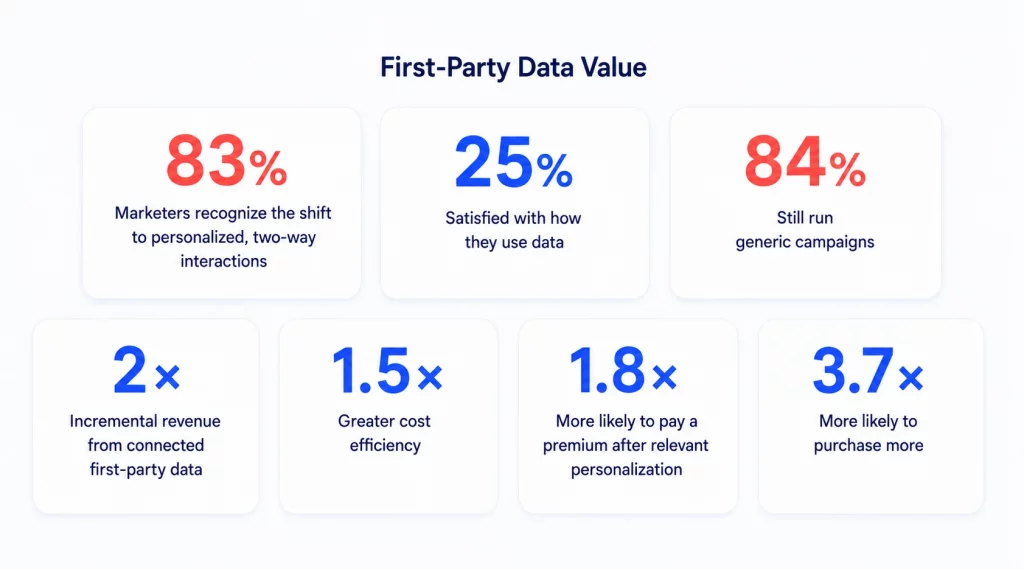
- 83% of marketers recognize the shift toward personalized, two-way customer engagement, but only one in four are satisfied with how they use data to support those interactions.
- 84% of marketers admit they are still running generic campaigns despite widespread AI adoption.
- Customers who experience personalized interactions are 1.8 times more likely to pay a premium and 3.7 times more likely to purchase more than they originally intended.
- Companies that linked all their first-party data sources generated twice the incremental revenue from individual marketing activations and achieved 1.5 times the improvement in cost efficiency compared with companies with limited data integration.
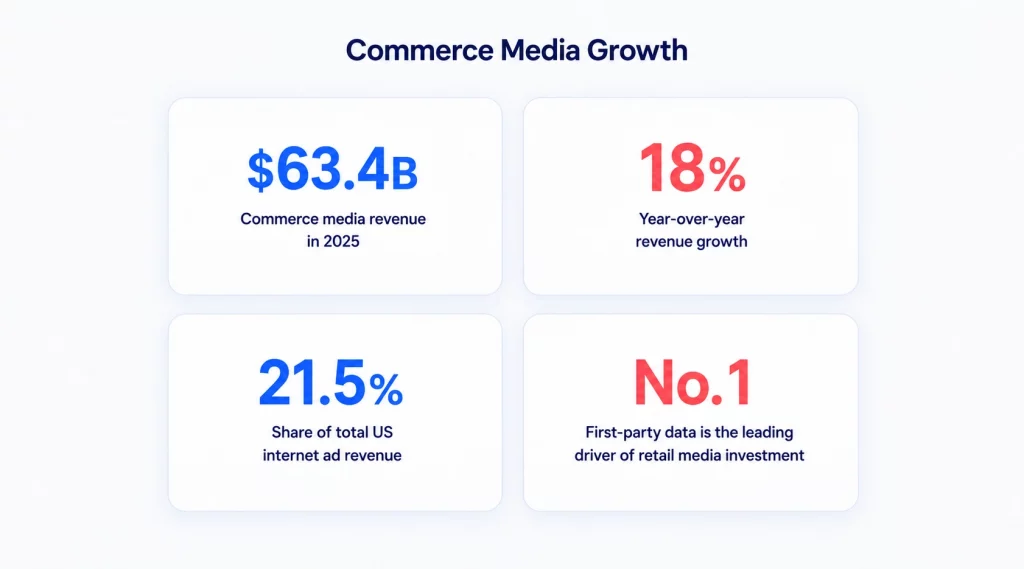
- Commerce media revenue grew 18% year over year to $63.4 billion in 2025, equivalent to approximately 21.5% of total US internet advertising revenue.
- Access to first-party data remained the leading driver of buy-side retail media investment.
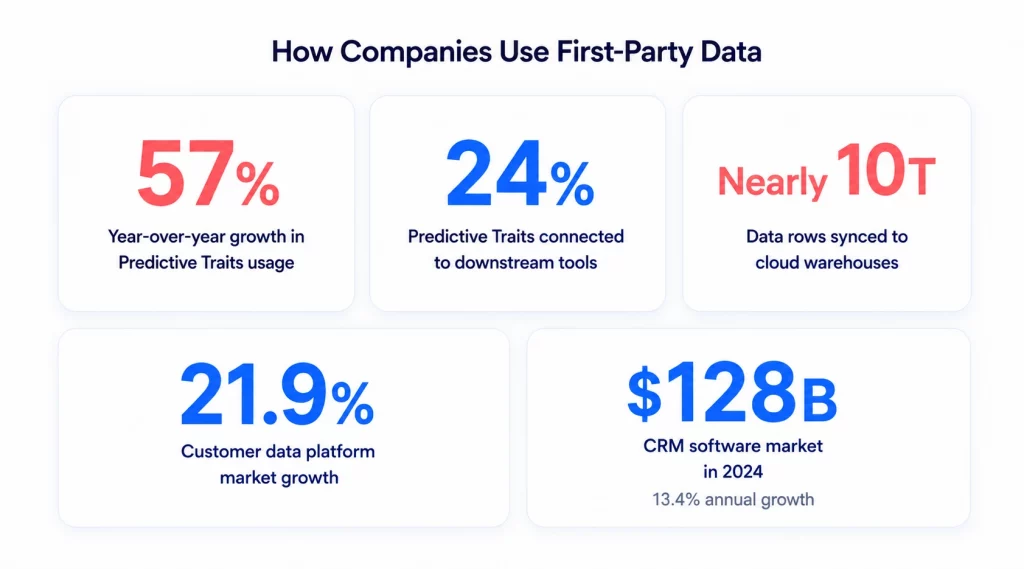
- Use of Predictive Traits on the Twilio Segment platform grew 57% year over year.
- Twilio Segment customers synced nearly 10 trillion rows of data to cloud warehouses such as Databricks, Snowflake, and BigQuery over one year.
- The CRM software market grew 13.4% to $128 billion in 2024, while customer data platforms grew 21.9%.
- As of June 2026, 23 US states had enacted comprehensive consumer privacy laws.
- Google is no longer proceeding with a browser-wide default phase-out of third-party cookies in Chrome.
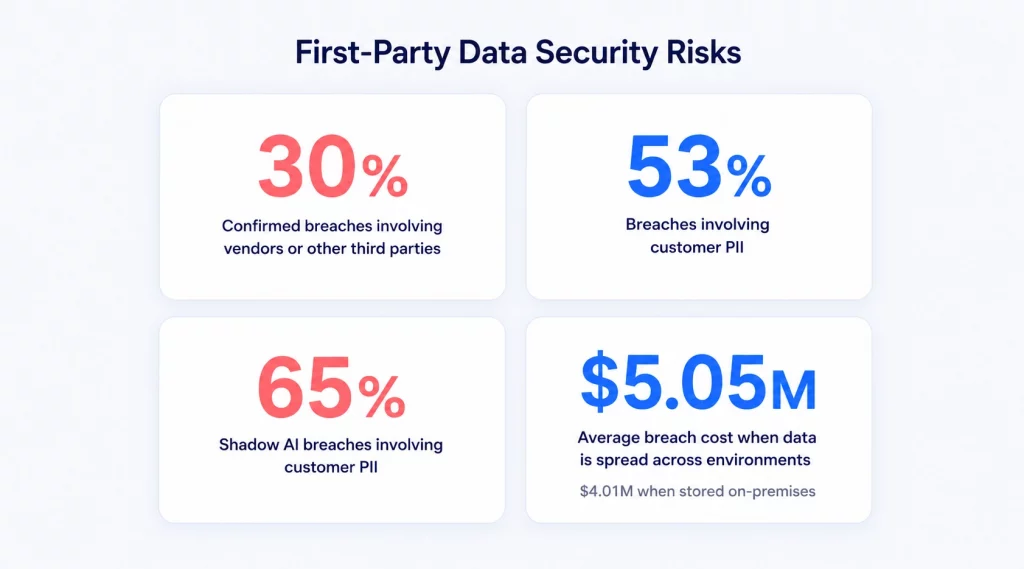
- Third-party involvement in data breaches doubled year over year from 15% to 30%. In this context, “third party” refers to vendors, partners, and supply-chain relationships rather than third-party marketing data.
- Breaches involving data distributed across multiple environments cost an average of $5.05 million, compared with $4.01 million for breaches involving data stored on-premises.
- Customer personally identifiable information was compromised in 53% of breaches studied, rising to 65% in breaches involving unsanctioned shadow AI.
- 75% of consumers said they would not purchase from an organization they did not trust with their data.
Below are the most important first-party data statistics highlighting why first-party data matters, how companies are collecting and using it in 2026, and where the near-term risks and misconceptions lie.
What is First-Party Data? – Definition & Examples

First-party data is information a business collects directly from customers, prospects, website visitors, app users, and other people who interact with its own channels.
It can include information people intentionally submit, such as contact details, preferences, and survey responses, as well as behavioral and transactional information generated through direct interactions.
| Data type | Where it comes from | Example |
|---|---|---|
| First-party data | Collected directly through your own channels and interactions | Website analytics, CRM records, purchase history, form submissions |
| Second-party data | Another company’s first-party data shared under a direct agreement | A partner brand sharing agreed customer insights for a joint campaign |
| Third-party data | Aggregated from sources with no direct relationship with the individual | Audience data purchased or licensed from a data provider |
Common first-party data sources include website and app activity, CRM records, order and transaction history, customer service interactions, loyalty program activity, and direct submissions through forms, surveys, and sign-ups.
First-party data should still be collected with appropriate notice and, where required, consent. The fact that data is collected directly does not eliminate a business’s privacy or data protection responsibilities.
Why does first-party data matter in 2026?
The business case for first-party data is not just a privacy story anymore. It is also about whether companies have sufficiently relevant, connected, and usable data to improve customer interactions.
Salesforce’s State of Marketing report, now in its 10th edition and based on a survey of approximately 4,500 marketing leaders worldwide, found that 83% of marketers recognize customers’ shift toward personalized, two-way interactions.
Yet only one in four are satisfied with how they use data to support these interactions, and 84% admit they are still running generic campaigns despite widespread AI adoption. The findings point to a data-use and data-quality gap, not simply a lack of marketing technology.
Gartner’s research puts a number on the potential commercial value of relevant personalization. In a survey of 1,464 B2B buyers and consumers conducted in November and December 2024, customers who experienced a personalized interaction were 1.8 times more likely to pay a premium and 3.7 times more likely to purchase more than they initially intended.
The same research also identified a trade-off. Customers receiving personalized interactions were twice as likely to feel overwhelmed by the volume of information and 2.8 times more likely to feel time pressure.
First-party data should therefore improve relevance, not simply increase the frequency or volume of communication.
One of the clearest direct ROI benchmarks comes from research by BCG and Google. Companies that connected all their first-party data sources generated twice the incremental revenue from an individual advertisement, communication, or outreach and achieved 1.5 times the improvement in cost efficiency compared with companies with limited data integration.
The study was published in 2020, but it remains a useful benchmark because it directly examines the relationship between first-party data integration and marketing performance.
First-party data and the rise of commerce media
One of the clearest signs that first-party data has become a revenue-generating asset is the growth of commerce media.
According to the IAB’s 2025 Internet Advertising Revenue Report, produced with PwC and published in 2026, commerce media revenue increased 18% year over year to $63.4 billion.
That was equivalent to approximately 21.5% of the $294.6 billion in total US internet advertising revenue recorded during the year.
Commerce media is broader than retail media alone. It includes retail and marketplace advertising across on-site, off-site, and in-store environments, using commerce or retail data to plan, execute, and measure.
The attraction is not simply access to advertising inventory. IAB Europe’s Attitudes to Retail Media 2025 report found that access to first-party data remained the leading driver of buy-side investment, ahead of reaching shoppers at the point of sale and emerging channels such as connected TV and audio.
Retail media therefore provides a visible example of the commercial value companies place on accurate purchase and customer-interaction data collected through direct relationships.
How are companies using first-party data?
Twilio Segment’s Customer Data Platform Report 2025 provides a useful view of what businesses using the platform do with customer data once they collect it.
Use of Predictive Traits on the Twilio Segment platform grew 57% year over year. Predictive Traits use machine learning to identify potential future behaviors, such as purchase intent or the likelihood of churn.
Twilio also reported that 24% of Predictive Traits were connected to downstream destinations, indicating that some businesses were moving beyond prediction and using these insights in analytics, advertising, marketing, and customer-engagement tools.
Twilio Segment customers also synced nearly 10 trillion rows of data to cloud data warehouses such as Databricks, Snowflake, and BigQuery over one year.
The figure shows the scale at which customer data is being consolidated and prepared for analysis and activation.
Infrastructure spending reflects the same demand. Gartner found that the CRM software market grew 13.4% to $128 billion in 2024, while customer data platforms grew 21.9%.
Customer data platforms grew faster than the overall CRM market, indicating continued demand for tools that unify customer information across systems.
Collecting first-party data is therefore only half the job. Its value depends on whether the organization can connect, maintain, analyze, and use it across relevant systems.
What happened to third-party cookies?
Third-party cookies were expected to disappear from Chrome, creating much of the early urgency around first-party data strategies.
That browser-wide default phase-out is no longer going ahead.
In April 2025, Google confirmed that it would maintain Chrome’s existing approach to third-party-cookie choice rather than introducing a new standalone prompt or forcing a universal phase-out.
Users can continue managing third-party-cookie preferences through Chrome’s privacy and security settings.
This decision is specific to Chrome. It does not mean every browser treats third-party cookies in the same way, nor does it reverse the wider movement toward tighter privacy controls.
It also does not make first-party data less important. The case for first-party data now depends less on a single browser deadline and more on data relevance, direct customer relationships, platform independence, and privacy regulation.
As of June 2026, 23 US states had enacted comprehensive consumer privacy laws. These laws can give residents rights over how covered businesses collect, use, correct, disclose, or delete personal information, regardless of the direction taken by a particular browser.
First-party data can also be more relevant and verifiable because it comes from direct interactions. However, it is not automatically accurate. Its quality still depends on how the information is collected, maintained, updated, and connected.
How do businesses collect first-party data?
Most organizations combine several core channels:
Website and app activity: Behavioral data generated through visits, clicks, searches, feature usage, content interactions, and other actions on channels operated by the business.
CRM systems: Customer and prospect records, sales interactions, account information, relationship history, and other structured data maintained by the organization.
Orders and transactions: Purchase history, product preferences, order value, returns, subscriptions, and related records.
Customer service interactions: Support tickets, calls, emails, and chats that reveal customer needs, recurring questions, and friction points.
Loyalty and membership programs: Information customers share when joining a program, earning rewards, choosing preferences, or interacting with membership benefits.
Direct forms and sign-ups: Feedback forms, registrations, warranty submissions, lead forms, surveys, quote requests, and newsletter sign-ups.
The right collection method depends on the intended use. Businesses should ask only for information they genuinely need and clearly explain the purpose of collecting it.
💡Explore more: How to Collect First-Party Data with QR Codes?
Is first-party data more secure than third-party data?
First-party data is not automatically more secure simply because a business collects it directly.
Businesses typically still use hosting providers, CRM platforms, analytics tools, marketing systems, integrations, and other vendors to store or process first-party data.
Verizon’s 2025 Data Breach Investigations Report found that third-party involvement in confirmed breaches doubled from 15% to 30%.
In this context, “third party” refers to vendors, software suppliers, partners, and supply-chain relationships. The finding does not directly compare first-party marketing data with purchased third-party data.
IBM’s Cost of a Data Breach Report 2025 found that customer personally identifiable information was the most frequently compromised data type, involved in 53% of breaches studied.
Among breaches involving unsanctioned shadow AI, customer PII was compromised in 65% of cases.
IBM also found that breaches involving data distributed across multiple environments cost an average of $5.05 million, compared with $4.01 million for breaches involving data stored on-premises.
This does not mean one storage model is always safer. It shows how fragmented storage and processing environments can increase breach complexity and cost.
Reducing unnecessary transfers and third-party dependencies can limit some exposure. However, the security of first-party data ultimately depends on access controls, encryption, integrations, retention policies, employee practices, and vendor governance.
Do consumers trust brands with their data?
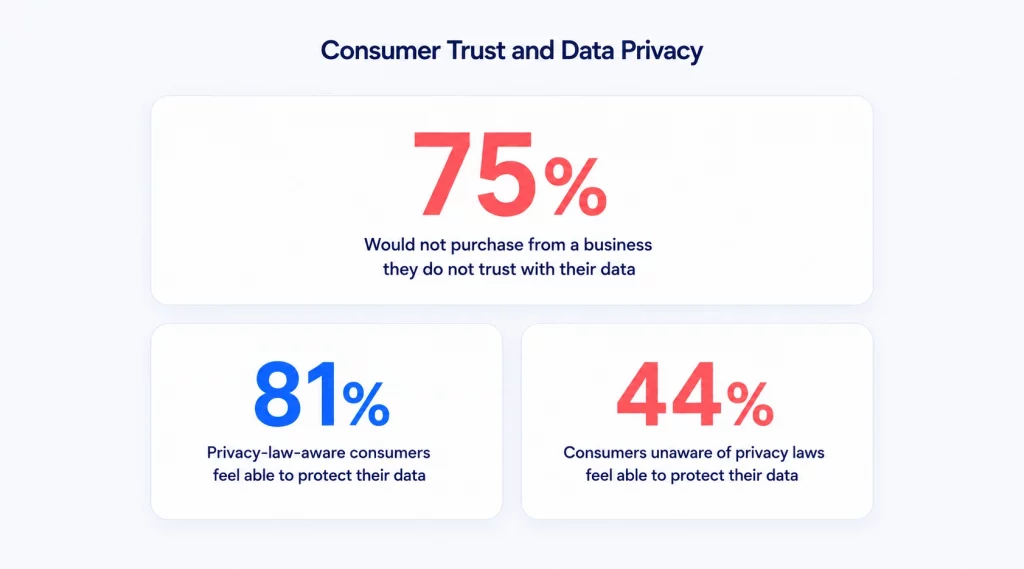
Trust is closely tied to customers’ willingness to share information directly.
Cisco’s 2024 Consumer Privacy Survey, based on responses from more than 2,600 consumers across 12 countries, found that 75% would not purchase from an organization they did not trust with their data.
The same research found that consumers who were aware of their country’s privacy laws felt substantially more capable of protecting their data.
Among consumers aware of local privacy laws, 81% said they could protect their data, compared with 44% among those unaware.
For businesses collecting first-party data, the direct relationship can be an advantage—but only when the collection process clearly explains what information is being requested, why it is needed, and how it will be used.
Collecting first-party data with QR code forms
A form QR code can connect a physical touchpoint with an online first-party data collection process.
A business can place the QR code on a receipt, table tent, product label, package insert, event sign, poster, or printed document. A customer scans the code, opens a mobile-friendly form, and submits the requested information.
With QRCodeChimp, form responses are recorded in the dashboard, where they can be reviewed, managed, and exported. (QRCodeChimp guide to managing form responses)
Businesses can control the form fields, design, branding, and response workflow.
Forms are especially useful because the individual actively submits the requested information rather than the business relying only on inferred behavior. However, businesses should still provide appropriate privacy notices and obtain consent where required.
Common use cases include:
- Customer feedback
- Event registration
- Lead generation
- Warranty registration
- Loyalty program sign-up
- Product surveys
- Quote requests
- Service requests
- Contests and promotions
For setup instructions, available field types, customization options, response management, and business use cases, see the QRCodeChimp Form QR Code guide.
Wrapping up
The case for first-party data has not weakened just because Chrome’s third-party-cookie deadline changed.
Businesses still need reliable data collected through direct interactions to understand customers, improve experiences, measure results, and reduce dependence on external platforms.
The organizations getting the most value are not necessarily collecting the most data. They are connecting and activating the information they already have, maintaining its quality, and using it in ways customers understand and trust.
A form QR code extends that first-party data strategy to physical touchpoints. It can turn a receipt, table tent, product label, package, or event sign into a direct data collection point, with responses recorded in your dashboard instead of being left on paper or entered manually.
Frequently asked questions
What is first-party data?
First-party data is information an organization collects directly from customers, prospects, users, and other audiences through its own interactions and channels. Examples include website activity, CRM records, transaction history, customer service interactions, and form submissions.
Is first-party data more important now that Chrome is not phasing out third-party cookies by default?
Yes, but the reason is no longer an imminent Chrome deadline. First-party data remains important because it can be more relevant to the direct customer relationship, gives businesses greater control over their data strategy, and reduces dependence on external audience providers and platform policies.
What is the difference between first-party, second-party, and third-party data?
First-party data is collected directly through your organization’s own interactions. Second-party data is another organization’s first-party data shared under a direct agreement. Third-party data is aggregated by an outside provider that does not have a direct relationship with the individual.
What are the most common ways to collect first-party data?
Common sources include website and app activity, CRM systems, purchase history, customer service interactions, loyalty programs, surveys, registrations, sign-ups, and QR code forms placed at physical touchpoints.
Is first-party data more secure than third-party data?
Not automatically. First-party data may involve fewer unnecessary hand-offs, but it can still be exposed through weak access controls, insecure integrations, poor retention practices, employee mistakes, or third-party vendors. Its security depends on how it is collected, stored, accessed, shared, and deleted.
Does more first-party data automatically produce better marketing results?
No. Data must be sufficiently accurate, relevant to the intended purpose, connected across appropriate systems, and used responsibly. Collecting more information without a clear activation strategy can increase complexity and privacy risk without improving results.
How can QR codes help collect first-party data?
A form QR code allows people to open and complete an online form by scanning a code placed on a physical or digital touchpoint. Businesses can use it for feedback, registrations, surveys, warranty submissions, lead capture, service requests, and other direct data collection workflows.
You may also like
Digital Business Card Statistics in 2026: Usage, Applications, Adoption, and Top Players
Discover some important statistics for digital business cards, including the market size of digital business cards, along with their key drivers, how people use them, and much more.
30+ Email Marketing Statistics for 2026: Benchmarks, Deliverability, and ROI
Verified email marketing statistics, including current open rate and click benchmarks, automation performance, deliverability, ROI, AI adoption, and sender requirements.
NFC Business Card Trends: What Businesses Should Know
See the latest NFC business card trends, from NFC-plus-QR cards and team management to lead capture, analytics, security, and adoption barriers.
QR Code Statistics for 2026: Usage, Market Growth, Payments, and Business Trends
The QR code landscape has changed significantly over the past few years, especially after the pandemic. We’ve compiled some QR code statistics and forecasts to help you better understand the usage and potential of QR codes.
Most Popular
Contact Sales