Printed contact details can become outdated, collected cards often require manual data entry, and traditional business cards provide no built-in way to measure engagement. NFC business cards address these limitations by connecting a reusable physical card to an updatable digital profile.
However, the value does not come solely from the NFC chip. It comes from combining tap-based sharing with a digital business card platform that manages profiles, captures leads, tracks engagement, and keeps information up to date.
This article examines the trends shaping NFC business cards, the limitations businesses should consider, and how teams can deploy them effectively.
Key Takeaways:
- NFC cards work best with an editable digital profile.
- Pair NFC with QR for wider compatibility and reliable sharing.
- Team controls, lead capture, and analytics drive business value.
- Lock NFC tags after testing, though stored URLs remain readable.
- Compare hardware, software, admin, and replacement costs together.
- What is an NFC digital business card?
- What reliable data can and cannot tell us
- Why businesses are adopting NFC business cards
- NFC business card trends you should be aware of
- NFC and QR codes have different strengths
- What could slow NFC business card adoption
- How QRCodeChimp supports NFC business card deployments
- The bottom line
- Frequently asked questions
What is an NFC digital business card?
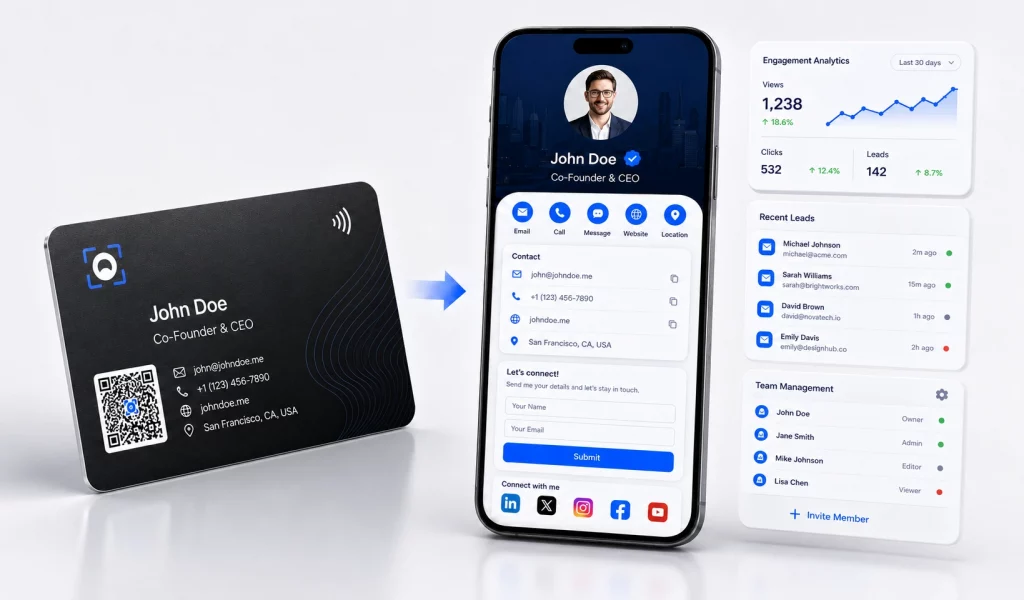
An NFC digital business card is a physical card or tag programmed with a link to an online professional profile. The chip typically stores a web address using the NFC Data Exchange Format, or NDEF, a standard defined by the NFC Forum.
When someone taps the card with a compatible smartphone, the phone reads the link and opens the digital profile. The recipient usually does not need to type a URL or install a dedicated app.
It helps to separate the experience into two layers.
The NFC card is the physical method for sharing. Its primary job is to store and deliver a link when tapped.
The digital business card platform hosts the experience. Contact details, branding, lead forms, analytics, CRM workflows, access controls, and team management belong to the hosted platform, not the NFC chip.
Because the chip stores a link rather than the full profile, the information behind that link can be updated without reprogramming or replacing the card. The same profile can also be shared through a QR code, direct link, email signature, or wallet pass.
What reliable data can and cannot tell us
Reliable public data measuring NFC business card adoption specifically remains limited. Commercial market estimates differ dramatically because research firms use different definitions, datasets, and methodologies. Some appear to measure physical NFC cards, while others include digital profiles, NFC hardware, payment applications, or other contactless products.
For that reason, no single NFC business card market-size estimate should be treated as definitive.
The broader digital business card market offers more useful context. Research shows that the market, which includes NFC, QR code, web-based, and app-based business cards, will grow from USD 217.04 million in 2026 to USD 331.78 million by 2031 at an 8.86% CAGR.
It also estimates that small and medium-sized businesses represented 38.51% of the market in 2025. These figures suggest that digital business card demand extends beyond individual users and large enterprises, though they do not specifically address NFC cards.
Consumer familiarity with NFC is also increasing. In a 2024 NFC Forum study, more than 80% of respondents reported using a smartphone or smartwatch for contactless payments. A related NFC Forum analysis reported that 73% considered themselves familiar or very familiar with NFC technology, up from 67% in the 2022 study.
These figures do not measure NFC business card adoption. They do show that tapping a phone or wearable has become a familiar interaction for many consumers.
Another study reported that 92% of cards shipped by its members and advisory council members in 2024 were contactless-enabled. This is payment-card data, not business card data, but it reflects how widely tap-based interactions have entered everyday use.
Why businesses are adopting NFC business cards
The practical appeal of an NFC business card comes from combining a reusable physical card with an editable digital profile.
At the moment of exchange, a tap removes the need to type an email address, photograph a paper card, or search for the person online later. The recipient can immediately view the professional profile, save contact details, open relevant links, or submit their information through a lead form.
The hosted profile also reduces the problem of outdated details. When someone changes their phone number, title, office, or social profile, the digital business card can be updated while the programmed NFC link remains the same.
For companies, this can reduce the need for repeat printing and shipping. A conventional business card may need to be reprinted after a role change, rebrand, or office move. An NFC card linked to an updatable profile can remain useful for longer.
The cost comparison should still account for the complete deployment. NFC cards cost more per unit than paper cards, digital business card platforms may charge subscription fees, and physical cards can be lost, damaged, or replaced when employees leave.
The accurate claim is that NFC cards can reduce the need for repeated printing and simplify updates. They do not eliminate every ongoing cost.
The sustainability case also depends on actual usage. A reusable card may reduce paper consumption by replacing repeated print runs. However, NFC cards contain electronic components and may be made of plastic, wood, metal, or composite materials.
Their environmental impact depends on the card material, lifespan, replacement rate, and number of printed cards displaced.
NFC business card trends you should be aware of
NFC business cards are evolving from individual networking accessories into managed business tools. The most relevant trends concern how cards are shared, administered, measured, and connected to follow-up workflows.
NFC and QR codes are increasingly used together
Businesses are increasingly adding both an NFC chip and a QR code to the same physical card.
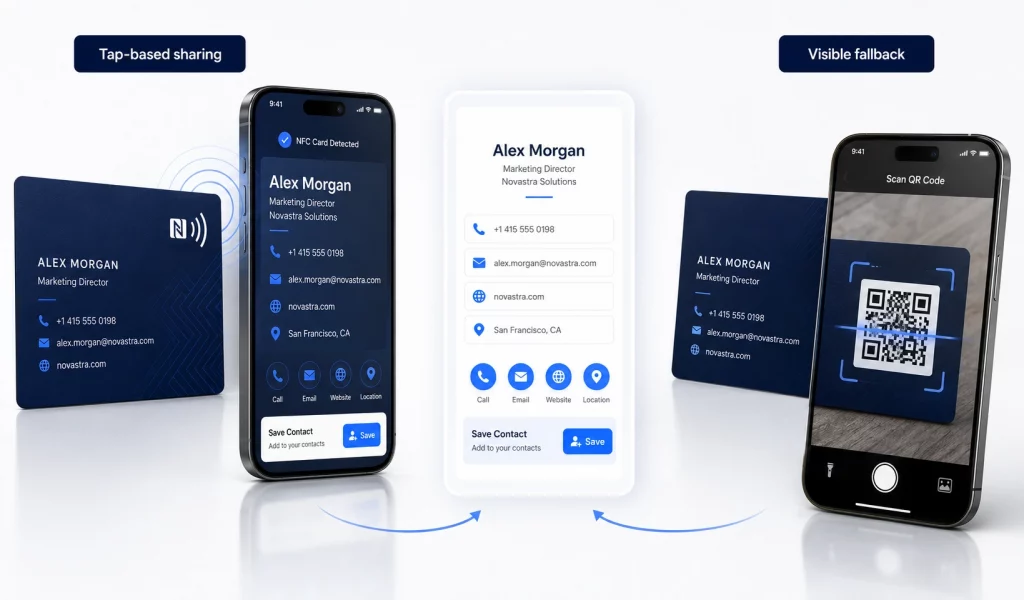
NFC provides a quick tap-based interaction. The QR code provides a visible, broadly compatible alternative when NFC is unavailable, disabled, or difficult to activate on a particular phone.
Both can open the same digital business card, giving the recipient multiple ways to reach the profile. This is more reliable than treating NFC and QR codes as competing formats.
Team deployments are becoming easier to manage
For organizations, issuing a card is only the beginning. Employee details change, people move between roles, branding must remain consistent, and access needs to be removed when someone leaves.
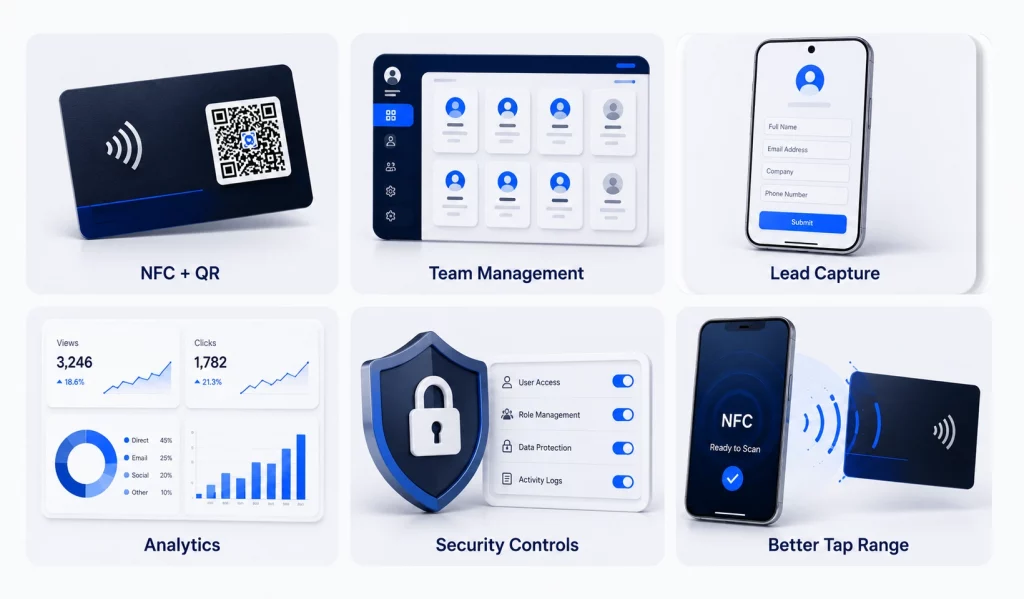
This is moving demand toward centrally managed deployments. Administrators can create cards in bulk, standardize templates, control which fields employees can edit, update information centrally, and manage access across teams.
The physical NFC card remains the sharing tool. The digital business card platform handles the operational work behind it.
Lead capture is replacing one-way contact sharing
A conventional business card usually supports one-way sharing. One person gives their information, while the recipient must take a separate step to respond.
A digital business card can include a lead form that lets the recipient share their details immediately. This turns the exchange into a two-way interaction and reduces the risk of losing a valuable contact after an event or meeting.
QRCodeChimp, for example, supports lead collection through digital business cards, allowing businesses to collect contact information directly from the hosted profile.
Networking is becoming more measurable
Traditional business cards cannot show whether someone viewed the information, clicked a link, or took action afterward.
A hosted digital profile can measure page visits and engagement with contact buttons, websites, documents, social profiles, booking links, and other calls to action. These insights come from the digital business card platform, not the NFC chip.
Businesses that need to distinguish NFC traffic from QR scans, shared links, or event campaigns should use separate tracking links or campaign parameters. QRCodeChimp supports UTM tracking for digital business cards and other dynamic profiles, helping teams identify the source, medium, and campaign behind traffic.
Security and governance are becoming buying criteria
As more companies issue digital business cards across teams, buyers are applying the same scrutiny they would apply to other business software.
Important questions include:
- Who owns and controls employee profiles?
- Which fields can employees edit?
- How is access removed during offboarding?
- Are profile pages delivered over HTTPS?
- Can administrators maintain consistent branding?
- Does the platform support identity integrations and role-based controls?
These controls matter more than claims that the NFC chip itself is inherently secure.
NFC standards are improving tap reliability
One practical limitation of NFC cards is that users may need to place their phone close to a specific part of the card. The correct tapping position can also vary by phone model.
NFC Release 15 extends the certified operating range for compliant NFC devices from approximately 5 mm to up to 20 mm. According to the NFC Forum, the fourfold increase is intended to reduce the need for precise alignment and make compatible NFC interactions more reliable.
The improvement applies to devices and tags designed and certified for Release 15. Businesses should not assume that every existing NFC card or smartphone already supports the extended range.
NFC and QR codes have different strengths
NFC business cards are sometimes marketed as inherently more secure than QR codes because the data is supposedly encrypted on the chip. That is not accurate for ordinary URL-based NFC business cards.
A standard NFC business card usually stores a readable URL in an NDEF record. Android’s NFC documentation explains how NFC tags can contain NDEF messages mapped to URIs and other data types.
If a tag remains writable and unlocked, someone with a compatible device and NFC-writing software can replace the stored URL.
Locking the tag after programming can prevent later changes, but it does not make the public URL secret or prevent copying.
Secure-element NFC is different. The NFC and Secure Element platform described by Apple uses dedicated hardware and credentials for applications such as payments, access, transit, loyalty programs, and tickets. A basic NFC tag containing a digital business card URL does not offer the same level of security.
QR codes also contain readable data and can be photographed or reproduced. With both NFC and QR codes, the most important security factors are the encoded destination, HTTPS protection, platform controls, and the recipient’s ability to recognize a legitimate page.
NFC offers a quick tap-based interaction. QR codes provide a visible alternative that works on a wider range of camera-equipped phones. For most business card deployments, using both is more practical than choosing only one.
What could slow NFC business card adoption
NFC business cards offer clear advantages, but they are not frictionless.
NFC support and behavior vary by device and operating system. Android devices support different NFC tag technologies, while Apple notes that background tag reading is available only on supported iPhone models and under specific operating conditions.
First-time users may also be unsure where to tap the card against their phone. Clear instructions and an accompanying QR code can reduce this friction.
Per-card hardware costs may be significant for large or high-turnover teams. Companies must also plan for lost cards, damaged tags, employee departures, and replacement inventory.
Tag quality matters. Poorly manufactured NFC tags may have limited range or fail over time. Writable tags should be tested and, where supported, locked after the correct URL has been programmed.
A digital business card subscription also introduces a software cost that a basic paper card program may not incur. However, paper cards create their own recurring design, printing, shipping, replenishment, and replacement expenses.
Businesses should compare total costs rather than comparing one NFC card with one paper card.
How QRCodeChimp supports NFC business card deployments
QRCodeChimp provides the digital profile and management layer that opens after an NFC tap.
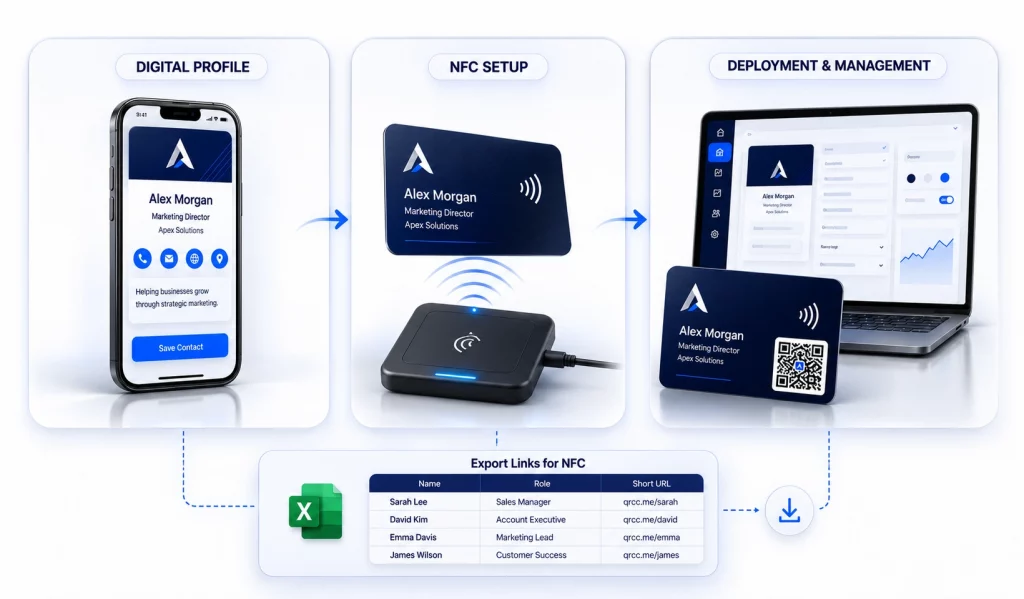
The QRCodeChimp NFC setup process works as follows:
- Create and save a digital business card in QRCodeChimp.
- Copy the card’s short URL.
- Write the short URL to a compatible NFC card or tag using an NFC-writing app or encoding device.
- Test the card on multiple smartphones.
- Lock the tag after confirming that it opens the correct profile, if the tag supports permanent locking.
- Add the profile’s QR code to the physical card as an alternative way to share.
The digital business card can be updated later without rewriting the NFC tag, provided the programmed short URL remains unchanged.
For team deployments, QRCodeChimp provides an Export Links for NFC option. Teams can download an Excel file containing the short URL and matching contact information for every digital business card in bulk.
This reduces the risk of linking a physical NFC card to the wrong employee profile when working with an NFC card printer or encoding team.
QRCodeChimp also supports business and enterprise deployments through features such as:
- Bulk digital business card creation
- Lead collection forms
- Engagement analytics
- Centralized profile management
- Field locking and access controls
- Brand consistency across employee cards
- Subaccounts and team administration
- SSO and Microsoft Entra ID integrations
- White labeling and custom domains on eligible plans
The QRCodeChimp Digital Business Card platform provides the hosted profile, short URL, QR code, management tools, and deployment data. It does not manufacture the physical NFC cards.
The bottom line
NFC business cards are most useful for professionals and teams that network frequently, need contact information to remain current, and want a measurable path from an in-person meeting to lead capture or follow-up.
The strongest deployments pair NFC with a QR code, lock the tag after programming, and connect both sharing methods to a well-managed digital profile. Businesses should also evaluate the complete cost of hardware, software, administration, and replacement rather than relying on claims that NFC cards are a one-time or cost-free solution.
The NFC chip enables the tap. The digital business card platform determines what happens next.
Frequently asked questions
The following answers address common questions businesses have when evaluating NFC business cards.
How big is the NFC business card market?
Published estimates for the NFC-only business card market vary too widely to support a reliable single figure. Research providers use inconsistent market definitions, and some published forecasts contain conflicting values or growth calculations.
The broader digital business card market, which includes NFC, QR code, web-based, and app-based cards, is estimated at USD 217.04 million in 2026 and is projected to reach USD 331.78 million by 2031.
Do NFC business cards work with all smartphones?
No. NFC support and background tag-reading behavior vary by phone model and operating system. Some devices may require NFC to be enabled, while others may support only certain tag types or reading conditions.
Adding a QR code to the same card gives recipients another way to open the digital profile.
Is the information on an NFC business card encrypted?
Usually not. A standard NFC business card typically stores a readable URL in an NDEF record.
Locking the tag can prevent the stored link from being changed, but it does not encrypt the URL or make it private. Security depends primarily on the destination website, HTTPS protection, platform controls, and responsible profile management.
Can someone rewrite an NFC business card?
A writable NFC tag may be changed if it has not been locked and the person has a compatible device and NFC-writing software.
Businesses should test the programmed URL and then lock the tag when the hardware supports permanent locking. Locking is generally irreversible, so the URL should be confirmed first.
Are NFC business cards a one-time purchase?
The physical card may be purchased once and reused, but the total cost may include digital business card subscription fees, replacement cards, encoding, administration, and cards for new employees.
NFC cards can reduce the need for repeat printing, but they do not eliminate all ongoing costs.
Are NFC business cards eco-friendly?
They can reduce paper consumption when a reusable card replaces multiple print runs. However, NFC cards contain electronic components and may be made of plastic, wood, metal, or composite materials.
Their overall environmental impact depends on how they are manufactured, how long they remain in use, and how many printed cards they replace.
Can I track NFC business card taps?
The digital business card platform can track visits to the hosted profile and engagement with its links or buttons.
However, when NFC, QR codes, and shared links all point to the same URL, the platform may not automatically identify which sharing method produced each visit. Separate tracking links, UTM parameters, or campaign organization can improve attribution.
You may also like
How to Group Cards in QRCodeChimp Entra ID Setup
Learn to organize digital business cards effectively using QRCodeChimp Entra ID grouping. Simplify card management by group, filter, or all-in-one.
Digital Business Card Statistics in 2026: Usage, Applications, Adoption, and Top Players
Discover some important statistics for digital business cards, including the market size of digital business cards, along with their key drivers, how people use them, and much more.
First-Party Data Statistics 2026: Adoption, ROI, Privacy, and Collection Trends
Discover the critical aspects of first-party data statistics. Learn how to use them to create personalized marketing campaigns and enhance customer experiences.
QR Code Statistics for 2026: Usage, Market Growth, Payments, and Business Trends
The QR code landscape has changed significantly over the past few years, especially after the pandemic. We’ve compiled some QR code statistics and forecasts to help you better understand the usage and potential of QR codes.
Most Popular
Contact Sales