Google reviews are one of the most cost-effective and high-impact ways to grow a local business. In many cases, they function as digital storefronts, shaping customer decisions before any direct interaction.
According to BrightLocal’s 2025 Local Consumer Review Survey, 83% of consumers check Google reviews before choosing where to spend their money. For local businesses, this means your review profile is your first impression. If your reviews are sparse, outdated, or inconsistent, potential customers simply move on.
A Google Review QR code removes the biggest barrier, i.e, effort, between a satisfied customer and a live review. With a quick scan, customers can leave feedback instantly, without any searching, navigation, or drop-off in intent.
Here’s how Google reviews for local business translate directly into more customers, and how to operationalize them effectively.
Key Takeaways:
- Google reviews drive trust, visibility, and growth for local businesses.
- Recent, consistent, and high-volume reviews perform best.
- Simpler review processes lead to more customer responses.
- QR codes make leaving reviews quick and effortless.
- Asking at the right moment boosts review conversion.
Google reviews for local business: Why they matter beyond trust
Most local businesses understand that reviews build trust. Fewer recognize their direct impact on visibility and customer acquisition.
Google’s local search algorithm treats reviews as a key ranking signal. Businesses with consistent, recent, positive reviews are more likely to appear in the local map pack – the top three listings shown in ‘near me’ searches. That placement alone can drive a disproportionate share of traffic.
Volume also influences decision-making. A business with 200 reviews at a 4.4 rating will almost always outperform one with 12 reviews at the same rating. Recency matters just as much. 73% of consumers only trust reviews from the last 30 days. Hence, a one-time push for reviews isn’t enough. It has to be continuous.
This is where a Google Review QR code creates leverage. Placed at the right moment, it turns review collection into a consistent, ongoing process instead of an afterthought.
12 Local businesses that benefit most (and how to deploy)
1. Restaurants and cafes
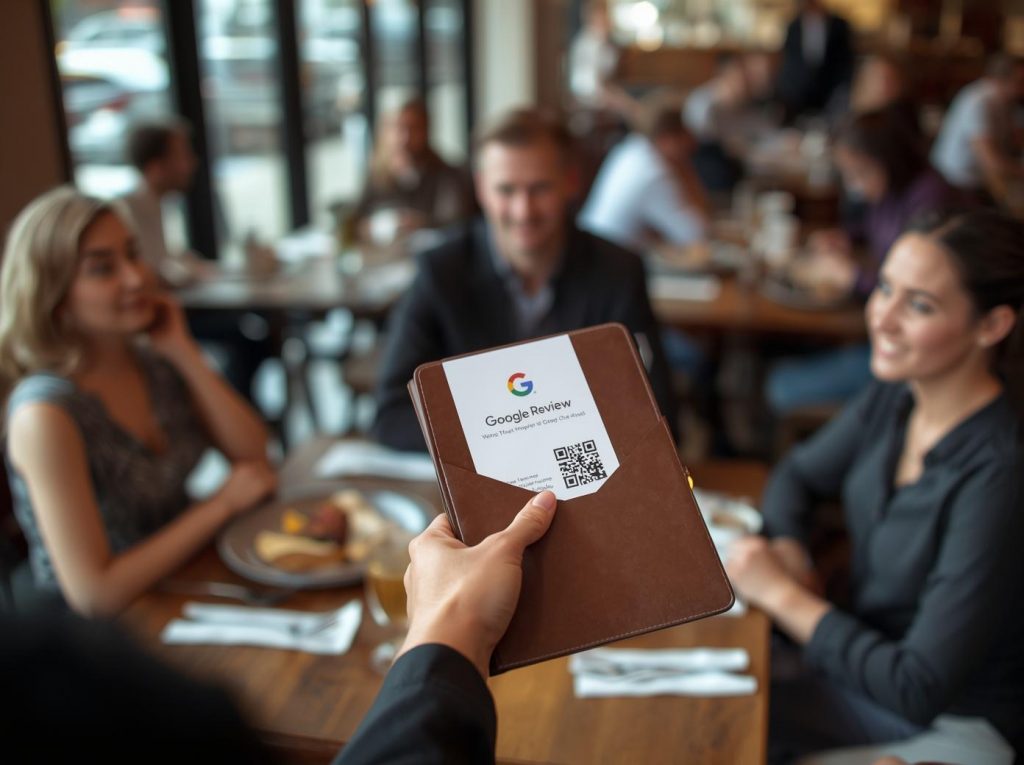
Dining decisions are almost entirely review-driven. Customers choose where to eat based on star ratings, recent comments, and photo evidence of actual dishes.
🔎 Where to place: Place the QR code on the back of menus, inside bill folders, or as table tent cards where customers can easily notice it.
😊 Highest-intent window: The best time to ask for a review is right after the meal, especially during payment, when the experience is still fresh.
📢 Pro tip: Use a simple and friendly CTA like “Enjoyed your meal? Rate us” to encourage quick action.
2. Salons and spas
Personal care is deeply trust-based. New clients almost always read reviews before booking, and a strong review profile is often the deciding factor between two equally-priced salons on the same street.
🔎 Where to place: Display the QR code at the billing counter, on appointment reminder cards, or near the exit for easy visibility.
😊 Highest intent window: The ideal time to request a review is immediately after the service, when the client is satisfied with the result.
📢 Pro tip: Encourage stylists or therapists to mention the review request verbally to increase participation.
3. Healthcare facilities
Hospitals, dental clinics, physiotherapy centers, and diagnostic labs operate in a trust-critical environment. Patients research heavily before committing to a provider, and a facility with detailed, positive reviews, particularly ones that mention specific staff or procedures, builds the kind of credibility that referrals alone cannot match.
🔎 Where to place: Add the QR code in waiting areas, on discharge summaries, or within follow-up emails sent after the visit.
😊 Highest intent window: The most effective moment is after the appointment or discharge, when the patient’s experience is complete.
📢 Pro tip: Keep the request gentle and optional to maintain trust and professionalism.
4. Home services (HVAC, plumbers, electricians, roofers)
This is one of the highest-value yet most underserved categories in the Google Review QR code conversation. Home service providers live and die by local search visibility and word of mouth. A plumber with 80 five-star reviews showing up in a ‘plumber near me’ search is essentially guaranteed the call.
However, the challenge is that technicians finish a job and leave. There’s no physical location where a QR code can be displayed. The solution is a mobile and print-based deployment.
🔎 Where to place: Include the QR code on invoices, job completion sheets, or provide a printed card after finishing the service.
😊 Highest intent window: The right time to ask is immediately after the job is completed and the customer is satisfied.
📢 Pro tip: Personally hand over a QR code card to make the request more direct and effective.
5. Professional services (Law firms, accountants, consultants, agencies)
For high-trust, high-consideration services, reviews function as referrals. A prospective client weighing two accounting firms will almost always choose the one with more detailed, credible reviews, even if both come recommended. Reviews that mention specific outcomes are especially powerful.
🔎 Where to place: Add the QR code to final invoices, thank-you cards, or email signatures for consistent visibility.
😊 Highest intent window: The best time to request a review is after a successful project or engagement has been completed.
📢 Pro tip: Combine the QR code with a personalized message to make the request feel more genuine.
6. Retail stores
Retail foot traffic is increasingly review-dependent. Shoppers on their phones will check ratings for a store they’re standing outside before deciding whether to enter. Stores with strong review profiles also see higher conversion from Google Maps discovery. Someone searching ‘stationery store near me’ is far more likely to click on a listing with 150 reviews than one with 8.
🔎 Where to place: Position the QR code at checkout counters, on shopping bags, or printed on receipts.
😊 Highest intent window: The ideal moment is immediately after purchase, when the customer leaves with a positive experience.
📢 Pro tip: Keep the QR code clearly visible and easy to scan at checkout to maximize responses.
7. Gyms and fitness studios
New gym-goers overwhelmingly rely on reviews before signing up for a membership. They want to know about equipment quality, class variety, staff friendliness, and whether the facility lives up to its marketing. A gym with a strong, recent review profile removes the hesitation that keeps many potential members from booking a trial.
🔎 Where to place: Display the QR code at the front desk, in locker rooms, or within onboarding materials.
😊 Highest-intent window: The most effective time is during the first few weeks of membership, when enthusiasm is highest.
📢 Pro tip: Focus on new members, as they are more likely to share positive early impressions.
8. Travel and hospitality (Hotels, tour operators, B&Bs)
Travelers read reviews obsessively. The hospitality sector generates more review activity than almost any other industry, which means standing still is falling behind. A hotel with 500 reviews and an average of 4.2 stars will outrank a competitor with 100 reviews and a 4.6 average in many search scenarios, simply due to volume and recency signals.
🔎 Where to place: Place the QR code at reception desks, inside rooms, or at tour completion points.
😊 Highest intent window: The best time to request a review is during checkout or at the end of the stay.
📢 Pro tip: Ask for feedback at checkout when the full experience is still fresh in the guest’s mind.
9. Real estate agencies
In high-value, low-frequency purchase decisions, trust is everything. Buyers and sellers choosing a real estate agent will read every available review. Detailed reviews that mention specific agents by name, describe the transaction timeline, and highlight communication quality are especially influential.
🔎 Where to place: Include the QR code in closing documents, on business cards, or in post-sale thank-you notes.
😊 Highest intent window: The ideal moment is right after the deal is successfully closed.
📢 Pro tip: A personal request from the agent significantly increases the chances of getting a review.
10. Educational institutions and coaching centers
Parents and students researching schools, colleges, tutoring centers, and coaching institutes rely heavily on peer reviews. A strong Google review profile, particularly one with detailed comments about teaching quality, results, and support, functions as a public testimonial board.
🔎 Where to place: Add the QR code to admission forms, ID cards, or communication newsletters.
😊 Highest intent window: The best time to ask is after results, achievements, or important milestones.
📢 Pro tip: Request reviews when outcomes are fresh, and satisfaction is high.
11. Heritage sites and museums
Cultural institutions benefit from review visibility in ways that many don’t actively pursue. Tourists and local visitors searching for ‘things to do near me’ rely heavily on Google’s local listings. And a heritage site or museum with strong, recent reviews ranks significantly better than one with sparse or dated feedback.
🔎 Where to place: Place the QR code at exits, on tickets, in guide booklets, or near exhibits.
😊 Highest intent window: The most effective time is at the end of the visit when the experience is complete.
📢 Pro tip: Position the QR code near exit points to capture immediate feedback.
12. Apparel and fashion retail
Apparel shoppers use reviews to validate fit, quality, and brand reliability before purchasing both in-store and online. For physical stores, a strong review profile attracts browsers who might otherwise scroll past in local search results.
🔎 Where to place: Include the QR code inside shopping bags, in fitting rooms, or at checkout counters.
😊 Highest intent window: The best time to request a review is after purchase or a positive trial experience.
📢 Pro tip: Use a simple prompt like “How did we do?” to make the request feel casual and easy.
QRCodeChimp: Built for managing Google reviews for local businesses
Any QR code linking to your Google review page will work. A well-designed one will perform significantly better.
QRCodeChimp allows local businesses to create branded, dynamic Google Review QR codes that align with their identity. You can customize colors, shapes, and CTAs so the code feels like a natural extension of your brand.
More importantly, the codes are dynamic. If your Google Business Profile link changes, you can update it without reprinting. For multi-location businesses, folder-based organization helps manage codes across branches. Built-in analytics provide visibility into scan performance by time, device, and location, so you can optimize placement over time.
Conclusion
For local businesses, Google reviews are not optional. They are a primary growth channel. They influence visibility, credibility, and ultimately, customer decisions.
The businesses that win are the ones that make review collection seamless and consistent. A Google Review QR code does exactly that. It removes friction, captures intent in real time, and turns satisfied customers into visible proof.
Deployed correctly, it doesn’t just collect reviews; it compounds trust, improves local rankings, and drives more customers through your door.
Frequently asked questions
Why are Google reviews important for local businesses?
Google reviews for local businesses influence both customer trust and local search rankings. Businesses with more positive and recent reviews are more likely to appear in Google’s local map pack and attract more customers.
How do Google reviews help win more customers?
They act as social proof. Most customers check reviews before making a decision, so a strong review profile increases credibility and improves conversion rates.
What is a Google Review QR code?
A Google Review QR code is a scannable code that takes customers directly to your review page, making it quick and easy for them to leave feedback.
Where should I place a Google Review QR code?
You can place it on receipts, menus, invoices, packaging, email signatures, or at checkout points anywhere customers complete their experience.
How can I get more Google reviews consistently?
Make the process simple and timely. Ask customers right after a positive experience and use tools like QRCodeChimp’s Google Review QR codes to reduce effort and increase response rates.
Do recent Google reviews matter more than older ones?
Yes. Recency is a key ranking factor, and most customers trust reviews from the past few weeks more than older feedback.
You may also like
Scaling Customer Reviews For A Multi-Location Auto Brand (Without Scaling Complexity)
Discover how a multi-location automotive brand increased Google reviews by 2.3× using bulk QR codes. A real-world use case on scaling review collection efficiently.
Most Popular
Contact Sales