Fake pesticides aren’t just a nuisance; they’re a serious threat to farmer safety and food security. According to the Ministry of Agriculture and Farmers Welfare, in 2024 alone, 2.75% of pesticide samples tested across India were found to be spurious.
To address this growing concern, the government has introduced the Insecticides (First Amendment) Rules, 2025, which make QR codes mandatory on all insecticide labels. These smart labels provide users with instant access to crucial product details — from manufacturing data to safety instructions — with just a scan.
Alongside QR codes, the updated rules also require clear usage guidelines, safety warnings, and customer care contact information on every package. The goal? To boost transparency, combat counterfeiting, and help farmers make safer, more informed choices.
Let’s unpack how this digital upgrade is set to transform India’s agrochemical landscape.
Key details of the new mandate
The following are the key amendments to insecticide packaging and labeling rules:
Insecticide packages must now be categorized into “big,” “small,” and “ultra small” based on their net content.
Labels should be printed in both Hindi and English, as well as in additional regional languages specific to the area of sale.
Each package should include a leaflet with complete product information, usage directions, and safety instructions.
Each label must display customer care numbers and a QR code linked to product details, such as manufacturing and expiry dates, unique identifier/GTIN, batch number, and license information.
Packages must clearly indicate the intended use of the chemical, such as “for Pest Control Operators,” “For Agricultural Use,” or “For Household Use.”
Statutory warnings like “Destroy the container after use as directed on the leaflet” must be printed on each insecticide container.
📌 Manufacturers must comply with the updated rules within six months of their commencement. After 30 months from the commencement date, the sale of non-compliant products will be prohibited.
Why was this shift needed?
The India insecticide market is projected to reach a valuation of USD 2.19 billion by 2030. While the market is growing at a rapid and consistent pace, it does face several challenges. The rise of counterfeit or substandard agrochemicals not only impacts crop yields but also endangers consumer health. Plus, a lack of product transparency and traceability hinders market growth.
The updated insecticide rules, however, reflect the government’s push to increase farmer awareness, eliminate counterfeiting, and strengthen the agricultural supply chain. The QR code mandate, particularly, highlights how this move aligns with the government’s ‘Digital India’ mission, making farmers and consumers more informed and connected today.
With QR codes on insecticide labels, they have a wealth of information — ranging from batch numbers to toxicity information — always at their fingertips. This ensures safer pesticide use and enables users to distinguish between authentic and fake products. Besides, it helps authorities track the movement of agrochemicals through the supply chain, ensure compliance, and respond promptly to quality violations.
💡 Facts & trivia
India’s new reform in insecticide rules mirrors similar initiatives undertaken by countries like Brazil and China. In June 2025, Brazil’s Ministry of Agriculture, Livestock, and Food Supply (MAPA) mandated the use of traceability identifiers, including QR codes and RFID tags, on pesticide packaging under the National Pesticide Traceability Program (PNRA). The move aims to ensure traceability throughout the logistics chain, prevent counterfeits, and enhance food safety.
In May 2025, China’s Ministry of Agriculture and Rural Affairs (MARA) issued a draft notification seeking public opinion on updated pesticide labeling requirements. As per the proposed rules, pesticide formulations must indicate the manufacturer’s name, product registration certificate number, and other traceability-related information via an electronic information code, such as a QR code.
What are the benefits of QR code labelling on insecticides?
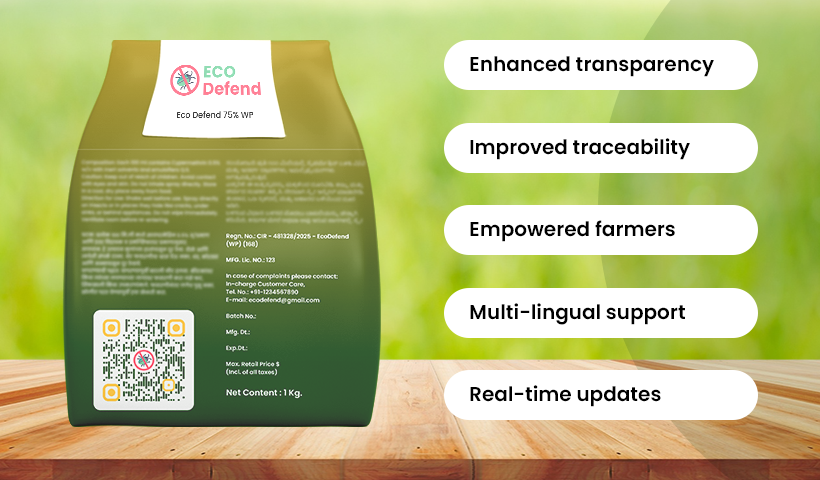
🔎 Enhanced product transparency
QR codes on insecticide labels link to product details, such as manufacturing date, registration number, GTIN, active ingredients, recommended dosages, expiry dates, and safety certifications. With a simple scan, farmers, retailers, or consumers can view this information, verify the product’s authenticity and quality, and hence, prevent counterfeits.
🚚 Improved traceability and supply chain visibility
Adding QR codes to insecticide labels improves product traceability and visibility across the supply chain. With a simple scan, users can instantly access key details that help them track each product, right from manufacturing to the point of sale. This enhanced traceability also helps regulatory authorities track product movement, identify potential bottlenecks, and prevent counterfeit or non-compliant products from reaching the market.
👉 Also read: QR Codes for Supply Chain Management.
👨🌾 Empowered and more informed farmers
Increased product transparency empowers farmers to make better, more informed decisions in the field. By scanning QR codes on insecticide labels, they can quickly access crop-specific recommendations, usage instructions, and safety precautions. It reduces their reliance on local sellers for critical information, which is often incomplete or inaccurate.
🗣️ Bridging language barriers
Many farmers across rural India are still unfamiliar with or struggle to use the English language. To help them effectively use the products, manufacturers can link the QR codes to digital content like how-to videos, localized instructions, or visual guides in Hindi or other regional languages.
⚙️ Real-time updates
Unlike printed labels on insecticide packaging, the content linked to QR codes can be updated as required. However, this is only possible with dynamic QR codes. These codes enable manufacturers to update the content whenever there are changes in usage instructions or safety information, and provide farmers with current and accurate product information.
🧐You may also like: 6 Most Effective Pest Control Marketing Strategies to Generate Leads.
Measures to overcome barriers to QR code adoption in rural areas
While QR code labeling on insecticides offers various benefits, it also poses several challenges, especially for farmers with poor digital literacy and limited internet access in rural areas.
Here are some effective measures the government can take to help overcome these barriers.
✅ Conduct training programs and workshops to guide farmers on how to use smartphones, scan QR codes, and utilize various digital agricultural content.
✅ Provide multilingual toll-free helplines or customer care numbers printed alongside QR codes to allow farmers to call and seek assistance with using the QR codes.
✅ Expand the internet infrastructure in rural India, particularly in high-farming zones, to ensure farmers have high-speed connectivity for accessing QR-linked information and other digital services.
✅ Ensure that product labels with QR codes are always paired with printed instructions to make essential information accessible to farmers without smartphones or internet access.
QR code solutions manufacturers can use for insecticide labelling
QRCodeChimp offers a comprehensive suite of solutions that insecticide manufacturers or brands can leverage to embed valuable product information directly into their labels. Take a look at the solutions that are a perfect fit for this use case.
| QR code solutions | Potential uses |
|---|---|
| URL QR code | Links directly to a website or a dedicated web page containing detailed information, such as product specifications, crop-specific dosage guidelines, recommended usage instructions, hazard classifications, storage requirements, and more. |
| Image gallery QR code | Displays visual guides or infographics explaining application methods, safety tips, etc. |
| YouTube QR code | Links to instructional/how-to videos on pesticide usage, crop-specific application, or precautionary steps on YouTube. |
| PDF QR code | Provides instant access to downloadable product guides or manuals, regulatory certificates, and safety data sheets. |
| Text QR code | Directly displays essential product details such as batch number, registration information, or customer care contact numbers, without requiring an internet connection. |
| vCard Plus | Redirects to a personalized landing page featuring contact information, including phone numbers and email addresses, of the manufacturer, local distributors, or customer support teams. |
| Feedback QR code | Links to a feedback form where users can provide instant feedback on product performance or packaging quality, and leave their thoughts or suggestions to help brands improve their products. |
| WhatsApp QR code | Directs to the brand’s WhatsApp business chat, where users can make inquiries, report issues, and request support in local languages, and get real-time responses. |
| App download QR code | Redirects to specific mobile apps on the Google Play Store or Apple’s App Store, encouraging users to install them for enhanced engagement. |
Conclusion
India’s QR code mandate for insecticide labelling marks a bold step towards a smarter, safer agricultural value chain. It mirrors many similar initiatives underway in countries like Brazil, China, the U.S., and the EU. QR codes are becoming the norm in today’s tech-driven agriculture, and India is positioning itself as a global leader in responsible farming by embracing this digital shift.
QRCodeChimp offers a beginner-friendly QR code generation platform for manufacturers adapting to new insecticide regulations. The platform enables them to create and manage QR codes for insecticide labels at scale, and offers robust features such as real-time updates and seamless tracking.
Frequently asked questions
What information do the QR codes on insecticide labels redirect to?
Upon scanning, these QR codes typically redirect to product details, such as manufacturing date, registration number, batch number, usage instructions, and safety guidelines.
Who needs to comply with the new regulations for insecticide labelling?
All insecticide manufacturers, distributors, and marketers in India must comply with the new regulations for insecticide labeling.
How will the new QR code mandate benefit farmers and consumers
By scanning QR codes on insecticide labels, they can instantly access comprehensive product information, which will help them make informed decisions and identify counterfeit or unsafe products.
You may also like
Best Digital Business Card Makers for 2026 – Secure, Enterprise, and Scalable
Discover the best digital business card platforms for 2026. Compare the top 8 solutions with features like branding, CRM integration, analytics, and enterprise-grade security to find the right fit for your team or business.
How a Consumer Electronics Brand Fixed Its Post-Purchase Gap Using Form QR Codes
Learn how a consumer electronics brand improved warranty registration and post-purchase engagement using Form QR Codes. Discover the strategy, implementation, and results.
When Excel Broke: How QRCodeChimp Simplified Digital Business Cards for a Fast-Growing IT/ITES Enterprise
Discover how a fast-growing IT/ITES enterprise replaced Excel uploads with QRCodeChimp’s form-based automation to create branded digital business cards faster, with HR control.
How to Build Meaningful Connections at Conferences
Build meaningful connections at conferences with these practical networking tips. Learn how to start authentic conversations, follow up, and nurture professional relationships.
Most Popular
Contact Sales