Yes, QR codes are effective for marketing when they give people a clear reason to scan and lead to a useful, mobile-friendly experience. The research behind that answer is stronger than many marketers realize.
Consumers are already scanning: 68% of US adults used a QR code in the past year, rising to 83% among Gen Z. In a randomized experiment, adding a QR code alongside the URL on mailed invitations lifted response rates from 7.00% to 8.31%. And 79% of shoppers say they are more likely to buy a product when a scannable code provides the information they want.
What the research does not support is the shortcut version of that claim. Adding a QR code to an advertisement, package, poster, or brochure does not automatically make the campaign successful. A scan indicates interaction, but it does not prove that the campaign generated a lead, sale, registration, or other meaningful result. The campaigns that work share a set of conditions — and they are all within a marketer’s control:
- The value offered to the person scanning
- The placement and visibility of the QR code
- Trust in the brand and destination
- The speed and quality of the post-scan experience
- The number of steps required to complete the action
- The metrics used to evaluate the campaign
This article examines what current consumer surveys, academic studies, and experimental research reveal about QR code effectiveness and explains how to run and measure campaigns that deliver results beyond the number of scans.
- What does QR code marketing effectiveness mean?
- What current research says about QR code effectiveness
- Where are QR codes most effective?
- How do companies measure QR code marketing effectiveness?
- What QR code research does not prove
- How to improve QR code campaign results
- So, are QR codes effective for marketing?
- Frequently asked questions
What does QR code marketing effectiveness mean?
A QR code connects a physical interaction with a digital destination. It can take someone from product packaging, an event display, a direct mail piece, or an in-store sign to a website, form, offer, video, payment page, or digital profile.
Its effectiveness should therefore be evaluated by what happens at each stage of that journey.
A QR code campaign may generate:
- Visibility without scans
- Scans without meaningful engagement
- Engagement without conversion
- Leads or other actions without immediate revenue
- Purchases, bookings, registrations, or repeat interactions
Each of these stages can be measured. That is what sets QR codes apart from most offline marketing: a plain advertisement, package, or poster offers no reliable way to know who engaged with it, while a QR code makes every step after the scan trackable.
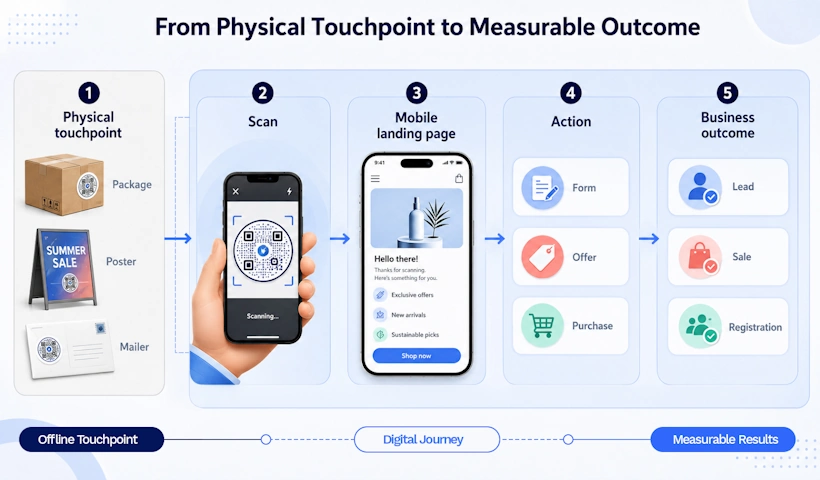
The right success metric depends on the campaign objective. For example, a product-information campaign may focus on page engagement, while an event campaign may measure registrations or ticket claims. A lead-generation campaign should track completed forms and qualified leads rather than total scans alone.
What current research says about QR code effectiveness
✔ Consumers use QR codes when they serve a clear purpose
QR codes are now familiar to a large part of the consumer population.
In 2024, TEAM LEWIS surveyed 1,000 demographically balanced adults across the United States. The study found that 68% had used a QR code during the previous year. Usage was higher among Gen Z respondents at 83% and millennials at 81%.
The most frequently reported uses were:
- Viewing restaurant menus: 48%
- Downloading mobile applications: 47%
- Accessing product information: 43%
- Connecting to Wi-Fi: 32%
- Accessing event tickets: 31%
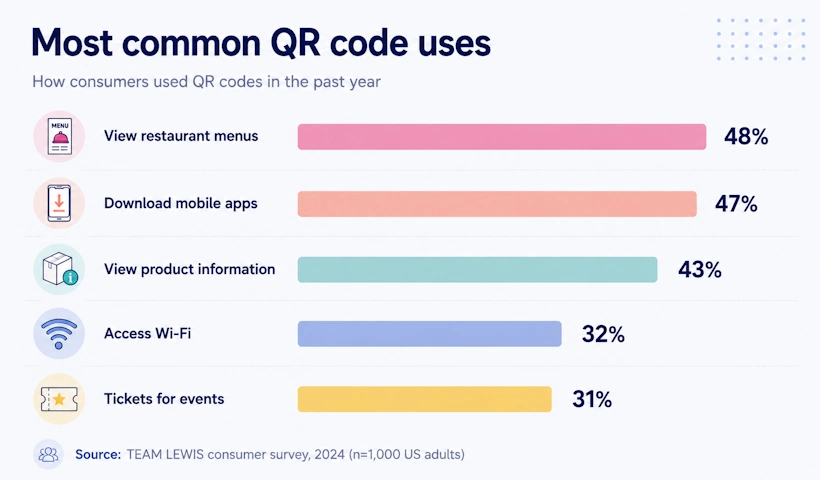
These use cases have one characteristic in common: the person scanning knows what they will receive. The QR code removes steps from an action they already want to complete.
This indicates that QR codes are generally more useful when the surrounding message offers a specific outcome, such as “View product details,” “Get your ticket,” or “Download the app,” rather than a vague instruction such as “Scan here.”
✔ Usefulness and convenience influence adoption
Research has repeatedly linked QR code adoption with perceived usefulness and convenience.
A 2018 study published in the International Journal of Engineering Business Management analyzed responses from 420 people in China who had purchased a product online through a QR code. The researchers found that perceived usefulness, feasibility, and acceptability influenced the participants’ experience, which was then associated with customer satisfaction and purchase intention.
The study should not be interpreted as proof that any QR code increases sales. It examined a self-selected group of people who had already used QR codes for online purchases. However, it supports an important principle: a QR code is more likely to contribute to a positive result when people find it practical, usable, and relevant to the action they are taking.
More recent research reached a similar conclusion in a specific retail context.
A 2024 study involving 996 consumers in Vietnamese supermarkets examined the intention to use QR codes for payments and product traceability. It found that perceived usefulness, attitude, customer satisfaction, and supply-chain transparency positively influenced the intention to use QR codes.
The findings suggest that consumers are more willing to engage when a QR code provides a functional benefit, such as simplifying payment or helping them understand where a product came from.
✔ People need a reason to scan
A QR code competes with other calls to action for a customer’s limited attention. The surrounding message should therefore explain what the person will gain.
A 2019 study published in the Journal of Business Research examined how curiosity, visual complexity, and perceived fit affect QR code scan intention. Highly curious consumers responded more positively to visually complex advertisements. For consumers with lower curiosity, a strong fit between the QR code advertisement and the brand helped offset the negative effect of visual complexity and was associated with greater scan intention.
TEAM LEWIS also recommends supporting QR codes with a clear call to action and a useful destination.
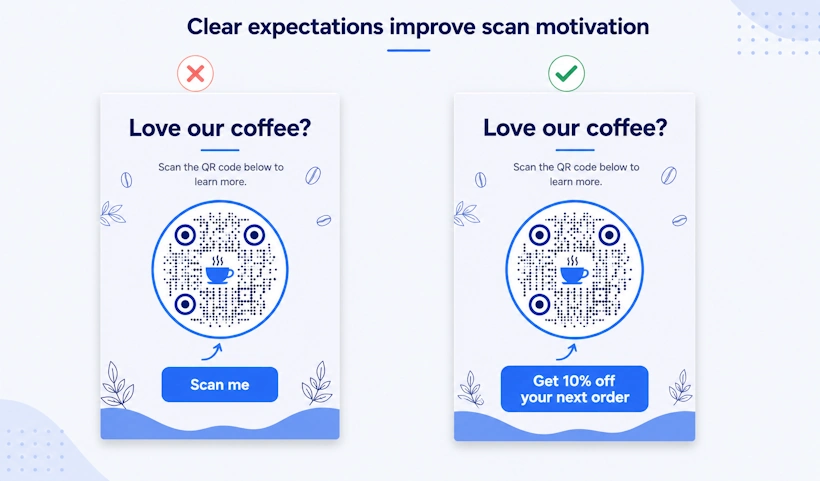
Both findings reinforce a practical campaign principle: the value of scanning should be visible before the interaction begins.
A call to action should set a clear expectation, such as:
- View ingredients and allergen information
- Get 10% off your next order
- Watch the setup video
- Register for the event
- Download the product guide
- Share your feedback
The QR code provides access. The promised value creates motivation.
✔ The post-scan experience can strengthen or weaken results
Getting someone to scan is only the beginning. A campaign can still fail if the destination loads slowly, is difficult to use, or does not deliver what the surrounding message promised.
The TEAM LEWIS consumer survey found that:
- 28% considered slow loading a problem.
- 33% wanted an easier user experience.
- 29% wanted companies to make QR codes safer and more secure.
The survey concluded that businesses should provide an intuitive, secure experience supported by a clear call to action.
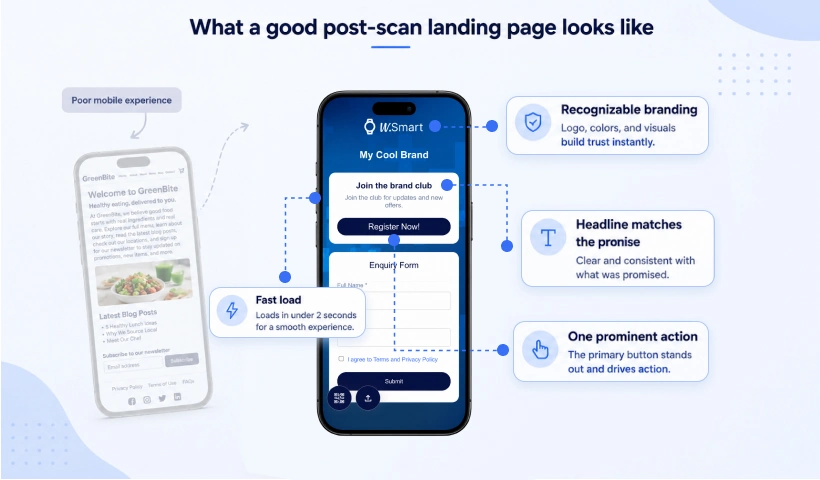
A QR code that opens a desktop-oriented page, a generic homepage, an expired offer, or an unrecognizable domain can introduce friction instead of removing it.
For stronger results, the destination should:
- Load quickly on mobile devices
- Match the promise made beside the QR code
- Display the main action prominently
- Avoid unnecessary navigation
- Use recognizable branding
- Request only the information needed
- Confirm when the user completes the action
✔ Product information can influence purchase decisions
Packaging has limited physical space, while shoppers may want detailed information about ingredients, instructions, sourcing, sustainability, safety, or product authenticity.
A 2024 GS1 US consumer survey found that 77% of surveyed consumers considered product information important when making a purchase. It also found that 79% said they were more likely to buy a product when a scannable barcode or QR code provided the additional information they wanted.
This is a measure of stated purchase likelihood, not observed sales. Still, it shows why connected packaging is a strong QR code use case: the code can provide useful information precisely when the shopper is evaluating the product.
💡For broader adoption, market, payment, and packaging data, see these QR code statistics for 2026.
✔ Speed and convenience matter in QR code payments
The factors influencing payment adoption may not apply equally to every marketing campaign, but payment research reinforces the importance of reducing friction.
A 2024 study of QR-enabled mobile payment adoption analyzed responses from 216 smartphone users in Saudi Arabia. Perceived usefulness, ease of use, convenience, social influence, and innovativeness collectively explained 52.3% of the variation in consumer attitudes. Attitude and transaction speed explained 55% of the variation in adoption intention.
The findings do not establish a universal conversion benchmark. They indicate that convenience and speed can meaningfully influence whether people intend to use a QR-based payment method.
The same principle applies more broadly: every unnecessary step between the scan and the intended action creates another opportunity for abandonment.
✔ QR codes can increase response to a defined action
Experimental evidence also suggests that QR codes can increase participation when they shorten the path to a clearly defined action.
In a randomized study published in 2024, researchers randomly assigned 5,500 residential addresses to receive mailed survey materials containing either a URL only or a URL plus a QR code. The materials containing a QR code produced an 8.31% response rate, compared with 7.00% for the URL-only version, a statistically significant difference.
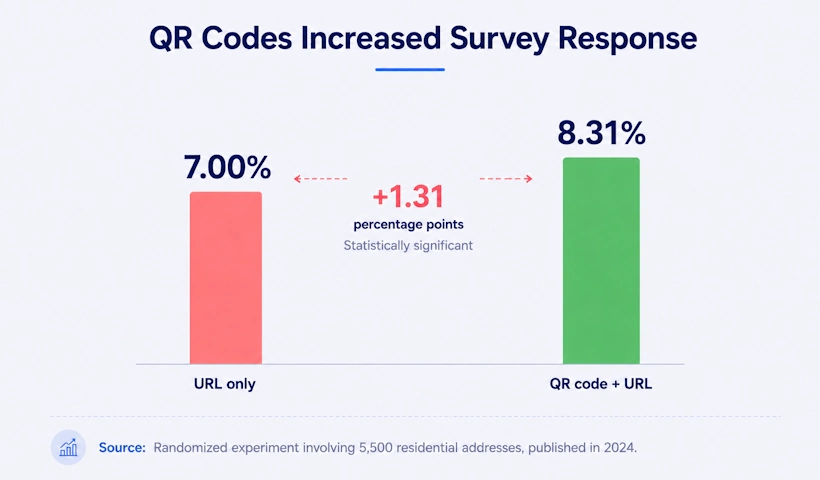
The study did not test call-to-action wording, but it provides stronger evidence than surveys alone that a QR code can make a clearly defined action easier to complete.
Where are QR codes most effective?
Research does not support one universally best QR code placement. Effectiveness depends on the customer’s situation and the action being offered.
QR codes are generally strongest in contexts where they shorten an otherwise inconvenient journey.
✅ Product packaging
A code can provide instructions, sourcing information, product details, videos, warranty registration, support, or offers without crowding the package.
✅ Events and physical venues
Attendees can use QR codes to register, access schedules, claim tickets, submit questions, download materials, or provide feedback while already engaged with the event.
✅ In-store displays
A code can connect shoppers with product comparisons, stock information, demonstrations, reviews, or promotions at the point of consideration.
✅ Print and direct mail
QR codes can make offline materials measurable by directing each placement or campaign variation to a trackable digital destination.
✅ Forms and lead capture
A form QR code can help people submit inquiries, registrations, feedback, or contact information without typing a web address. The form should remain short enough for the context in which it is being completed.
✅ Repeatable customer actions
QR codes can simplify actions such as reordering a product, accessing support, joining a loyalty program, downloading an application, or making a payment.
💡For detailed campaign applications and placement guidance, refer to the QR code marketing guide.
How do companies measure QR code marketing effectiveness?
Measurement is a core part of the business case for QR codes. They turn offline placements — packaging, mail, signage, print — into channels with digital-grade analytics.
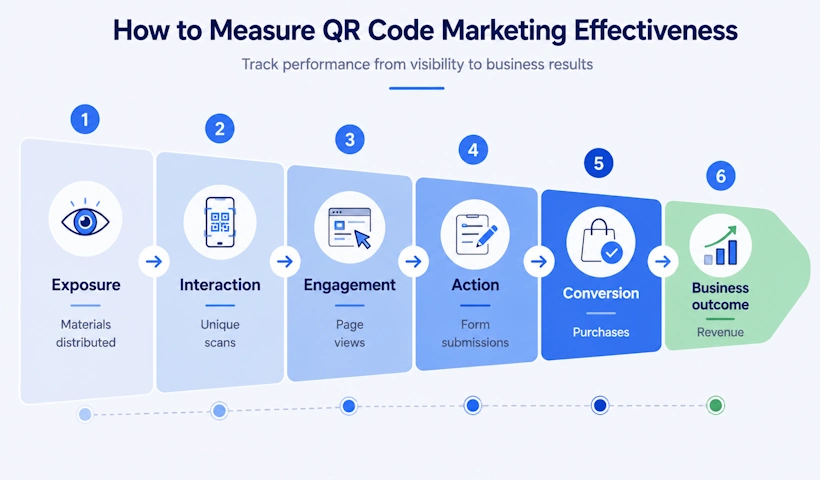
To use that capability well, companies should measure QR code campaigns as a funnel rather than judging them by a single number.
| Measurement stage | Examples |
|---|---|
| Exposure | Estimated people who saw the package, poster, mailer, display, or advertisement |
| Interaction | Total scans, unique scans, and repeat scans |
| Engagement | Page views, time on page, button clicks, video views, and downloads |
| Action | Form submissions, registrations, coupon claims, contact saves, or app installs |
| Conversion | Qualified leads, completed bookings, redemptions, or purchases |
| Business outcome | Revenue, acquisition cost, cost savings, retention, or return on campaign spend |
👉 Track unique scans, not only total scans
One device may scan the same code several times. Total scans can therefore overstate the number of distinct devices that interacted with the campaign.
Unique scans provide a better estimate of the number of distinct devices that scanned the QR code. They should not be treated as an exact count of individual people, since one person may use multiple devices and several people may share one device.
Repeat scans can reveal continuing interest or repeated utility. Both metrics can be useful, but they answer different questions.
👉 Measure the post-scan journey
QR code analytics can show when and how often a dynamic QR code was scanned, along with device information and approximate location data. Businesses should connect that information with analytics on the destination page.
Use campaign-specific links and UTM parameters to identify:
- Which QR code generated the visit
- Where the code was placed
- Which creative or offer was used
- What the visitor did after arriving
- Whether the visit resulted in a conversion
This is particularly important when the same landing page is promoted through several offline placements.
👉 Compare results with exposure
When campaign exposure can be estimated, businesses can calculate an estimated unique-device scan rate:
Estimated unique-device scan rate = unique scans ÷ estimated exposure × 100
Exposure may be based on the number of packages distributed, mailers delivered, event attendees, printed materials handed out, or estimated display views.
This calculation is imperfect because seeing a printed item does not mean that the person noticed the QR code. However, it provides more context than reporting scans alone.
👉 Connect scans with business outcomes
Scan counts alone can hide the real result. A campaign with fewer scans may be more successful if those scans produce more qualified leads or purchases.
A 2022 hospital pilot study published in Vaccines illustrates this kind of measurement. Across six outpatient departments, 351 users generated 529 QR code scans and spent an average of 1 minute and 4 seconds reading the linked health information. Among users who remained on the page, 32% selected the “Talk to my doctor” call to action. The researchers also observed more scans when a clinical research associate was present to explain the study and encourage patients to scan, suggesting that passive placement alone may not be enough.
The study was limited to one healthcare setting and did not compare different calls to action, so the 32% figure is not a universal benchmark. However, it shows why businesses should measure what people do after scanning rather than treating the scan itself as the final result.
Businesses should define the intended outcome before launching the campaign and configure the destination and analytics accordingly.
When a QR code leads to a registration, survey, inquiry, or feedback form, it can also help a business collect customer-provided information.
💡Learn more about the role and collection of first-party data.
What QR code research does not prove
Research on QR code adoption and effectiveness has important limitations.
❌ Purchase intention is not the same as a purchase
Some studies measure whether people intend to use a QR code or buy a product rather than tracking completed transactions. These findings are useful for understanding consumer attitudes, but businesses should measure actual campaign outcomes wherever possible.
❌ Results may vary by audience and context
Research conducted in one country, industry, or setting may not predict performance in every campaign. A QR code used on product packaging may produce different results from one used at an event or in direct mail.
❌ Scans do not prove business impact
A scan shows that someone interacted with the QR code, but it does not confirm that the campaign generated a lead, registration, purchase, or other meaningful result. Businesses should track the actions that follow the scan.
How to improve QR code campaign results
Research and campaign measurement point to several practical principles.
👉 Give people a specific reason to scan
State what the user will receive or be able to do. Avoid placing an unexplained code beside a generic “Scan me” instruction.
👉 Match the destination to the context
Someone scanning product packaging may want product information or support. Someone at an event may want a ticket, schedule, or registration form.
Do not send every audience to the company homepage.
👉 Reduce the number of steps
Take the user directly to the intended content or action. Avoid unnecessary menus, account creation, or repeated information requests.
👉 Optimize the destination for mobile devices
Use readable text, accessible buttons, short forms, and fast-loading images. Test the entire journey on different screen sizes before printing or distributing the QR code.
👉 Build trust around the code
Use recognizable branding, explain the destination, and avoid placing codes where they could be easily replaced or tampered with.
👉 Use a dynamic QR code for measurable campaigns
A dynamic QR code lets businesses track scan activity and update the destination without replacing the printed code. It also allows separate codes to be created for different placements or campaign variations.
👉 Measure the intended outcome
Do not stop at scans. Track whether people completed the action the campaign was designed to generate.
So, are QR codes effective for marketing?
Yes, QR codes can be effective when they reduce friction between a physical interaction and a valuable digital action.
The strongest evidence is experimental: in a randomized study, adding a QR code to mailed invitations produced a measurable, statistically significant lift in response. Around it, research consistently points to usefulness, convenience, transparency, speed, trust, and customer satisfaction as the influences on QR code adoption, and consumer surveys show that people expect codes to load quickly, feel safe, and deliver a clear benefit.
But the QR code itself is not the campaign.
A successful campaign needs the right audience, placement, call to action, destination, offer, and measurement system. Businesses that evaluate downstream actions instead of relying only on scan totals will have a much clearer picture of whether their QR code marketing is working.
QRCodeChimp helps businesses create customizable dynamic QR codes, manage campaigns, and view scan analytics from one platform.
Frequently asked questions
Are QR codes still effective for marketing?
QR codes can be effective because they let people move from physical materials to digital content without entering a web address. Their effectiveness depends on whether the campaign provides a clear benefit and a smooth post-scan experience.
How do companies track the effectiveness of QR code marketing?
Companies can track total and unique scans, scan time, approximate location, device information, page engagement, form submissions, coupon redemptions, leads, purchases, and revenue. The most important metrics depend on the campaign objective.
What is a good QR code scan rate?
There is no universal good scan rate. Results vary by placement, audience, visibility, incentive, code size, campaign duration, and the accuracy of the exposure estimate. Businesses should establish their own benchmarks across comparable campaigns.
What makes people scan a QR code?
People are more likely to scan when the surrounding message explains what they will receive, such as product information, an offer, a ticket, instructions, a form, or exclusive content.
Do more QR code scans mean a campaign was successful?
Not necessarily. High scan volume indicates interaction, but the campaign may still produce few meaningful actions. Evaluate engagement, conversions, and business outcomes alongside scan totals.
You may also like
How to Prepare Your GS1 QR Codes for Targeted Product Recalls
Learn how GS1 QR Codes can support batch-level and item-level product recalls, and use a 7-step mock recall to test whether your systems are ready.
Top 10 Free QR Code Generators to Help You Market in 2026
The most important aspect of using QR codes for your business is selecting the right QR code generator. Here are ten free QR code generators to help you get started.
How to Create and Manage White Label Merchandise?
Learn the step-by-step process to create and manage customized white label merchandise like digital business cards, pet tags, and medical alerts using QRCodeChimp.
QR Code Surveys: How to Get People to Scan and Respond
A QR code survey makes feedback easier to access, but the code alone doesn't generate responses. This guide explains how to create a QR code survey that earns the scan and keeps respondents moving to submission.
Most Popular
Contact Sales