Ingredients, allergens, origin, recipes – it’s all there in one scan. Here’s why the food industry is paying attention to the GS1 Digital Link revolution.
Walk through any supermarket today, and you’ll notice something has changed in consumer behavior. The shopper next to you is inspecting each and every detail printed on a jar of pasta sauce before tossing it into the cart. 🧐
The one ahead is scanning a QR code on a wine bottle instead of just flipping it over to check the price and expiry date.
They’re not looking for a discount. They’re looking for information, and expect the packaging to provide it instantly.
This expectation is now colliding with a global industry reckoning. GS1 Sunrise 2027 is preparing retailers worldwide to support GS1-standardized 2D barcodes at the point of sale. And at the center of that shift is the GS1 QR code, built on the GS1 Digital Link standard.
For food and beverage brands specifically, a QR code for food products changes what a label can say, what a scan can do, and what a shopper can know before an item ever leaves the shelf.
Key Takeaways:
- GS1 QR codes enable full food transparency.
- Dynamic updates prevent costly reprints.
- Batch-level traceability aids quick recalls.
- Sunrise 2027 drives global 2D barcode adoption.
- QRQRCodeChimp simplifies GS1 compliance at scale.
The traditional barcode wasn’t built for this moment
For fifty years, the humble 1D barcode only told a checkout scanner what the product was and how much it cost. That was enough in 1974. Today, it falls spectacularly short.
Consumers want to know whether a sauce contains tree nuts, whether the olive oil is actually from where it claims to be, and what the sustainability credentials behind a brand’s packaging actually mean, right from the pack. A QR code for food products is increasingly the most direct way to give them all of that, but only if the code is built to carry it.
A traditional barcode stores 12 characters – your GTIN and nothing else. A GS1 QR code, built to the GS1 Digital Link standard, can store up to 7,000 characters in a space smaller than a postage stamp. It can encode your GTIN, batch number, expiry date, country of origin, allergen declarations, and a live URL that links to a product page you can update at any time, without reprinting a single label.
That’s a fundamentally different kind of label.
What GS1 QR codes actually unlock for food brands
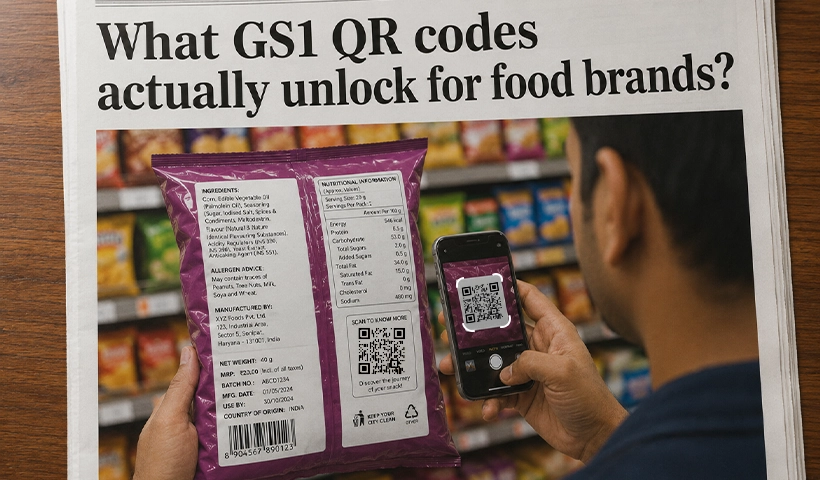
When a food or beverage brand uses food labels with QR codes using the GS1 Digital Link standard, a single scan surfaces an entire ecosystem of product information.
Think of GS1 Digital Link as a web address structured in a standard way, so that both a supermarket checkout scanner and a customer’s smartphone camera can read the exact same code, but receive different, relevant information based on context.
As shown in the architecture below, the GS1 Digital Link acts as a ‘traffic controller.’ While a supermarket scanner extracts the SKU for checkout, a consumer’s phone is routed to a rich, context-aware landing page – all from the same square.
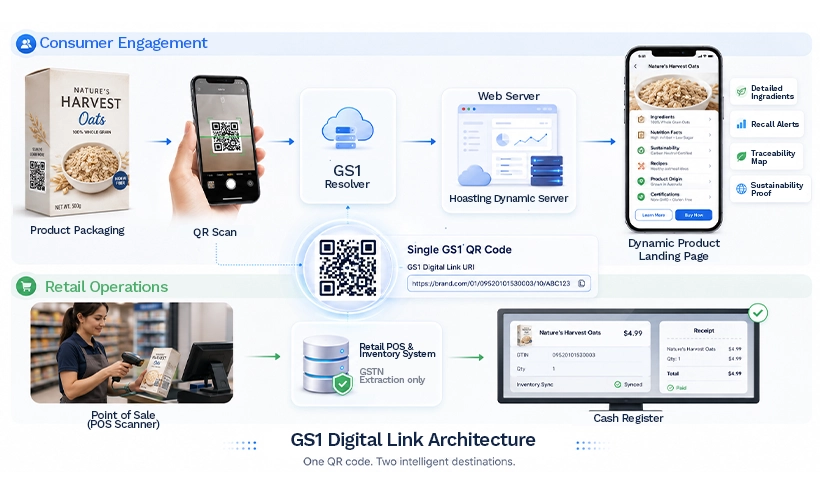
Here is what that looks like across the four operational areas where transparency matters most:
Safety, ingredients, and real-time agility
For the 33 million Americans and an estimated 17–26 million Europeans living with food allergies, according to a 2023 meta-analysis published by the European Academy of Allergy and Clinical Immunology, allergen disclosure is essentially a safety feature.
The EU’s Food Information to Consumers regulation already mandates allergen disclosure; similar frameworks are expanding globally.
A GS1 Digital Link QR code links to a complete, regularly updated ingredient list. Critically, its dynamic nature allows for real-time formulation updates. If a supply chain disruption forces a business to switch from sunflower oil to soybean oil, the digital ingredient list can be corrected immediately. This avoids costly reprints, over-stickering, and any period of consumer risk.
Origin, traceability, and the regulatory pressure building around it
Whether a brand is communicating the specific farm a coffee bean came from, or the fishing region for a seafood product, a GS1 QR code creates a verifiable digital thread from source to shelf. The regulatory backdrop here is becoming impossible to ignore.
In the US, the FDA’s FSMA Rule 204 (Section 204 of the Food Safety Modernization Act) requires companies handling high-risk foods on the Food Traceability List to make electronic records available to the FDA within 24 hours of a request.
A Lot Number encoded as Application Identifier 10 in a QR code for food products enables a brand to pull its entire chain of custody during an audit instantly. It also transforms recall management. Instead of a blanket public notice, a brand can update the destination link so that scanning an affected batch immediately surfaces a “DO NOT CONSUME” warning. In contrast, unaffected batches continue to show recipes and origin stories.
Meanwhile, the EU’s Digital Product Passport (DPP) framework under the Ecodesign for Sustainable Products Regulation will roll out phased requirements between 2026 and 2030 across priority product categories. GS1 Digital Link is already recognized as a valid product-identifier pattern under the ESPR standard. While food is currently outside the initial DPP scope, the direction of regulatory travel globally is unmistakable. Structured, scannable, verifiable product data is becoming the baseline expectation.
Recipes and usage content – the commercial opportunity
An ingredient on a shelf becomes a starting point when a QR scan delivers three recipe ideas, a video tutorial, or a pairing guide. This is the kind of connected packaging content that deepens brand relationships and turns a product page into a content experience without adding a single printed word to the box. The scan data from this content also shows which products people research before buying, and which recipes are actually driving repeat purchases.
Personalization and closing the loop
Because GS1 Digital Link allows for contextual redirection, a shopper in Mumbai can see ‘Veg/Non-Veg’ certification prominently, while the one in London sees carbon-neutral credentials. As sustainability regulations tighten, brands can use QR codes to provide localized recycling instructions based on the user’s location, something no physical label can do cost-effectively at scale.
GS1 Sunrise 2027: The shift already underway
GS1 Sunrise 2027 is the global industry initiative driving retailers and brands toward support for GS1-standardized 2D barcodes at the point of sale, including GS1 QR codes built on the Digital Link standard. The goal is to ensure that by 2027, retail systems worldwide can scan and process 2D barcodes alongside traditional 1D barcodes.
Pilots are already active in 48 countries, representing 88% of global GDP. Major industry players, including Unilever and Procter & Gamble, are undertaking large-scale 2D barcode initiatives. In the UK, Tesco has begun live trials focused on date-code accuracy, food waste reduction, and improved consumer product information.
For food and beverage companies, the operational implications are significant. Products with pre-printed packaging may need label redesigns, while fresh-food manufacturers can begin incorporating dynamic expiration dates and batch-level traceability into real-time labeling workflows. The industry is moving toward a future in which food labels with QR codes and traditional 1D barcodes coexist.
That transition also brings practical packaging considerations. Maintaining adequate spacing between the two codes is important, as POS scanners need clear sight lines to avoid reading both symbols during a single scan.
What a smart implementation of the GS1 QR code for food packaging looks like
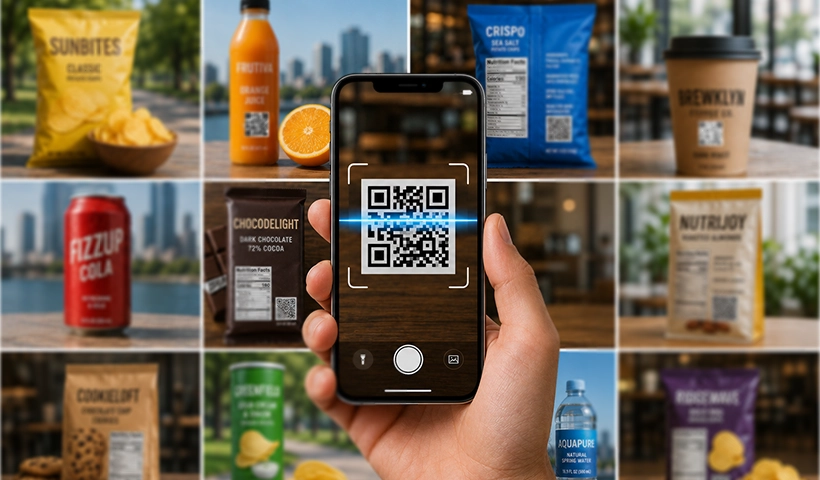
The brands getting this right share a common thread. They’re treating a QR code for food products as a customer communication channel instead of a compliance checkbox – a standard that turns a product identifier into a live, updatable web address.
Practically, that means building the QR code correctly so scanners can identify details like expiry dates and batch numbers, while also linking shoppers to information that’s actually useful. Ingredient lists should be easy to read and up to date. Allergen information should be clear and prominent. And origin details should help consumers understand where a product comes from, rather than just a country code.
It also means using the scan data. A dynamic GS1 QR code surfaces analytics, such as what was scanned, when, where, and on what device, giving food brands a direct line of sight into consumer behavior at the exact moment of purchase consideration.
QRCodeChimp’s GS1 QR Code Generator handles both sides of this equation. The generator is built to GS1 Digital Link standards. It supports primary identification keys (such as GTINs), key qualifiers (batch numbers, serial numbers, consumer product variants), and data attributes (packaging dates, sell-by dates, expiration dates, and country of origin).
Codes can be made dynamic, meaning the destination URL updates without reprinting the physical label, which is crucial for high-volume manufacturers managing seasonal formulations, recalls, or frequent recipe updates. Bulk generation is supported, which matters for manufacturers running large SKU catalogs.
The transparency gap is a trust gap
Here’s the thing about food transparency: it often gets framed as a compliance issue, but increasingly, it’s a trust issue. Consumers want to know what’s in their food, where it comes from, and whether the claims on the packaging hold up.
A GS1 consumer study found that 77% of shoppers consider product information important when making a purchase, while IBM research shows that sourcing and sustainability practices increasingly influence consumer buying decisions.
That shift is changing how food brands think about packaging. A QR code for food products is becoming a practical way to deliver real-time product information, build transparency, and strengthen consumer confidence at the point of purchase.
The food and beverage brands adopting GS1 Digital Link early are positioning themselves for a retail environment where transparency is increasingly expected. In a crowded aisle, being the brand that clearly shows its ingredients, sourcing, traceability, and product story can become a stronger differentiator than packaging claims alone.
Frequently Asked Questions
Does GS1 Sunrise 2027 mean traditional barcodes will disappear?
No. Traditional 1D barcodes will coexist with 2D barcodes for years. The “Sunrise” deadline specifically requires that retail Point-of-Sale (POS) systems be capable of scanning and processing GS1-standard 2D barcodes, but it does not mandate the immediate removal of 1D barcodes.
Can any QR code work for GS1 Digital Link and Sunrise 2027?
No. Standard marketing QR codes typically contain only a simple URL. A GS1 QR code must be built using the GS1 Digital Link syntax, which embeds structured data (like the GTIN, Batch, and Expiry) in a specific format that retail scanners can interpret as product data.
Do I need to change my packaging for every batch to show the Batch/Lot number?
Ideally, yes, for full traceability. Many modern food manufacturers use “Inline Printing” or “Laser Marking” to print the dynamic part of the QR code (Batch/Expiry) during the packaging process. However, you can still start with a “Master” GS1 QR code that identifies the product type and links to a dynamic landing page.
How does this help with food waste and sustainability?
Because the QR code can carry a machine-readable Expiry Date (AI 17), retailers can use automated systems to apply dynamic markdowns as products approach their “Best Before” date. This reduces food waste and ensures better stock rotation without manual intervention.
What is the difference between a Static and a Dynamic GS1 QR code?
A Static code has the data permanently “burned” into the pattern. A Dynamic GS1 QR code (supported by QRCodeChimp) allows you to change the destination URL or update product information after the label is printed. This is essential for managing recalls or updating ingredient lists without reprinting millions of packages.
You may also like
GS1 Application Identifiers Explained: GTIN, Batch, Serial, Expiry, and More
This guide explains the most important GS1 Application Identifiers used for product identification, traceability, retail, and packaging.
Steps to Integrate Microsoft Entra ID (Azure AD) with QRCodeChimp
Learn how to connect Microsoft Entra ID with QRCodeChimp to automate digital business card creation, improve security, and simplify onboarding.
Privacy-First Connected Packaging: What Brands Need to Know
What should brands keep in mind when designing a connected packaging experience that respects customer privacy? Let’s uncover how brands should approach privacy-first connected packaging.
Bulk QR Codes for Business: Use Cases and Benefits
Discover how bulk QR codes for business can streamline product packaging, employee cards, events, multi-location campaigns, inventory, and more
Most Popular
Contact Sales