Retail is changing quietly, but significantly.
For decades, the traditional barcode has done one job well: identify a product at checkout. But today, businesses need more from every scan. They need expiry dates, batch details, recall information, authenticity checks, sustainability data, and digital product content to move across retail systems without slowing operations.
That is where GS1 Sunrise 2027 comes in.
Led by GS1, Sunrise 2027 prepares businesses for a future in which 2D barcodes, including GS1 QR Codes, work at the point of sale and connect products to richer digital information via GS1 Digital Link.
GS1 describes Sunrise 2027 as a global transition from 1D UPC barcodes to 2D barcodes that provide greater transparency, stronger traceability, and richer supply chain data.
For retailers, brands, manufacturers, and supply chain partners, this is not a distant technical update. It is a business readiness shift.
The companies that prepare early will move faster, reduce risk, and deliver the product information customers and retail partners increasingly expect.
Here’s all you need to know about Sunrise 2027.
Key Takeaways:
- Sunrise 2027 makes retail packaging more data-driven and connected.
- GS1 QR Codes help products carry richer, usable information.
- Businesses need cleaner product data before updating packaging.
- Retailers must prepare their POS systems to scan 2D barcodes reliably.
- Early planning reduces scan issues, rework, and retail disruption.
What is GS1 Sunrise 2027?
GS1 Sunrise 2027 is a global initiative to prepare retailers, brands, and supply chain partners for the adoption of 2D barcodes at the point of sale by 2027. In practice, retail systems need to scan and process both advanced barcodes, viz GS1 QR Codes, and traditional linear barcodes.
This shift came about because traditional barcodes were designed for one main purpose: product identification at checkout. They still do that job well, but retail now needs more than basic identification.
Businesses need product codes that support:
- Expiry dates
- Batch or lot numbers
- Recall details
- Authenticity information
- Sustainability data
- Digital product content
A standard linear barcode cannot efficiently carry or connect all this information. The limitation is structural: common retail barcodes such as UPC-A and EAN-13 are 1D linear barcodes built primarily for identification. UPC-A carries 12 digits, while EAN-13 carries 13 digits.
That works for price lookup and product identification, but not for batch-level data, expiry details, recall information, authenticity checks, sustainability content, and digital product experiences.
What is driving the shift?
The move toward GS1 QR Codes is being driven by practical business needs: product transparency, traceability, compliance, recall readiness, and better customer communication.
Product information already influences buying decisions. In a 2025 NSF survey of 1,000 U.S. adults, 83% of consumers said they read food labels before making a purchase decision, and 64% said they pay more attention to labels than they did five years ago.
The first details they look for include expiration dates, ingredients, health claims, allergen warnings, and country of origin.
The pressure on packaging is also increasing. The same NSF research found that 82% of consumers want more detailed processing information, 80% want comprehensive allergen information, and 69% want ethical sourcing information on product labels. That is too much information to fit cleanly on most packaging, especially on small packs, bottles, flexible pouches, and multi-language labels.
This is where GS1 Digital Link becomes important. It connects a physical product to structured digital information. GS1 Digital Link can encode identifiers such as GTINs, batch numbers, serial numbers, and expiry dates while connecting the product to online information.
What businesses should know now
Sunrise 2027 is an industry-led initiative, not a government mandate. It also does not mean every business must remove traditional barcodes overnight.
The transition will take time, and many products will carry both a traditional barcode and a GS1 QR Code during the shift. What matters now is readiness.
Businesses need to review packaging, product data, barcode systems, and retail partner requirements before the transition becomes urgent.
How does Sunrise 2027 impact businesses?
| Aspect | Before Sunrise 2027 | After Sunrise 2027 | What this means |
|---|---|---|---|
| Product ID | Barcodes identify products for checkout. | GS1 QR Codes identify products and connect richer data. | Product codes move from simple lookup to connected product intelligence. |
| Packaging | Key details are limited to printed label space. | One code links to updated digital product information. | Packaging becomes a gateway to richer product details. |
| Checkout | POS systems scan linear barcodes. | POS systems scan 2D barcodes alongside linear barcodes. | Retailers need scanners and systems ready for both formats. |
| Traceability | Batch, lot, and expiry data need separate systems. | GS1 QR Codes support traceability through structured data. | Businesses can track products with more accuracy. |
| Customer info | Customers rely on printed packaging. | Customers scan for ingredients, allergens, usage, and more. | Product information becomes easier to access and update. |
| Recalls | Affected products can take longer to identify. | Batch-level data helps speed up recall response. | Teams can respond faster when product issues arise. |
| Retail readiness | Focus is barcode scannability. | Focus expands to data, systems, packaging, and partner alignment. | Sunrise 2027 becomes a cross-functional business project. |
| Business value | Barcode is mainly an operational tool. | GS1 QR Code becomes a data, compliance, and engagement tool. | Product codes create value beyond checkout. |
Sunrise 2027 impacts packaging, retail operations, product data, supply chains, and customer communication. It is not just a barcode update. It changes how product information is stored, shared, scanned, and used across the product lifecycle.
Here’s what you should look forward to.
Packaging and labeling need tighter planning
Businesses need packaging that supports GS1 QR Codes while maintaining traditional barcodes during the transition. That means clear decisions around code placement, size, contrast, print quality, scannability, and spacing between codes.
A code that looks clean on artwork can still fail in real use if it is printed too small, placed on a curved surface, crowded near another barcode, or tested only on mobile phones instead of POS scanners.
Another key challenge is the placement of dual barcodes. If the traditional barcode and GS1 QR Code are placed too close to each other, POS scanners can misread, capture the wrong code, or create checkout delays. Packaging teams need to maintain a safe distance between the two codes and test the layout with actual retail scanners before finalizing artwork.
📦 Start with a packaging audit. Identify which SKUs have sufficient space for a GS1 QR Code, which packs need redesign, where both barcode types should appear, and the spacing needed to avoid scanning issues during the transition.
Product data becomes a business priority
A GS1 QR Code is only as useful as the data behind it. You need clean, structured, and accurate product data, including GTINs, batch numbers, expiry dates, product attributes, certifications, and consumer-facing information.
Sunrise 2027 brings product information management into sharper focus. If teams rely on spreadsheets, disconnected systems, or outdated records, those gaps will surface quickly once GS1 QR Codes are introduced into packaging and retail workflows.
🏷️ Review product data before changing packaging. Every priority SKU needs accurate identifiers, complete product details, and clear ownership for future updates.
Retail and POS systems must be ready
Retailers need scanners and POS systems that read and process GS1 QR Codes at checkout. This includes checkout lanes, self-checkout stations, mobile POS systems, warehouse scanners, and back-office workflows.
GS1 states that the industry goal is for retail point-of-sale systems to read and process a defined set of GS1-standard 2D barcodes by the end of 2027, alongside existing linear barcodes.
Brands also need to align with retail partners on readiness timelines and technical requirements. During the transition, products will often carry both traditional barcodes and GS1 QR Codes to prevent checkout disruption.
🛒 Test early with real packaging samples. Check scanning performance across retail scanners, self-checkout systems, warehouse scanners, and smartphones.
Supply chain visibility improves
Sunrise 2027 strengthens traceability across manufacturing, warehousing, distribution, and retail. With the right data structure, GS1 QR Codes support batch-level information, expiry tracking, recall management, and authenticity checks.
This matters most in categories where safety, freshness, compliance, and product movement directly affect business risk, including food, healthcare, pharma, cosmetics, and other regulated products.
For example, a grocery retailer can use expiry and batch-level data to manage recalls more quickly, improve stock rotation, and make better markdown decisions. A pharma brand can use the same data structure to support product authenticity and lot-level traceability.
Customer communication becomes more useful
Sunrise 2027 also gives businesses a better way to connect physical products with digital product information.
A customer scanning a GS1 QR Code can access ingredient information, usage instructions, warranty details, sustainability information, certifications, and product updates.
This behavior is already forming. A 2025 GS1 US consumer survey found that 66% of U.S. consumers would scan a QR code on food packaging to access information such as freshness, ingredients, and shelf life. The same survey found that 71% are reading food labels more closely and often because of higher food costs.
The scan experience needs to be useful. A QR code that leads to a generic homepage wastes the opportunity. The destination should match the product, the customer’s intent, and the business goal.
🔗 Plan the customer-facing experience before rollout. Decide what customers should see when they scan each product, and keep that content accurate, relevant, and easy to update.
Which businesses will be the most impacted?
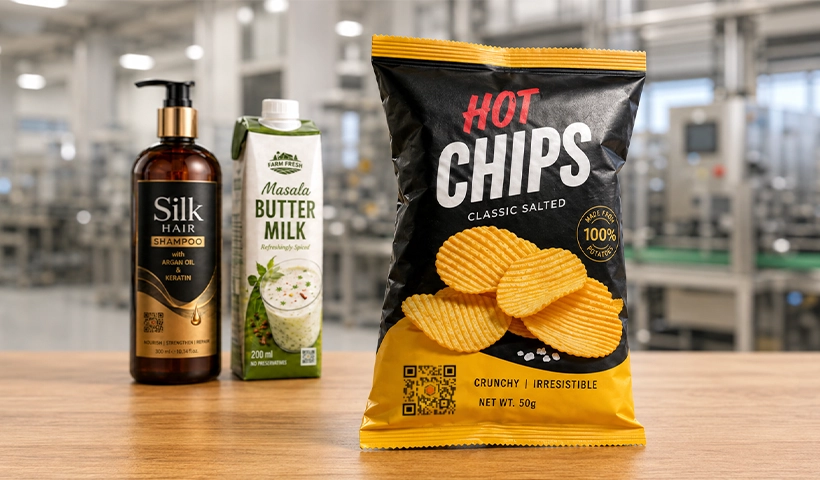
Sunrise 2027 affects any business that makes, sells, distributes, or scans retail products. The biggest impact falls on companies whose operations are directly influenced by product data, traceability, compliance, expiry management, and consumer transparency.
For these businesses, GS1 Sunrise 2027 is not just a packaging update. It changes how products are identified, scanned, tracked, and connected to digital information.
Retailers and grocery chains
Retailers sit at the center of the Sunrise 2027 transition because checkout systems must reliably read and process GS1 QR Codes. This includes checkout lanes, self-checkout, mobile POS, inventory systems, and receiving workflows.
Grocery chains face an even bigger shift because they handle perishable goods, expiry dates, recalls, substitutions, and frequent supplier updates. GS1 Digital Link gives them better access to product-level and batch-level information when it matters.
Food, beverage, and CPG brands
Food, beverage, and CPG brands are heavily impacted because their products move through large retail networks and depend on accurate information at scale.
These businesses manage ingredients, allergens, expiry dates, batch numbers, nutrition details, certifications, sustainability claims, and recall data. A GS1 QR Code gives them a cleaner way to connect this information directly to the product.
Healthcare, pharma, and regulated product companies
Healthcare, pharma, cosmetics, supplements, and other regulated categories face significant challenges because product identity, safety, authenticity, and compliance are business-critical.
GS1 QR Codes help connect product identifiers with batch, lot, expiry, and regulatory information. This strengthens traceability, improves recall response, and reduces the risk of incorrect or incomplete product data.
Manufacturers and suppliers
Manufacturers and suppliers need to prepare because retailers will expect packaging and product data to support the new scanning environment.
This affects packaging artwork, labeling lines, print quality, GTIN management, product master data, and retail approvals. Suppliers that delay readiness risk failed scans, packaging rework, and slower acceptance from retail partners.
Logistics and supply chain partners
Logistics providers, distributors, and warehouse operators are impacted wherever scanning supports receiving, picking, inventory movement, returns, and recall workflows.
Sunrise 2027 improves visibility only when supply chain systems can correctly scan, read, and use GS1 QR Code data. For supply chain partners, the shift is about making product movement more accurate, traceable, and efficient.
How can businesses prepare for Sunrise 2027?
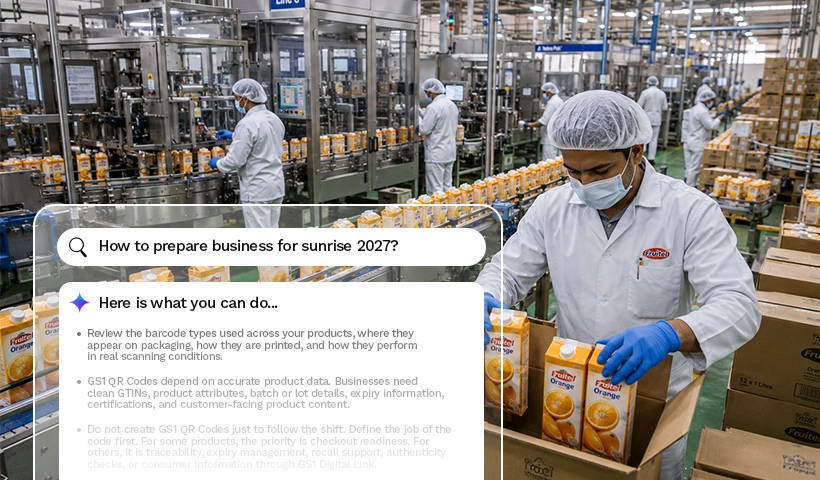
Preparing for Sunrise 2027 starts with one clear idea: the barcode is only the visible part of the change. The real work happens behind it, in product data, packaging, systems, and retail coordination.
Businesses that start early avoid rushed packaging changes, failed scans, disconnected data, and retailer compliance issues.
Audit your current barcode and packaging setup
Start with what you already have. Review the barcode types used across your products, where they appear on packaging, how they are printed, and how they perform in real scanning conditions.
Pay close attention to small packs, curved surfaces, flexible pouches, bottles, and products with limited label space. These formats often create the biggest scannability and placement challenges.
Clean and structure your product data
GS1 QR Codes depend on accurate product data. Businesses need clean GTINs, product attributes, batch or lot details, expiry information, certifications, and customer-facing product content.
This is where many companies will find gaps. If product information lives across spreadsheets, old systems, and disconnected teams, Sunrise 2027 will expose the problem quickly.
Decide what each GS1 QR Code should support
Do not create GS1 QR Codes just to follow the shift. Define the job of the code first.
For some products, the priority is checkout readiness. For others, it is traceability, expiry management, recall support, authenticity checks, or consumer information through GS1 Digital Link.
The right approach depends on the product category, retail channel, compliance needs, and customer expectations.
Test with real-world scanning environments
A GS1 QR Code must work beyond a design file. Test it on actual packaging, with real scanners, in real conditions.
That includes checkout counters, self-checkout systems, mobile POS, warehouse scanners, smartphones, and different lighting or packaging conditions. A code that scans on a phone is not automatically ready for retail.
Coordinate with retailers and supply chain partners
Sunrise 2027 readiness depends on alignment. Brands, retailers, manufacturers, and logistics partners need to work with the same standards and expectations.
Confirm retailer requirements, scanner readiness, data expectations, packaging timelines, and transition plans before scaling GS1 QR Codes across product lines.
Start with priority SKUs
A full rollout does not need to begin everywhere at once. Start with products that carry the highest business impact.
Focus on high-volume SKUs, perishable products, regulated items, products sold through major retailers, and items with traceability or recall sensitivity. Once the process works, scale it across more categories.
Choose a scalable GS1 QR Code solution
Businesses need a practical way to create, manage, and update GS1 QR Codes across products and teams. The solution should support GS1 compliance, organized code management, and reliable scan destinations.
QRCodeChimp fits naturally here for businesses that want an easy, scalable way to create GS1 QR Codes and manage product-linked QR experiences without adding unnecessary complexity.
Final thoughts
Sunrise 2027 is a clear signal that retail is moving toward smarter, data-rich product identification. Traditional barcodes will continue to play a role during the transition, but businesses now need packaging, systems, and product data that support GS1 QR Codes and GS1 Digital Link.
The companies that prepare early will reduce scanning issues, improve traceability, support retailer requirements, and give customers easier access to trusted product information.
Start with your highest-priority products. Audit your current barcodes, clean your product data, test GS1 QR Codes on real packaging, and align with your retail partners. Once the foundation is in place, use a scalable solution like QRCodeChimp to confidently create and manage GS1 QR Codes across your product lines.
Frequently Asked Questions
1. What is GS1 Sunrise 2027?
GS1 Sunrise 2027 is a global initiative to prepare retailers, brands, and supply chain partners for 2D barcodes at the point of sale by 2027. It means retail systems need to scan and process GS1 QR Codes alongside traditional barcodes.
2. Does Sunrise 2027 mean traditional barcodes will disappear?
No. Traditional barcodes will continue during the transition. Many products will carry both a linear barcode and a GS1 QR Code until retailers, systems, and supply chain partners are fully ready.
3. What is a GS1 QR Code?
A GS1 QR Code is a QR code that follows GS1 standards. It can carry structured product information such as GTIN, batch number, expiry date, and product links through GS1 Digital Link.
4. How does GS1 Digital Link support Sunrise 2027?
GS1 Digital Link connects a physical product to structured digital information. It allows one GS1 QR Code to support checkout, traceability, recall information, compliance details, and customer-facing product content.
5. How should businesses prepare for Sunrise 2027?
Businesses should audit current barcodes, clean product data, identify priority SKUs, test GS1 QR Codes on real packaging, and coordinate with retailers and supply chain partners before scaling the rollout.
You may also like
Privacy-First Connected Packaging: What Brands Need to Know
What should brands keep in mind when designing a connected packaging experience that respects customer privacy? Let’s uncover how brands should approach privacy-first connected packaging.
Blurry QR Code? Why It Happens and How to Fix It
Blurry QR code? Learn what causes poor QR clarity and how to fix low resolution, resizing, compression, printing, and design issues for reliable scanning.
Airbnb QR Codes: Share Useful Information and Enhance Guest Experience
Discover practical ways Airbnb hosts can use QR codes to share WiFi, guides, directions, and property information while improving the guest experience.
QR Code Surveys: How to Get People to Scan and Respond
A QR code survey makes feedback easier to access, but the code alone doesn't generate responses. This guide explains how to create a QR code survey that earns the scan and keeps respondents moving to submission.
Most Popular
Contact Sales