Barcodes have been the backbone of retail for over five decades. They’re reliable, fast, and still essential at checkout. But they were built for a simpler job: identify a product and move it through the system.
Today, that’s no longer enough.
Consumers want clearer product information, regulators expect traceability, and brands need post-purchase engagement. A single line-based code can’t deliver all three.
GS1 US research supports this shift: 71% of consumers read food labels more closely and more often, while 66% would scan a QR code on packaging for details like freshness, ingredients, and shelf life.
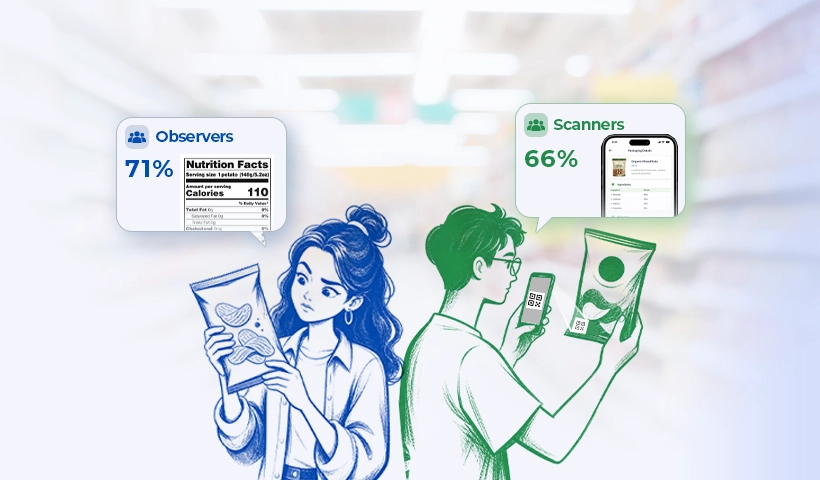
Shoppers are not just open to QR codes. They’re actively choosing brands that use them.
That’s why the shift is happening. Not as an overnight replacement, but as a fundamental upgrade to how products connect with systems, retailers, and people.
If you’re weighing barcode vs. QR code for your packaging, or trying to understand what the real difference between a barcode and a QR code means for your business, this shift matters more than it appears.
Here’s what’s changing, why it’s happening now, and what your brand should do next.
Key Takeaways:
- QR codes are replacing barcodes as packaging needs data, interaction, and traceability.
- Barcodes still support checkout but fall short on flexibility and consumer engagement.
- Dynamic QR codes let brands update product information without reprinting packaging.
- GS1 Sunrise 2027 is accelerating QR code adoption across retail supply chains.
- QR codes turn packaging into a measurable channel for trust and engagement.
- What barcodes were built to do, and where they fall short
- Barcode vs. QR code: What’s actually different
- Why QR codes are replacing barcodes now
- What this shift means for your brand
- How to start the transition without disrupting operations
- Barcodes were built for the past. QR codes are built for what’s next.
- Frequently Asked Questions
What barcodes were built to do, and where they fall short
To understand why QR codes are taking over, you first need to look at what barcodes were designed to solve, and where that design starts to break down.
The original purpose of barcodes
Barcodes were created to solve a specific operational problem: speed up checkout and simplify inventory tracking.
At their core, they store a product identifier, typically a GTIN or SKU, enable quick scanning at the point of sale, and help businesses manage stock across systems.
They still do this reliably.
But they were built for machines, not people. The goal was speed and accuracy, not information or interaction. That limitation becomes obvious when you look at what modern commerce now expects from product packaging.
Where barcodes fall short today
The gap is not in how barcodes function. It’s in what they can no longer do.
Limited to a single data point
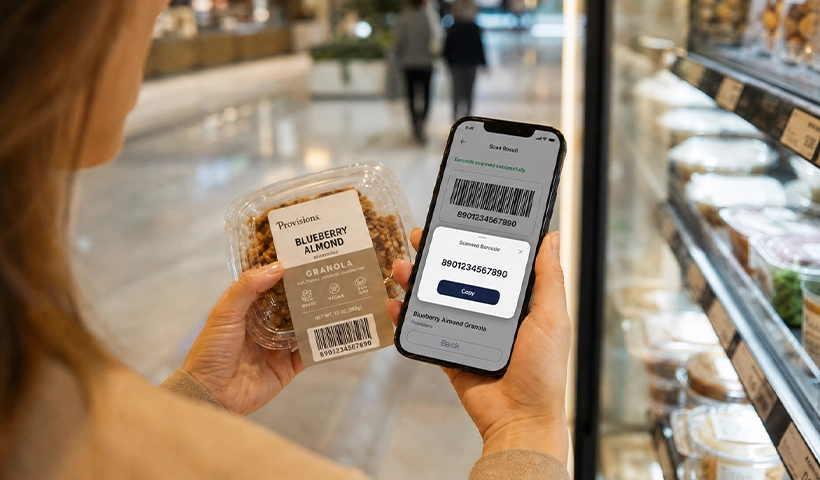
A barcode contains a product ID that points to backend systems for additional details. This works internally but creates a disconnect at the consumer level.
A packaged food product cannot show ingredient sourcing or certifications through a barcode scan. A cosmetic product cannot surface usage instructions or safety information at the moment of interaction.
No flexibility once printed
Barcodes are static by design.
Once printed on the packaging, the data cannot be changed. If product information is updated, the backend system changes, but the barcode on the shelf remains the same.
In situations like recalls or reformulations, this limits your ability to reach consumers where it matters most.
No consumer interaction
Barcodes were never designed for engagement. They do not trigger any experience after scanning, and most consumers cannot scan them meaningfully with their phones.
This means missed opportunities to share product stories, collect feedback, offer tutorials, or drive repeat purchases.
Rising compliance expectations
Regulators and industry bodies such as GS1 now expect greater visibility into products, particularly in food, pharma, and FMCG. Barcodes rely on disconnected backend systems, making it difficult to provide real-time, consumer-accessible traceability data.
All in all, barcodes still work at checkout. They were not built for what commerce demands today.
Barcode vs. QR code: What’s actually different
The difference between a barcode and a QR code is not just technical. It’s functional. When you compare the two, you’re comparing a system built for identification with one built for interaction.
Barcode vs. QR code at a glance
| Factor | Barcode | QR Code |
|---|---|---|
| Data capacity | Very limited | High |
| Flexibility | Static | Dynamic |
| Consumer interaction | None | High |
| Use case | Checkout only | End-to-end product lifecycle |
| Update capability | Not possible | Real-time |
| Analytics | None | Rich scan data |
A traditional barcode does one job at one point in the journey. A GS1 QR code supports the entire product lifecycle, from supply chain to post-purchase consumer engagement.
Why QR codes are replacing barcodes now
This shift is driven by specific, compounding trends across retail, supply chain, and consumer expectations. Here are the six forces making the transition inevitable, and how you can align your brand accordingly.
1. From product identification to product experience
QR codes extend the barcode experience.
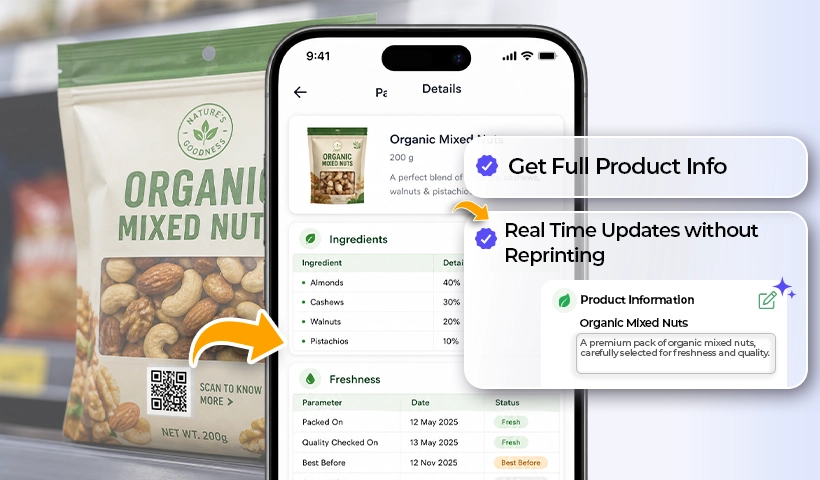
With a single scan, your customer can access product details, sourcing information, how-to videos, certifications, or reviews, right from the packaging. That turns your label into an active touchpoint rather than a passive identifier.
A food brand, for example, can let shoppers scan and instantly see farm origins, nutritional breakdowns, and sustainability practices. That level of transparency builds trust and directly influences purchase decisions.
💡 What to do: List the top five questions your customers ask after purchase and map each one to a QR code experience you can build today.
2. Real-time updates without reprinting
Barcodes are fixed. Once printed, that’s it. Dynamic QR codes are built differently.
You can update the content behind a QR code at any time, without changing the packaging. The same code can show a seasonal campaign in one market and a compliance update in another. You can respond to a recall, update a formulation note, or refresh a promotion without touching the physical label.
This shifts packaging from a print-once asset to a living communication channel.
💡 What to do: Identify one product line where outdated packaging content is causing friction. Use that as your pilot for dynamic QR codes.
3. GS1 Sunrise 2027 is making this mandatory
The transition is no longer just a strategic choice. It’s becoming a compliance requirement.
GS1’s Sunrise 2027 initiative is moving the global retail industry toward 2D barcodes, primarily GS1 QR codes, at the point of sale.
QR codes with GS1 Digital Link are becoming the new standard for structuring and accessing product data. And major retailers and POS system providers are upgrading their infrastructure to accommodate this shift.
This is a structural shift, not a trend. Brands that wait for the deadline will scramble. Brands that start now will be ready.
💡 What to do: Begin piloting GS1 QR codes on select SKUs. Early adoption gives your teams time to test workflows, train staff, and refine the experience before compliance becomes mandatory.
4. Traceability and transparency are now expectations, not extras
Consumers and regulators in food, pharma, and FMCG expect full visibility into product origins, ingredients, batch data, and certifications.
QR codes make it possible to surface all of this through a single scan. A pharmaceutical brand can enable instant authenticity verification. A food brand can offer farm-to-shelf traceability. A cosmetics company can achieve full ingredient transparency through third-party certifications, without cluttering packaging.
This is not just about compliance. It’s about earning and keeping consumer trust.
💡 What to do: Identify the traceability and compliance data points most relevant to your product category and build your QR code experience around those first.
5. One code for supply chain and marketing
Most brands currently use separate codes for operations and consumer engagement. That creates packaging clutter and disconnected data.
A GS1 QR code changes that. A single code can handle retail checkout, internal logistics tracking, and consumer-facing engagement simultaneously. Every scan, whether from a retailer’s scanner or a customer’s phone, feeds into the same system.
This simplifies your packaging, reduces operational overhead, and creates a unified data trail across the product lifecycle.
💡 What to do: Audit your current packaging for multiple codes. Map out where a single GS1 QR code could consolidate those functions and reduce complexity.
6. Scan analytics that barcodes cannot provide
Barcodes generate no consumer data. QR codes do.
Every scan can tell you where it happened, how often, what content the user engaged with, and how behavior varies across markets. This turns your packaging into a measurable channel, similar to a campaign or a product page.
You can identify which regions engage most, which products get the most post-purchase attention, and what content drives the strongest response.
💡 What to do: Treat packaging as a data source from day one. Build your QR code analytics dashboard before you launch, so insights are ready the moment you go live.
What this shift means for your brand
If you’re evaluating the barcode vs. QR code question, keep in mind that this is not a packaging decision. It’s a strategic one.
You’re not swapping one label for another. You’re deciding how your product will communicate with the world after it leaves your facility.
QR codes give you the ability to:
- Own the customer relationship beyond the point of sale
- Turn packaging into a direct, measurable engagement channel
- Stay ahead of GS1 Digital Link compliance requirements
- Build a feedback loop between your products and your business decisions
Early-moving brands are already using this to deepen consumer trust, streamline operations, and gather real-world product intelligence. The shift is not theoretical for them. It’s operational.
The brands that move early will set the standard. The rest will spend the next few years catching up.
How to start the transition without disrupting operations
Making the switch does not require an overnight overhaul. A phased approach works well for most brands.
- Start with one product line. Pick an SKU that already has a high consumer touchpoint or a compliance need. Test there first.
- Run both codes during the transition period. GS1 recommends carrying both a barcode and a QR code on packaging during the switchover. This keeps your products scanning at every retail POS while your QR code experience runs in parallel, with zero disruption to operations.
- Use a GS1-compliant QR code generator. Make sure the code format aligns with GS1 Digital Link standards from the start. Use a compliant platform, such as QRCodeChimp’s GS1 QR Code Generator, for the best results.
- Test across the full chain. Validate that your QR code scans correctly at POS, in warehouse environments, and on consumer devices.
- Set up analytics before launch. Know what you’re measuring before the first scan happens.
- Brief your packaging and supply chain teams together. The switch touches both, and alignment early avoids rework later.
Build internal capability now. Compliance windows close faster than packaging cycles allow.
Barcodes were built for the past. QR codes are built for what’s next.
Barcodes solved a critical problem for their time. That problem has evolved.
What you’re seeing now is a shift from static to dynamic, from identification to interaction, from internal systems to consumer-facing experiences.
QR codes sit at the center of this transition, and GS1 Sunrise 2027 is accelerating it for every brand that sells through retail.
The question is no longer barcode or QR code. It’s how soon you can get ahead of it.
Start with one product. Implement a GS1 QR code. See how it fits your packaging workflow and supply chain. Build from there.
The brands that act now will not just meet compliance. They will lead the next era of product communication.
Frequently Asked Questions
What is the difference between a barcode and a QR code?
A barcode stores a single product identifier, such as a GTIN, primarily for checkout and inventory. A QR code can store much more data and link to digital content. It enables product information, engagement, and tracking, making it far more versatile for modern business needs.
Are QR codes replacing barcodes completely?
Not immediately. Barcodes will continue to be used during the transition. However, with GS1 Sunrise 2027, QR codes are expected to become the standard for retail and supply chains, gradually replacing traditional barcodes for most use cases.
What is a 2D barcode vs. QR code?
A QR code is a type of 2D barcode. Other 2D barcodes include Data Matrix and PDF417. QR codes are more widely used because they are easily scannable by smartphones and support both consumer engagement and retail applications.
Why should businesses switch from barcode to QR code?
QR codes offer flexibility, real-time updates, better data capacity, and customer interaction. They also support traceability and compliance requirements. This makes them more suitable for modern commerce, where products need to connect with both systems and consumers.
Do QR codes work with GS1 standards?
Yes, QRCodeChimp’s GS1 QR codes follow the Digital Link standard. They allow you to encode product identifiers like GTIN along with additional data, such as batch or expiry. This ensures compatibility with retail systems while enabling digital experiences for consumers.
You may also like
How Retail Stores Can Collect Customer Feedback Without Staff Prompts
Set up a feedback QR code for retail stores to collect customer feedback without relying on staff prompts. Learn where to place it and improve responses.
GS1 Sunrise 2027 Migration Guide: Moving From UPC and EAN Barcodes to GS1 QR Codes
Use this GS1 Sunrise 2027 migration guide to plan dual marking, verify product data, test packaging and POS systems, and scale your 2D barcode rollout.
How to Write High-Converting QR Code Call to Action Phrases (50+ Examples)
Learn the CTA formulas, design tips, and 60+ examples that boost QR Code scans and conversions plus how to test and measure them using QRCodeChimp tools.
QR Codes for Events: Where to Place Them, What to Link, and How to Track Results
Stop linking every event QR code to your homepage. See how to QR codes for events and what to link on posters, tickets, badges, and exit signage, with placement and sizing tips.
Most Popular
Contact Sales