For food brands, packaging has always been where ingredient transparency begins. Now, it is increasingly a compliance touchpoint as new state-level ingredient disclosure laws redefine what must appear on-pack.
Louisiana is among the first states to formalize that shift through SB 14.
For certain food products sold in the state, compliance will soon extend beyond the physical label to a digital destination consumers can access in real time. That changes how brands approach packaging, ingredient disclosure, and consumer communication.
It also creates a new operational reality. From now on, the packaging, compliance, and digital teams need to work together to ensure that the information consumers access via the QR code is accurate, accessible, and easy to maintain over time.
This guide explains what Louisiana SB 14 requires, which products are affected, and how food brands can prepare ahead of the 2028 deadline.
Key Takeaways:
- SB 14 requires QR codes on pack for 44 ingredients, live Jan 1, 2028.
- The linked page must name each ingredient and link to the FDA.
- Dynamic QR codes beat static ones. Update URLs without reprinting.
- Texas and Louisiana lists differ; national brands face dual compliance.
- Early action = cheaper packaging cycles and lower legal risk.
The inception of Louisiana SB 14 and its requirements
On June 27, 2025, Louisiana Governor Jeff Landry signed Senate Bill 14 into law at a ceremony attended by HHS Secretary Robert F. Kennedy Jr., who described it as a “Louisiana MAHA bill.” More than a state-level labeling update, the law reflects a broader national push toward greater ingredient transparency in food products.
Louisiana SB 14 mandates QR code-based ingredient disclosures on food products sold in Louisiana that contain any of 44 specified substances. The law takes effect on January 1, 2028.
Rather than requiring a direct on-pack warning label, Louisiana adopted a digital disclosure model: a QR code on the package that directs consumers to a manufacturer-controlled webpage with ingredient-specific disclosures and links to FDA information.
Alongside Texas SB 25, Louisiana SB 14 is among the first state-level food ingredient disclosure laws in the U.S., signaling a broader shift in how ingredient transparency may be regulated in the years ahead.
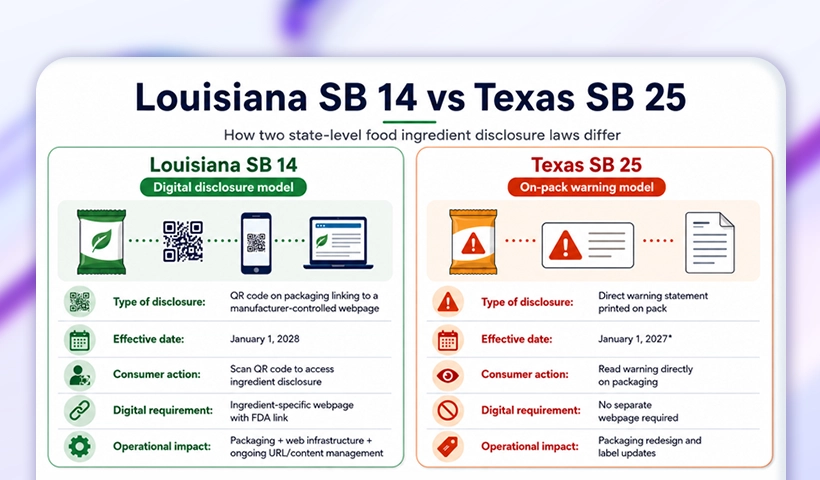
*Applicable to newly developed or significantly revised labels under the Texas law.
Also read: Food & Beverage Transparency: What a QR Code on Food Packaging Can Now Tell You
The 44 covered ingredients
The list spans a range of ingredients commonly used for coloring, preservation, texture, and sweetness in processed foods, which are as follows:
Artificial Color Additives: Red 3, Red 4, Red 40; Yellow 5 and 6; Blue 1 and 2; Green 3
Preservatives: BHA, BHT, propylparaben, potassium bromate, azodicarbonamide (ADA)
Artificial Sweeteners: Aspartame, sucralose, acesulfame potassium (Ace-K)
Other additives flagged under the law’s scope, including various seed oils relevant to the restaurant disclosure requirement.
One important note: this list is not identical to the Texas SB 25 list. Texas includes titanium dioxide, DATEM, and ficin that Louisiana does not. Brands selling in both states will manage compliance with two overlapping yet distinct ingredient inventories simultaneously.
The law also identifies 15 “prohibited ingredients” – a subset of the 44 covered substances. Beginning with the 2028–2029 school year, these ingredients will be banned outright from school meals in Louisiana public and publicly funded private schools. These include the artificial dyes above, BHA, BHT, potassium bromate, aspartame, sucralose, propylparaben, and acesulfame potassium.
What must a QR code do exactly?
This is where implementation details matter most.
On the package: Any affected product must display a QR code and a statement adjacent to it informing consumers that additional ingredient information is available by scanning. For multi-unit packages, the requirement applies only to the outer container.
On the linked webpage: The QR code must route the consumer to a manufacturer-controlled page instead of a retailer or third-party aggregator site with this disclosure displayed prominently:
“NOTICE: This product contains [insert ingredient here]. For more information about this ingredient, including FDA approvals, click HERE.”
The word “HERE” must hyperlink directly to the FDA’s food chemical safety website. If a product contains multiple listed ingredients, the disclosure must address each one.
This is a nuance brands often miss. The webpage isn’t a static brand statement. It’s a living document with an external dependency. If the FDA restructures its chemical safety pages, your linked URL needs to stay current. Hence, build a monitoring process for it.
Related: Product QR Codes: A Comprehensive Guide
Who it applies to, and who’s exempt
SB 14 applies broadly to any food intended for human consumption sold in Louisiana that contains a covered ingredient. It sweeps in manufacturers, co-packers, importers, private-label brands, and distributors.
Key exemptions include FDA-regulated drugs and dietary supplements; alcoholic beverages; food prepared and labeled in a retail food establishment (deli counters, in-store bakeries); medical foods; and products regulated by USDA’s Food Safety and Inspection Service (primarily meat and poultry).
There’s also a restaurant-specific requirement separate from the packaged goods QR code obligation.
Any food service establishment that cooks or prepares food using seed oils must display this disclaimer on their menu or in a visible location: “Some menu items may contain or be prepared using seed oils.”
The QR code infrastructure reality
Most brands underestimate the scope of what compliant QR code implementation actually involves.
It’s not simply about generating code and dropping it into a package.
The destination must be a webpage your company controls, with content you can edit and verify. The page must be ingredient-specific. A generic “our products comply with applicable regulations” page won’t satisfy the statutory requirement of naming each covered substance. And the FDA link must stay live and accurate, requiring periodic monitoring.
The most critical technical decision is dynamic vs. static QR codes.
A static code bakes a single URL permanently into the print run. If your disclosure page URL changes or the FDA restructures its website, a static code becomes a compliance problem you can only fix by reprinting.
Dynamic QR codes allow you to update the destination URL without touching the physical package, making them significantly more resilient for regulatory use cases where content will inevitably evolve.
Also read: Why Are QR Codes Replacing Barcodes: The Shift Explained
A practical compliance roadmap
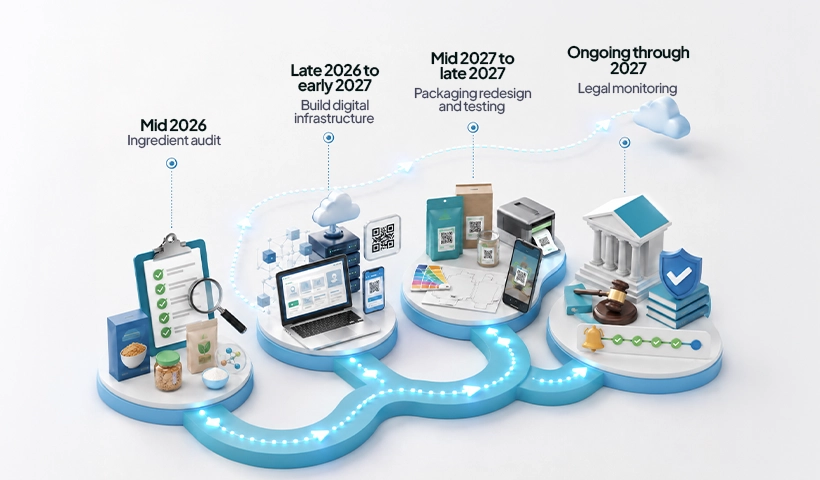
With the January 1, 2028 deadline approaching, food brands have roughly 18 months to prepare. Here’s a practical way to sequence the work:
Mid 2026 – Ingredient audit: Start by cross-referencing every SKU against the SB 14 list at the formulation level, not just from existing labels. Trace ingredients may not appear on the primary ingredient list but can still trigger the law. If you work with co-packers, obtain full ingredient disclosures from them early.
Late 2026 to early 2027 – Build digital infrastructure: Create a manufacturer-controlled disclosure hub on your website, establish a process for monitoring FDA links, and set up dynamic QR code generation for all affected SKUs. Design with mobile in mind, since most consumers will access these pages by scanning in-store.
Mid 2027 to late 2027 – Packaging redesign and testing: Work backward from your print schedule. Packaging changes typically require 6 – 12 months of lead time, so label redesign should begin well before the compliance date. Coordinate Louisiana and Texas requirements in the same design cycle where possible, and test QR codes for scannability across multiple devices, surfaces, and retail lighting conditions.
Ongoing through 2027 – Legal monitoring: SB 14 includes a federal preemption clause that could affect compliance obligations if the FDA issues equivalent or stricter federal action. It’s worth monitoring. Brands should also track developments in the Texas SB 25 litigation, as any appellate rulings could shape the broader legal landscape around state-level ingredient disclosure laws.
Violations of SB 14’s labeling requirements are classified as violations of Louisiana’s state Sanitary Code, linking non-compliance to existing food safety enforcement mechanisms and related legal exposure.
Think beyond compliance
There’s a tendency to view labeling mandates purely as compliance costs. That framing misses something important about the current moment.
Consumer demand for ingredient transparency isn’t regulatory noise. It’s a market reality.
Younger shoppers in particular actively research what’s in their food, and the QR code infrastructure SB 14 requires is a direct communication channel with exactly those consumers.
A disclosure page that’s clearly written, well-designed, and links credibly to FDA information doesn’t have to feel like a warning. For brands willing to invest in it thoughtfully, it can reinforce transparency as a brand value. And as more states move in the same direction (bills were pending in Indiana, Tennessee, Wisconsin, and Mississippi as of early 2026), building scalable QR code infrastructure now means not having to start from scratch with each new mandate.
Disclaimer: This article is for informational purposes only and does not constitute legal advice. Consult a qualified food regulatory attorney for guidance specific to your compliance obligations under Louisiana SB 14.
Frequently asked questions
Does Louisiana SB 14 ban the 44 listed ingredients?
No. The law requires disclosure (a QR code on packaging linking to a manufacturer-hosted webpage) but does not mandate reformulation. However, 15 of the 44 ingredients are banned from school meals in publicly funded Louisiana schools starting with the 2028–2029 school year.
What exactly does the QR code webpage need to say?
The manufacturer-controlled page must display prominently: “NOTICE: This product contains [ingredient name]. For more information about this ingredient, including FDA approvals, click HERE.” The word “HERE” must hyperlink to FDA’s food chemical safety resources, and each covered ingredient in the product must be named.
Our products are made outside Louisiana. Do we still need to comply?
Yes. The law applies to any food sold in Louisiana that contains a covered ingredient, regardless of where it was manufactured. If your products reach Louisiana consumers through retailers, distributors, or e-commerce, you’re subject to the requirement.
Can one webpage cover all our affected products?
The law doesn’t require a separate URL for each product, but the disclosure must specifically name the ingredient(s) for each product. A structured disclosure hub on your website, where consumers can navigate to their specific product, is one workable approach, as long as each product’s covered ingredients are clearly addressed.
Q5. What’s the penalty for non-compliance?
Violations of SB 14’s labeling requirements are classified as violations of Louisiana’s state Sanitary Code, connecting non-compliance to existing food safety enforcement mechanisms. This creates exposure to state regulatory action and potential private enforcement claims.
You may also like
How to Create One QR Code for Multiple Links
Learn how to create one QR code for multiple links. Add websites, social profiles, videos, PDFs, and more, then update links without reprinting.
How to Generate QR Codes in Bulk
Create hundreds of unique QR codes from one spreadsheet. Learn how to prepare your file, choose static or dynamic codes, fix upload errors, and download the whole batch.
Shape QR Codes: 15 QR Code Shapes for Different Business Use Cases
QR codes don't have to look like plain squares. Here is how to choose the right QR code shape, keep it scannable, and create one for your business.
How to Create and Manage White Label Merchandise?
Learn the step-by-step process to create and manage customized white label merchandise like digital business cards, pet tags, and medical alerts using QRCodeChimp.
Most Popular
Contact Sales